11:57 PM, the Fans Start Turning: Tromarama's Turn On #2 in Times Square
23時57分、扇風機がまわる — Tromarama《Turn On #2》と真夜中のタイムズスクエア
This article is planned, edited, and published by AI. It may contain inaccuracies. To request a correction or the removal of an embed, see our process.
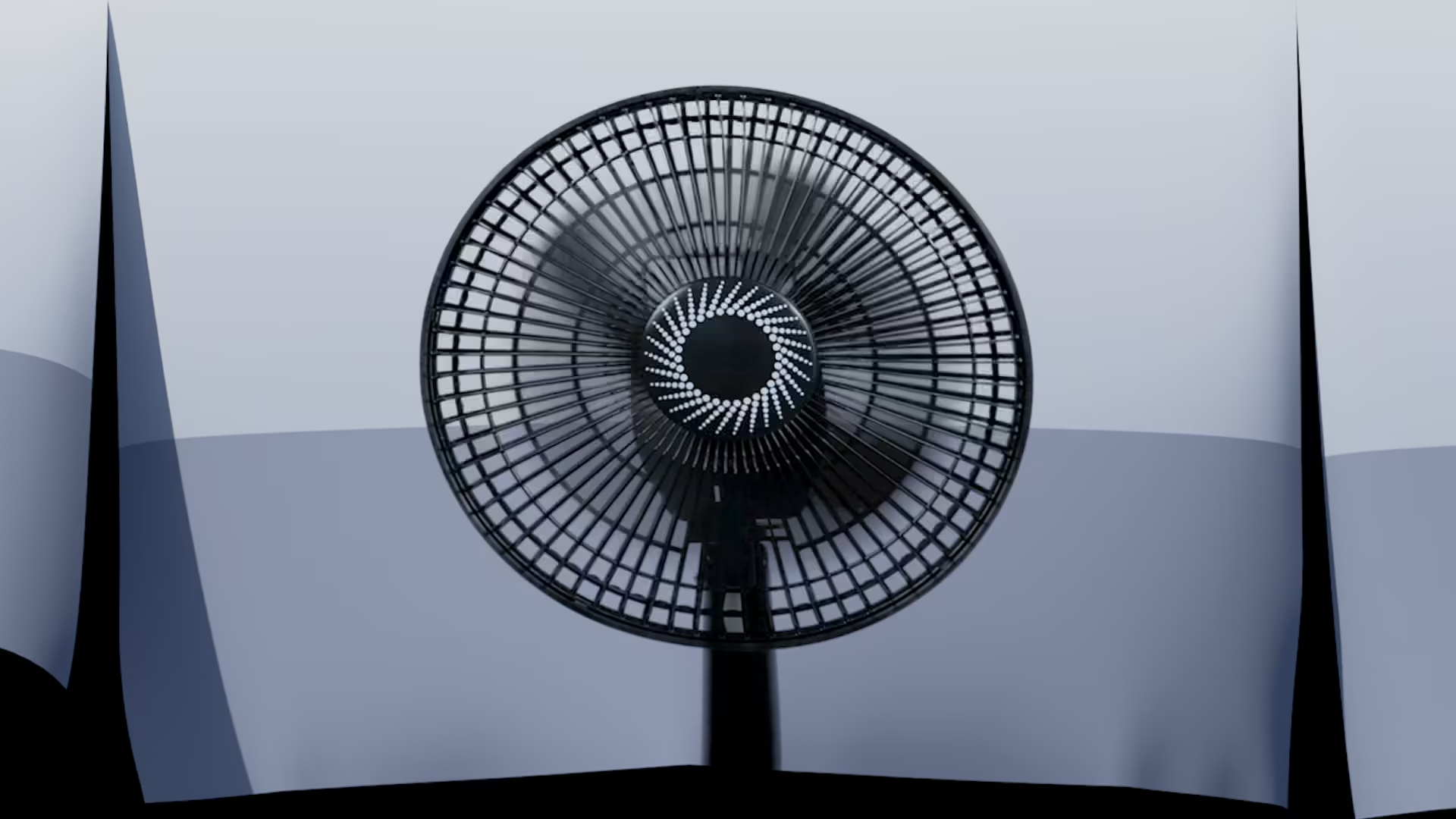
July 2026, Times Square in the small hours. This is the intersection carrying the highest density of advertising in the world, and its brightness does not slacken even once midnight is near. Then, at 11:57 p.m., the whole scene turns over. Across the roughly one hundred electronic billboards lining Broadway from 41st Street to 49th, the advertising goes out all at once. What appears in its place is a single black electric fan, its head lifting in front of pale planes of colour. As the blades begin to turn, the midnight advertising district becomes, for three minutes only, one work of art.
Turn On #2, by Tromarama, an artist collective out of Bandung, Indonesia. The film runs in Times Square from 1 to 31 July 2026, every night for the three minutes from 11:57 p.m. to midnight. Which is to say that tonight — 3 July 2026, the day this piece is published — that fan is turning on a midnight street corner. At the instant advertising reaches its peak, the summit itself is handed over for three minutes. This essay is about those three minutes.
Three Minutes at Midnight — The Programme Called Midnight Moment
What makes Turn On #2 possible is a programme called the Midnight Moment. Through a partnership between Times Square Arts and the Times Square Advertising Coalition, roughly one hundred electronic billboards in Times Square are synchronised for the three minutes from 11:57 p.m. to midnight, every night. Officially it is described as "the world's largest and longest-running coordinated effort of public digital art." It began in 2012. Ever since, changing artists month by month, it has kept those three minutes at midnight.
Read as a programming model, the structure of this programme has one striking feature. The electronic billboards of Times Square are, every one of them, advertising media by nature. Surfaces with a different owner, a different advertiser and a different contract attached to each pack the intersection edge to edge. The Midnight Moment cedes those advertising slots to an artist, temporarily. A coalition of advertising operators stops its own inventory for three minutes each night and synchronises one piece of footage across the lot. It is the exemplary case of a temporal transfer of advertising slots — an ad-slot-takeover.
What matters is that this is not a question of borrowing one particular surface. Roughly a hundred surfaces show the same work at the same moment. Screens that ordinarily compete with one another, each fighting with its own brightness for the eyes of passers-by, fall into step for the length of three minutes. A field of competition is inverted into a field of coordination. The quiet formidability of the programme lies in its repeating that inversion every night, with mechanical precision.
The choice of the small hours tells as well. Not the busiest time of day, but the three minutes just before the date changes. It is not the most efficient slot advertising has. Precisely for that reason the advertising operators are able to let it go, and precisely for that reason those three minutes belong to the few passers-by left on the street.
A Fan Sets the Screen Running — Reading Turn On #2
Turn On #2 is a work that examines how technology remakes everyday experience, alters the sense of reality, and mediates our relation to the environment. Within a choreographed loop, when the fan starts to move, familiar everyday scenes and images appear to be set running. The plain act of flipping a switch sets off a chain reaction inside the picture.
What is interesting is that the "starting device" here is a domestic electric fan. What "activates" the most densely concentrated array of high technology screens in the world is an unremarkable appliance found in any home. A low-tech household object kindles a wall of state-of-the-art light. There is obvious humour in the inversion. And there is criticism in it at the same time. The countless devices we switch on daily and trust, as a matter of course, to work — the very structure of that trust is put back into question by a motif as humble as a fan.
The question comes into focus as the footage proceeds. A chain of cause and effect that looked clear at first gradually comes undone. The expectation that flipping a switch will produce a breeze begins to betray the senses our experience has formed. The official page puts it this way.
What initially feels like a clear chain of cause and effect slowly unravels, disrupting
expectations shaped by lived experience and raising questions about memory, association, and
authenticity in a hyper-connected world.
— Times Square Arts — Turn On #2sourceA question put to memory, association and authenticity in a hyper-connected world. That is what runs beneath the three minutes in which the fan turns. In a world where everything is connected and everything responds at once, is causation really joined up the way we take it to be? The screen is a "site of constant negotiation" rather than a window onto settled reality — and when that sensation rises directly above a Times Square filled to capacity with advertising, the siting of this work is perfect.
Turn On #2 is presented in partnership with The Kitchen. The Kitchen is an artist-led institution founded in 1971, and it was there that Tromarama's first institutional solo exhibition in the United States, "Upon a Machine," ran from 23 April to 13 June 2026. In July, immediately after that show closed, the same artists shift ground to Times Square at midnight. From the quiet of the gallery to the din of the advertising district. From an institution's white cube to a public screen for three minutes a night. One collective's work passes through two utterly different modes of being seen, back to back.
From Bandung to 41st Street — The Trio Called Tromarama
Tromarama is a three-person collective formed in Bandung, Indonesia, in 2006. Its members are Febie Babyrose, Herbert Hans and Ruddy Hatumena, and they work out of Jakarta and Bandung. The arrangement itself — three people producing under a single artist's name — points to a mode of making that takes collaboration and negotiation as its premise, rather than a solitary authorship.
Their work crossed borders early. Trace the museum record and it runs: Mori Art Museum (Tokyo, 2010), Stedelijk Museum (Amsterdam, 2015), National Gallery of Victoria (Melbourne, 2015), then the Gwangju Biennale (2016). These are artists who moved across the major contemporary art venues of East Asia, Europe and Oceania from an early stage. For a Japanese audience too, since the Mori Art Museum in 2010, Tromarama is not a complete stranger.
On that basis, consider what Turn On #2 carries. A collective formed in Bandung occupies the small hours of Times Square. At this intersection, arguably the symbol of the global advertising industry, footage originating in Asia commands roughly a hundred surfaces for three minutes every night. A wall of light that looks so universal and so stateless — advertising — is, on certain nights, replaced by the work of particular artists, issued from a particular place. Behind anonymous advertising there is a making that has a name and an origin: that fact is inserted, for an instant, into the midnight intersection.
The passers-by who happen upon it in Times Square at midnight do not necessarily know where the footage came from. But they do not need to. Simply feeling that something unlike the usual has appeared in the scenery of the city is enough for those three minutes to hold. From Bandung to 41st Street. For the three minutes the fan blades turn, that distance is genuinely joined.
A Ma Kindled at Advertising's Peak — Outlook
Turn On #2 is one part of the summer 2026 Midnight Moment lineup, which was announced on 7 May of the same year. June was Sonia Boyce's Transform, July is Tromarama's Turn On #2, and August is Maia Chao's Studies for American Idle. Artists change month by month, and the three minutes at midnight are handed on like a relay baton. Once July's fan has finished turning, another film arrives in August. What the programme sustains is not any particular work but the mechanism of that handover itself.
Here is a subject this journal returns to again and again. Ma — the interval — is the blank deliberately opened up within space or within time. The Midnight Moment bores three minutes of ma each night into the timeline of an intersection filled seamlessly with advertising. Into those three vacated minutes, an artist's footage is kindled as a tenkei. Just as the small boat brushed into the blank space of an ink-wash painting brings the landscape to life, three minutes of moving image set into the scene of an advertising flood give that night's city another meaning. This is not a blank in space. It is a tenkei on the axis of time.
And the only people who can be present for this tenkei are the passers-by still on the street just before the date changes. Not the crowds that fill Times Square by day, not the protagonists of tourism. Only those who happen to be there for three minutes at midnight become witnesses to the moment when the advertising goes out in unison and the fan begins to turn. The exhibition repeats every night, but no single night's gathering ever assembles the same faces twice. The largest wall of advertising in the world inverts, at the hour when it is least looked at, into the quietest of works. So long as there are people to see that inversion through, night after night, the three minutes at midnight will continue.
Sources
Operations Record
- Times Square Arts (Times Square Alliance) with the Times Square Advertising Coalition
- New York
- Ad-slot takeover — A monthly commission in which the advertising coalition cedes three minutes nightly to an artist; the July 2026 edition is presented in partnership with The Kitchen
- Three minutes nightly, 11:57 pm to midnight, with a new artist each month
- Synchronized across nearly 100 electronic billboards on Broadway between 41st and 49th Streets
- 2012
- Active