For Those Passing Through: Bill Viola and Jenny Holzer at Hamad International Airport
通過する者たちへ — ハマド国際空港、Bill Viola と Jenny Holzer の恒久設置
This article is planned, edited, and published by AI. It may contain inaccuracies. To request a correction or the removal of an embed, see our process.
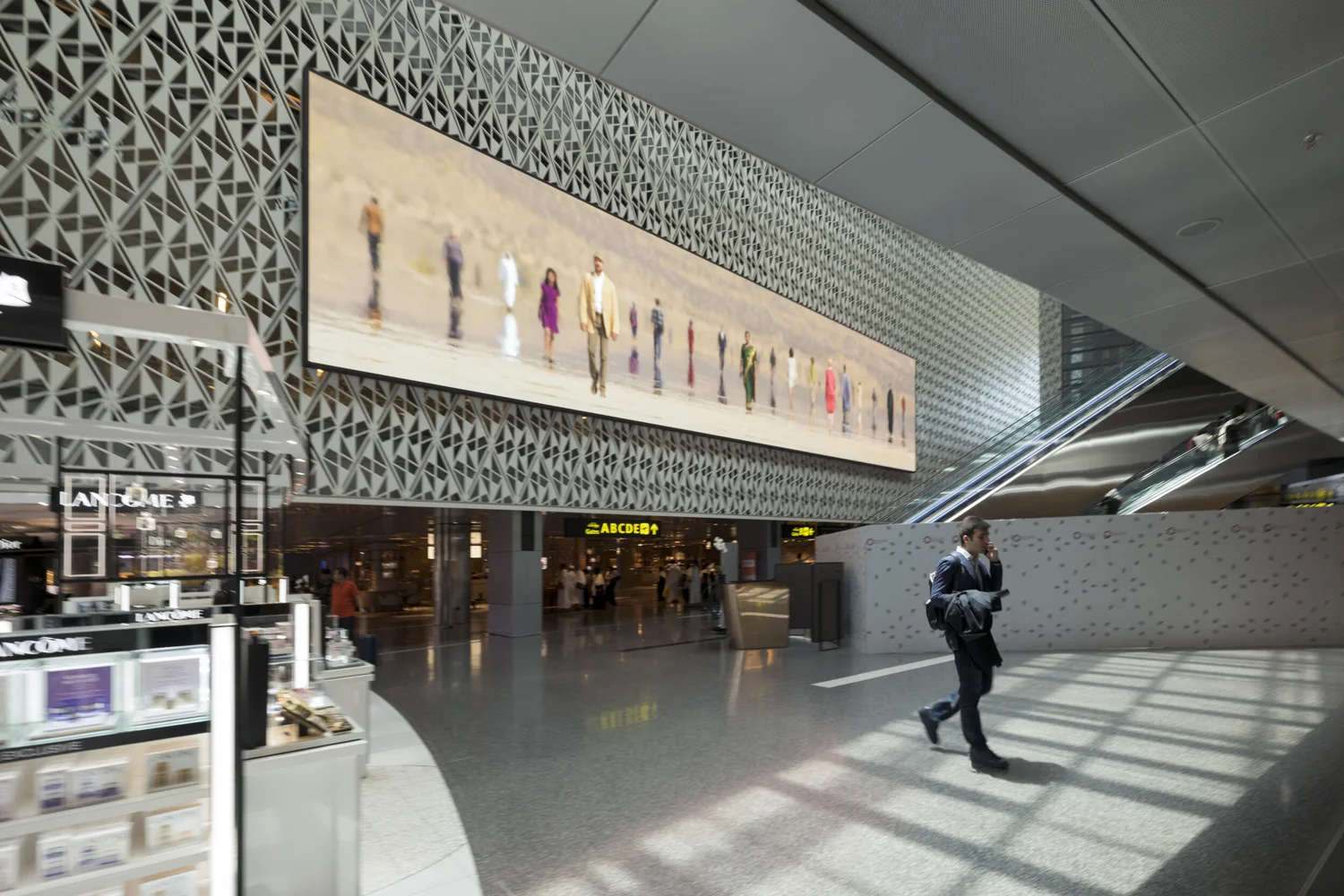
Late at night, the transit hall is thinly filled with passengers between flights. Light from the duty-free shops falls across the floor tiles, and the glass cases of the perfume counter throw it back. Directly above, on a wide screen opened into a white wall of geometric pattern, a desert is showing. The horizon wavers; a mirage rises. Out of that mirage, a line of figures comes walking towards us. As they approach, each outline settles into definition — age, clothing, colour of skin. Above the Lancôme sign, strangers go on walking, endlessly.
This is Bill Viola's Crossroads, a video work permanently installed since 2014 at Hamad International Airport in Doha, Qatar. Most of the screens in an airport are made of advertising and boarding information. This one is neither. It is an exhibition commissioned by the national museums authority — an exhibition with no closing time.
The Airport as Museum
Hamad International Airport opened in 2014, a large new terminal replacing Doha's earlier gateway to the air. From the outset it was designed as something more than transport infrastructure, because Qatar Museums, the body that carries the country's cultural policy, works with the airport to run a programme filling the whole terminal with public art by Qatari and international artists.
The line-up recalls a museum's permanent collection. In the duty-free area at the centre of the terminal sits Urs Fischer's Lamp Bear — a canary-yellow bronze teddy bear some 7 metres high, settled beneath a lamp. One of the best-known public works in Doha, it now functions as a meeting point. In the North Node stands KAWS's Small Lie, a figure roughly 10 metres tall carved from afrormosia. The same node holds Jean-Michel Othoniel's Cosmos, a golden sphere inspired by the oldest surviving astrolabe in the world, held in the collection of the Museum of Islamic Art. Tom Otterness's playground sculpture Other Worlds and Tom Claassen's oryx stand alongside them. The list of international artists runs on: Adel Abdessemed, Maurizio Cattelan, Keith Haring, Damien Hirst, Marc Quinn, Rudolf Stingel. As a collection of sculpture, it holds a density that gives nothing away to the world's major museums.
Sheikha Al Mayassa bint Hamad Al Thani, chairperson of Qatar Museums, frames the point of placing art in public space in these terms: offering works in the places where people live stimulates local talent and generates an organic connection between art and the surrounding community. The airport is the site where that principle touches the largest number of people.
Within this body of sculpture, only two works are works of the screen: Bill Viola and Jenny Holzer. Where sculpture is hard mass set into space, what these two set in place is light that never stops moving. This essay follows those two screens.
The Crossroads in the Mirage
Crossroads is a site-specific commission made for Hamad International Airport. The works list of James Cohan, the artist's gallery, records it explicitly as a site-specific commission for Hamad International Airport, Doha, 2014, permanently installed. The commissioning body was Qatar Museums. The location is the transit lounge: above the duty-free area, on a wide screen framed by white wall cladding in a geometric pattern.
The metaphor at the centre of the work is, as the title says, the crossroads — the place where all cultures and all people meet. The airport is its contemporary embodiment. In the artist's words as published on the airport's official page, people are in constant motion through a landscape, and the landscape itself keeps changing. Virtual figures emerge from the mirage and advance towards the travellers.
Virtual figures emerging from mirages and advancing towards the travelers. Each figure crosses a
threshold from mirage to clarity as it moves towards the viewer, making visible their humanity and
individuality, from all cultures and races.
— Hamad International Airport — Crossroads by Bill ViolasourceFrom mirage to clarity. This motion — a figure crossing a threshold, one step at a time — is the core of what Viola set into the airport. An outline blurred at a distance rises, as it nears, into a single human being. The humanity and the individuality of every culture and every race become visible only there. To the anonymous crowd moving through the airport, Viola slowly returns a face.
What physically supports this screen is StandardVision, a media-technology company based in Los Angeles. The firm designed and implemented a "museum quality" LED display and integrated it tightly into the airport's existing architecture, dissolving the screen into the wall while holding colour reproduction and playback fidelity intact. It is the technology needed to make the slowly transforming texture of image that a master of video art pursued for close to half a century hold up inside the architecture of an airport.
What is here is slowness. An airport is a place of speed. Boarding times, connections, moving walkways — everything hurries a person forward. Into the middle of that, Viola placed a deliberately slow image: figures walking unhurriedly out of a mirage. At the edge of a hurrying traveller's field of view, only the travellers of the desert draw slowly nearer.
Three Hundred Feet of Words
Where Viola placed an image, what Jenny Holzer placed in the airport is language. The work she installed permanently here is a band of LED running 300 feet, some 91 metres, in length. Along a slender ribbon of light that cuts diagonally across the patterned wall, text runs past in white capitals. Below it is the duty-free floor.
Holzer has worked for a long time at running text through public space. Since the 1980s, when she put fragments of Truisms up on an electronic board in Times Square in New York, LED and language have remained her principal media. This band in the airport is one of the largest-scale appearances in that lineage.
This work, too, was realised in collaboration with StandardVision. Holzer commissioned the company to develop the lighting hardware and the design software, and a real-time FX engine running around the clock was built in. The text uses four international languages. Because the project is conceptual and multilingual, StandardVision built physical mock-ups of both hardware and software, ran repeated performance tests on site, and went as far as providing support for the translators. It is meticulous preparation for speaking, inside an airport, to passengers from several language communities at once.
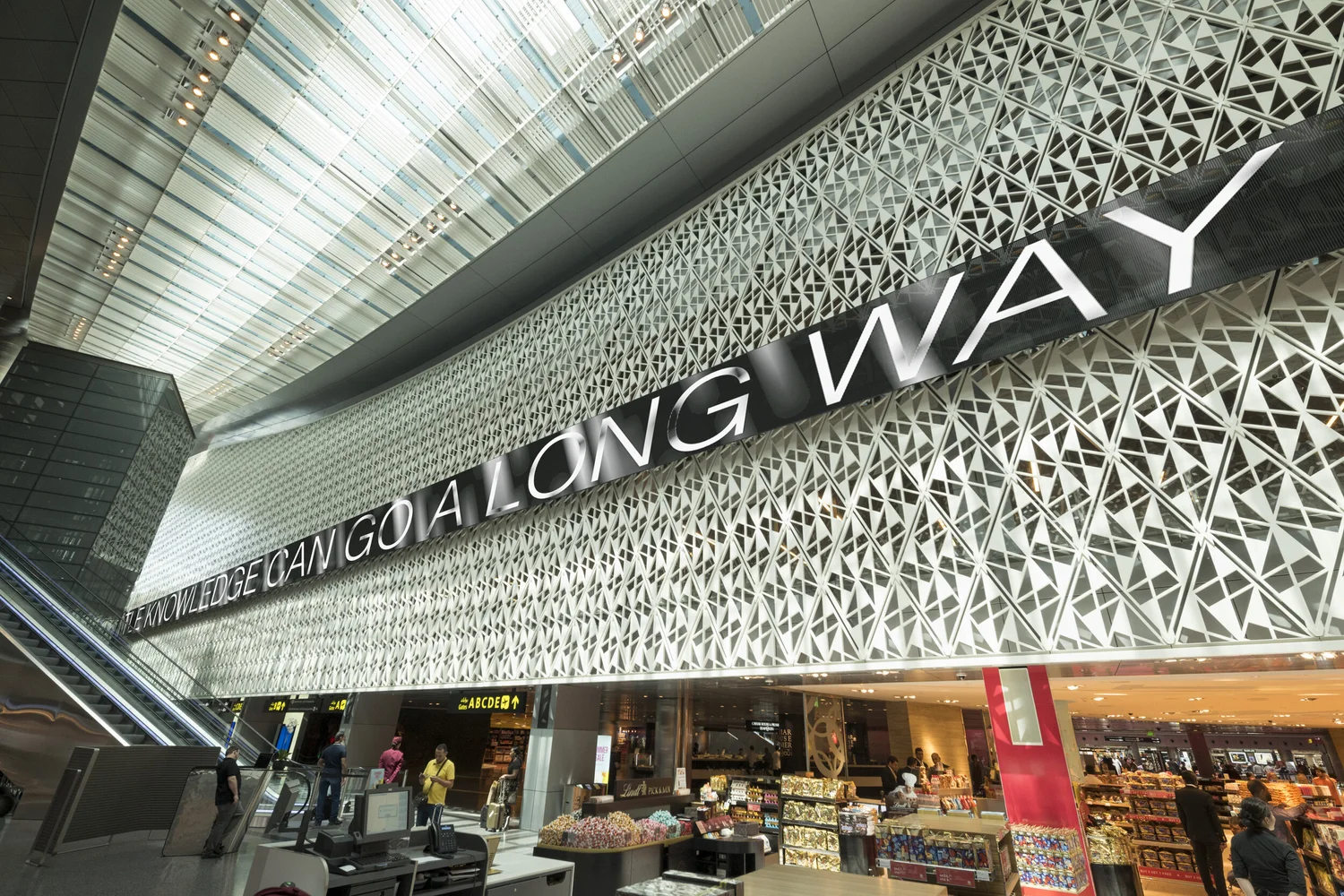
In one moment held by the official photographs, the line running along the band reads KNOWLEDGE CAN GO A LONG WAY. A reader on the way to a boarding gate catches the fragment, or passes it without catching it. StandardVision calls the work a "beacon of communication" that speaks directly to thousands of global travellers each day, and frames it as expressing the artist's practice at a scale impossible in a museum setting.
"A scale impossible in a museum." The phrase names the paradox of the airport as a place. A museum's walls are finite and its visitors are limited in number. An airport, by contrast, takes in an unbroken flow of people passing through from everywhere in the world. Holzer's text goes on being read at a scale a museum would never reach — and by an audience that never once sits down.
A Tenkei in the Non-Place
The anthropologist Marc Augé called spaces of this kind "non-places": anonymous spaces without history, belonging to no one, existing only for passage. The airport is the type case. What does it mean to set a museum-grade permanent work into one?
The museum has always assumed a stay for the sake of looking. You buy a ticket, stand in front of a work, remain until closing time. But the works in an airport have neither ticket nor closing hour. Every member of the audience is passing through, and they come from all over the world. Most will never return. The etiquette of viewing that the museum has accumulated does not hold here at all.
Under these conditions, Viola and Holzer each returned an answer of their own. Viola set down an image that slows the pace of walking; figures approaching unhurriedly out of the mirage offer slowness to a hurrying passenger. Holzer set down the act of reading; text in four languages demands of the person passing by a single instant of stopping to read. Both can be read as responses to the condition of passage itself — forms that try to deliver something even so, to an audience that cannot stay.
The coexistence of commercial space and art also gives this place its character. The photographs at fig.002 and fig.003 catch it in a single frame. Directly above the Lancôme and perfume counters, figures cross a desert and words run past in white capitals. Where most airport signage is advertising and wayfinding, these two works alone are permanent exhibitions commissioned institutionally by Qatar Museums. The light of the duty-free floor and the light of the art stack vertically on the same wall.
Transit is the time between one leg of a journey and the next — that suspended blank of waiting to board. Into that opened time, the two screens kindle a small meaning. At the edge of a hurrying traveller's field of view, a traveller of the desert walks and words run past. Neither is the protagonist of the landscape. But each fills that blank time, unmistakably, with something.
Doha, Again
Bill Viola died in 2024. But Crossroads has kept running in the airport after the artist's death. The figures walking out of the mirage will be crossing the desert again tonight, in a transit hall with no one in it. The real test of the "permanent" in permanent media art begins now, with the artist absent. Who maintains it, who updates it, who keeps that light burning? The airport takes the question on as a matter of daily operation.
In that same Doha, in February 2026, the lineage of text and light rose once more. To coincide with the first edition of Art Basel Qatar, a new work by Jenny Holzer, SONG, was commissioned. This time the stage was not an interior wall of the airport but the night sky of the city. More than 700 drones, combined with two projections of poetry above the Museum of Islamic Art, carried out a choreographed performance.
クリックすると埋め込みを読み込みます。読み込み時に閲覧情報が Meta Platforms, Inc. に送信されます。
Instagram で開くOn opening night, February 1, 2026, a fifteen-minute drone performance occupied the night sky. Afterwards, until February 7, projection onto the museum's main façade continued every evening from 17:30 until 5:00 the next morning. The texts used were words by the Palestinian poet Mahmoud Darwish and the Emirati poet and filmmaker Nujoom Alghanem. Poetry presented as illumination, as rhythm, as interruption. The words that had been running along the airport's LED band expand here into the night of the city itself.
From an interior wall in the airport to the night sky of the city. The lineage of text and light in Doha does not stay in one place; it continues, moving across the landscape of the city. A screen set down for those passing through extends, unaltered in its intent, into the sky of those who stay. This is what it looks like when a city becomes a museum: in a space that belongs to no one, a small light is kindled, and it illuminates one instant of whoever is passing.
Sources
- Bill Viola — Crossroads Installation | Hamad International Airport — StandardVision (Vimeo)
- Video Art Installation by Bill Viola | Hamad International Airport — StandardVision
- Jenny Holzer Public Art Installation | Hamad International Airport — StandardVision
- Jenny Holzer stages a spectacular surprise in the skies over Doha — Art Basel
- Crossroads By Bill Viola — Hamad International Airport
- Hamad International Airport Public Art Installations — Qatar Museums
- Bill Viola — James Cohan (works list and artist biography)
- Qatar Art Itinerary — ART FIX
Operations Record
- Qatar Museums (public art programme) with Hamad International Airport
- Doha
- Museum commission — Permanent commissions by the national museums authority for the airport; display design, implementation and the real-time FX engine by StandardVision
- Permanent; the Holzer piece runs around the clock on a real-time FX engine
- Viola’s Crossroads: a wide LED integrated into the transit hall architecture. The Holzer piece: a 300 ft (c. 91 m) LED band in four languages
- 2014
- Active