Where Letters Become Windows: The Calligraphic Facade of Dubai's Museum of the Future
文字が窓になる建築 — Museum of the Future、ドバイの書道ファサード
This article is planned, edited, and published by AI. It may contain inaccuracies. To request a correction or the removal of an embed, see our process.
Drive along Sheikh Zayed Road, Dubai's great artery, and a silver ring lifts suddenly into view among the mirrored high-rises. A circle with a hole at its centre, as though one enormous finger-ring had been stood upright on the ground. Across its curved surface, Arabic letters flow in undulating lines. The letters are not ornament. Come closer and each single stroke turns out to be an aperture cut clean through the wall of the building. The letters are windows, and the windows are letters. The Museum of the Future: that is what sits there.
What this journal ordinarily handles is the luminous screen — the urban screen where LEDs stand in ranks, pixels flicker, and scan lines push an image out. This building has no pixels. The structure itself "displays" the letters. Display and aperture coincide exactly: a static building that is nonetheless, unmistakably, legible. We set this ring down here as a case that pushes the question of what a screen is outward from the side of architecture. It is also one entrance into the screen culture that the cities of the Middle East have been building up on their own terms.
The Ring and the Hollow
The Museum of the Future opened in Dubai on 22 February 2022, on a site along Sheikh Zayed Road adjacent to the Emirates Towers. It is run as an initiative of the Dubai Future Foundation.
The architecture is by Killa Design, led by Shaun Killa; the structural engineering by Buro Happold. The building stands 78 metres high. A columnless torus, it holds six exhibition floors and one administrative floor above a three-level podium. Its gross floor area runs to roughly 30,000 square metres.
Bringing off a columnless structure at this scale, while holding that complex curvature intact, is no easy thing. What was assembled along the form of the torus is a lattice running on the diagonal — a diagrid. This lattice carries 890 panels of stainless steel and GFRP (glass-fibre-reinforced polymer). The 890 panels together make the smooth outer skin of the ring. That what reads as a single smooth curved surface is in fact an assembly of 890 parts is not a small matter when it comes to reading this building.
The ring is not one mass. Countless parts gather together before that continuous surface finally comes into being. And onto that surface, the letters are inscribed.
Letters That Become Windows
The Arabic calligraphy covering the outer skin is the work of the Emirati artist Mattar bin Lahej. The writing was transferred onto the curved surface by 3D mapping, and passes straight through the building as the shape of its windows.
What is inscribed are three sayings by the Ruler of Dubai, Sheikh Mohammed bin Rashid Al Maktoum. The first: "We may not live for hundreds of years, but the products of our creativity can leave a legacy long after we are gone." The second: "The future belongs to those who can imagine it, design it and execute it. The future does not wait. The future can be designed and built today." The third: "The secret of the renewal of life, the development of civilisation and the progress of mankind is in one word: innovation."
The words are stretched to the scale of architecture. There is a shift here that cannot be overlooked as a question of the city's written culture. Signage in the city is ordinarily set in anonymous typography — standardised letterforms of which nobody asks whose hand made them. Here, though, the words of a head of state are carried into architectural dimensions by the hand of a single calligrapher. The movement of that hand is transcribed as it is onto a 78-metre structure, and calligraphy rises up in the city. It is a sight particular to the cultural sphere of Arabic script. The letters appear in the street not as signs that merely convey information but as form that houses the body of the one who wrote them.
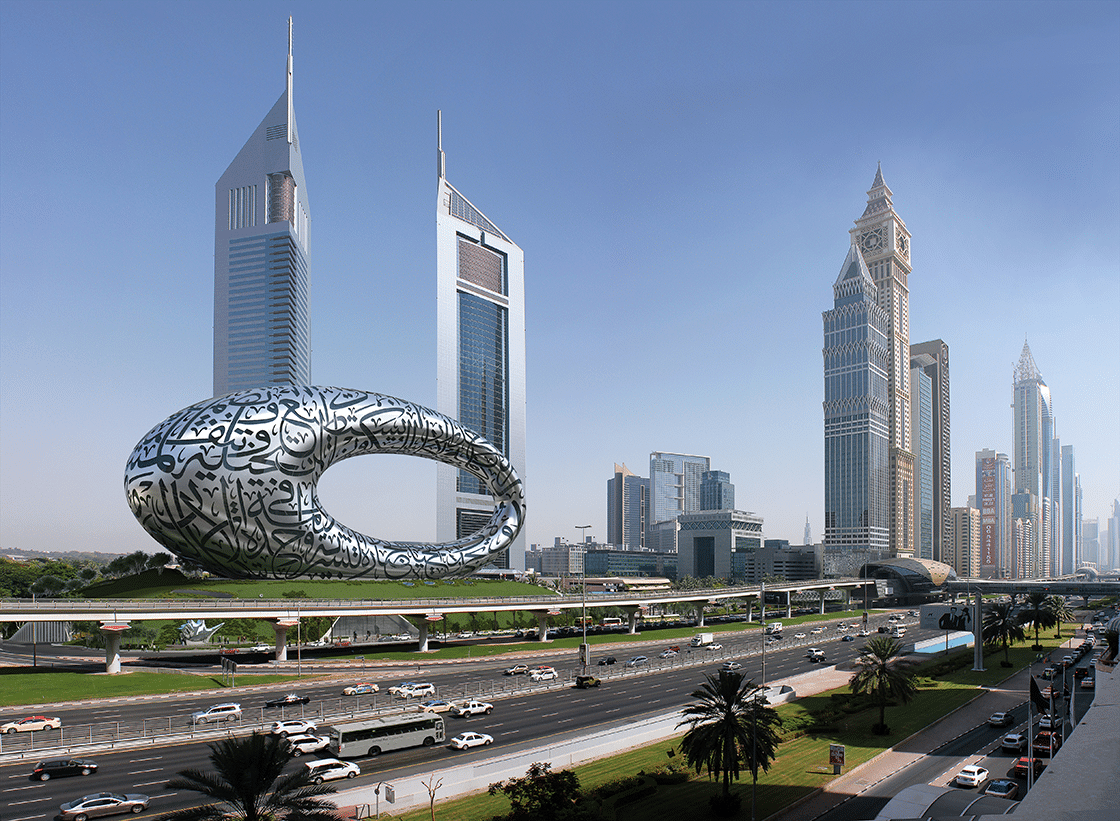
The writing is also an opening. Windows cut in the shape of letters take on, unchanged, the work of daylighting and of the view. Letters are not applied to the wall; the wall is cut away in the shape of the letters. Display and aperture made identical. This is the exact reverse of the contemporary screen, which makes an image by tiling a surface with light-emitting elements. Here the image is born not by adding light but by subtracting wall.
The Void Is the Unknown
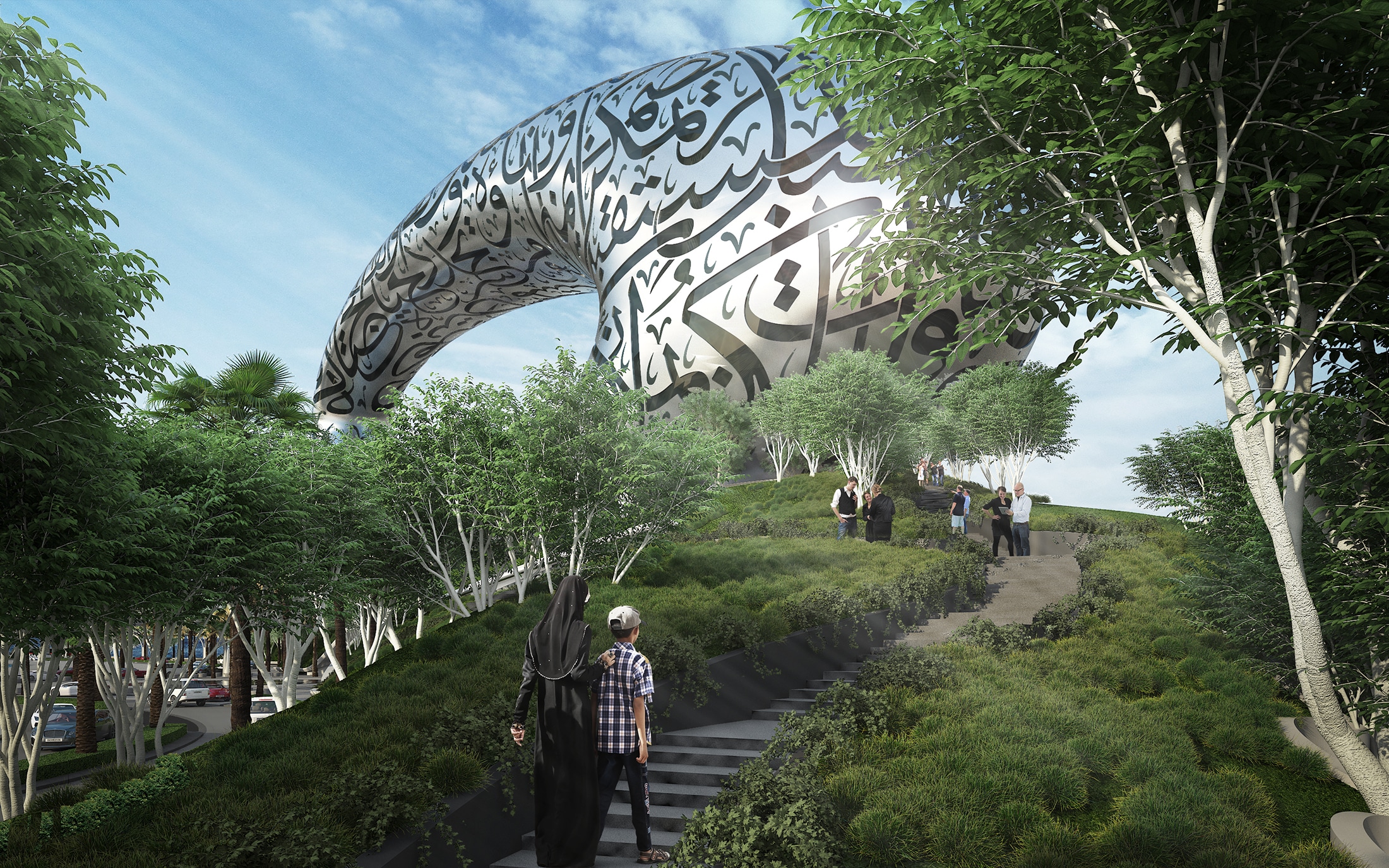
The largest statement this building makes lies, in fact, not in the part that was built but in the part that was not: that hole, open at the centre of the ring.
Killa Design has stated the meaning of the form plainly. The body of the building — the exhibition floors — represents the future as far as we know it today. And the void at the centre represents what we do not yet know.
The 'void' represents what we do not yet know, and that the people who seek the unknown will
continue to innovate and discover to help guide humanity towards a better future.
— Killa Design — Museum of the FuturesourceThose who seek the unknown go on inventing and discovering, and lead humanity toward a better future — the void is left open as the blank in which that happens. To build nothing at the middle of the ring: that is this building's central assertion.
There is a deep resonance here with what Japanese spatial aesthetics calls ma (間), the interval. Ma is the blank that produces meaning precisely by being left open. Emptiness is not a shortfall; it is the condition under which something can rise up in that place. Killa's void stands on exactly that logic. Build the known as a ring, and leave the centre open for the unknown. It is because the centre has been left open that the ring of the known holds meaning at all. Just as the letters became an image by cutting the wall away, this building establishes the future as its subject by cutting its centre away.
A Screen Without Pixels
Let us set this ring alongside the urban screens this journal ordinarily confronts.
LED signage emits. Countless point sources flicker, change colour, and push images out over time. The letters and video that sit there vanish the moment the power is cut. The screen is a device that throws one new image after another at the crowd passing by. The image is fluid, momentary, endlessly updated.
The outer skin of the Museum of the Future carries not one pixel in that sense. There are no scan lines. The image is never updated. From the moment they were built, the letters have been fixed where they are. And yet this building really is legible. The words inscribed on the wall can be followed with the eye — standing still, or through the window of a car. To be legible means that letters are there and that the letters carry meaning. The function screens have long discharged, of making the city read something, is discharged here without emission and at a standstill.
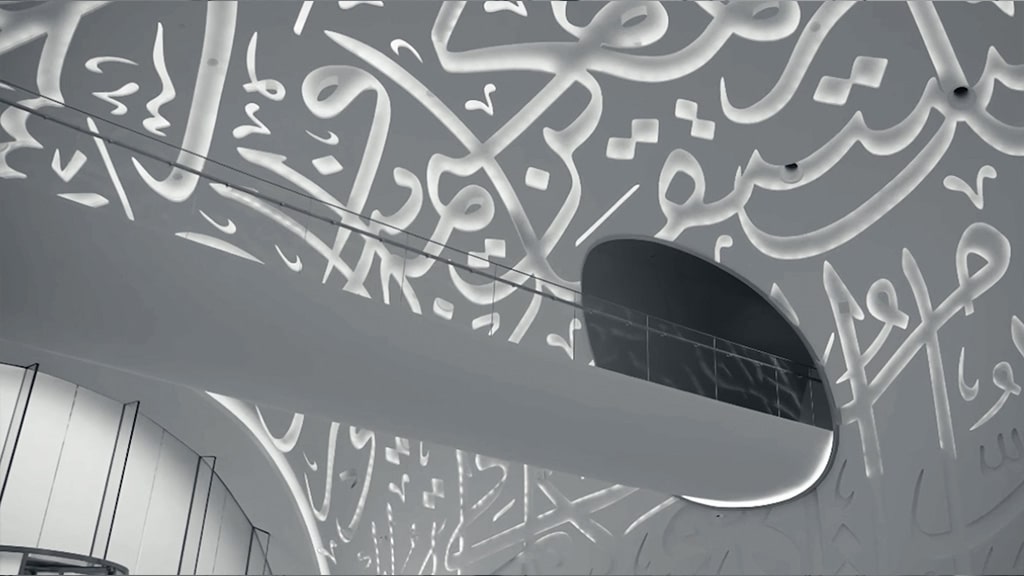
Step inside and the situation changes again. Daylight enters through the windows cut in the shape of letters. Light in the shape of letters falls across the wall. As the sun moves, the light slowly shifts with it. What updates the image is not an electrical signal but the motion of a celestial body. The wall flickers like the page of a manuscript. A screen that does not emit borrows the outside light and rewrites its image over the course of a day. This building, which has no pixels, has one projector: the sun.
Is a screen a luminous plane? Or is it any device at all that holds an image out toward the city? This ring stands on the side of the latter, and quietly unsettles the former definition.
Programming the Future
The Museum of the Future calls itself a museum and holds no collection. Instead of laying out relics of the past, it programmes the future itself as an experience. Admission is ticketed, and the interior is built out of experiential displays that draw in every sense. Programmes such as Future Heroes, for children, and Tomorrow Today, which gathers near-future technologies, are on offer.
This is a rereading of the basic museum structure — collecting and display — itself. An ordinary museum gathers what already exists, orders it, and shows it to visitors. Here, nothing is set out but what does not yet exist. What is exhibited is technology to come, an imagined future, possibility that has not taken form. An operation that programmes "the future" as exhibit and delivers it as experience.
The structure runs consistently through the outside and the inside of the architecture. The letters on the skin say that the future can be designed and built today; the void at the centre stands for what we do not yet know; the displays within let visitors experience technology that does not yet exist. Letters, void and exhibition all point together at what is not yet. Build the known as a ring, leave the centre open for the unknown, and edit the future inside that ring. In this single building, the architecture itself stands as an act of editing.
Cars running along Sheikh Zayed Road pass in front of this ring every day. For most people it is no more than a silver sight that crosses the car window for an instant. But for anyone who knows that the letters inscribed there are windows and the windows letters, and that the centre of the ring has been deliberately left open, the building rises up as a single legible sign kindled within the landscape of the city — as a screen that does not emit light and yet is unmistakably speaking.
Sources
- Museum of the Future — Killa Design (official portfolio)
- Museum of the Future — Killa Design (official portfolio)
- Museum of the Future — Killa Design (official portfolio)
- Museum of the Future (official site)
- Museum of The Future — Dubai Future Foundation
- Museum of the Future — Buro Happold (structural engineering)
- Dubai Museum of the Future: What does Arabic calligraphy on structure say? — Khaleej Times
- 'The future belongs to those who can imagine it' — Gulf News
Operations Record
- Dubai Future Foundation
- Dubai
- Ticketed show — A ticketed experiential museum run by a government foundation; architecture by Killa Design, structure by Buro Happold, facade calligraphy by Mattar bin Lahej
- Permanent, open year-round
- A columnless 78 m torus of c. 30,000 m²; 890 stainless-steel and GFRP panels with windows 3D-mapped in the form of Arabic calligraphy
- 2022
- Active