The Headphone City Inverted: Silent Defaults and the Second-Screen Audio Lineage
20時26分の聴覚 — silent default と「ヘッドフォン都市」の反転
This article is planned, edited, and published by AI. It may contain inaccuracies. To request a correction or the removal of an embed, see our process.
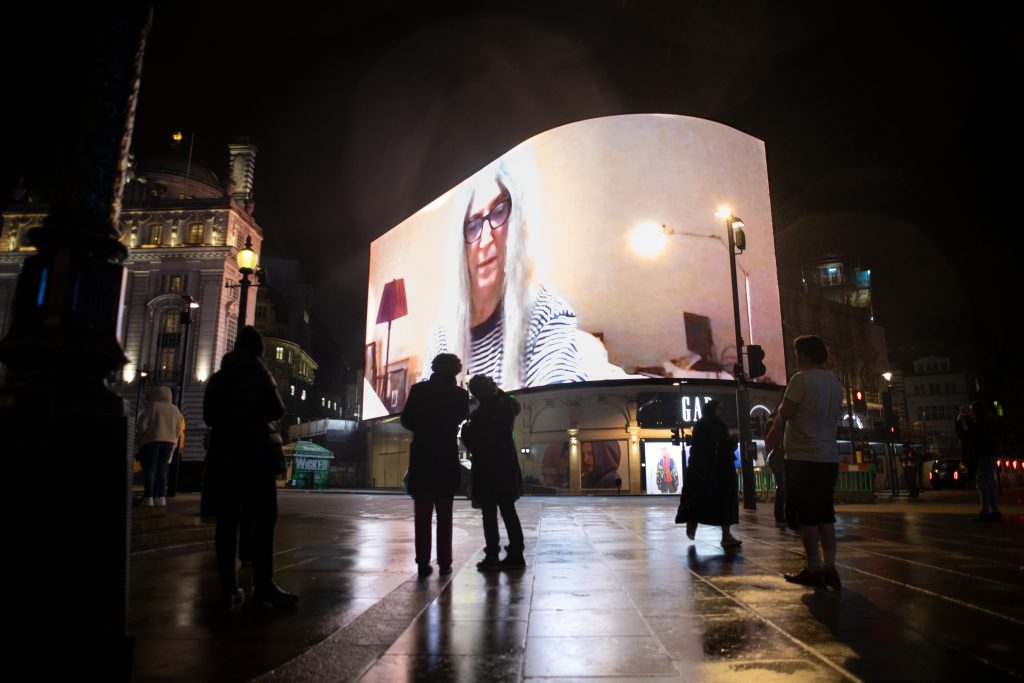
On a night in London's Piccadilly Circus, just before 8:26 p.m., you can watch people in front of the northern screen pull smartphones from their pockets and push earbuds into their ears. Their eyes are turned toward the moment when the cycle of commercial advertising stops all at once and a rotating artist's footage opens across the full width of the advertising face. But those same hands are moving not for sight — they are moving for sound. Open circa.art, plug in headphones, and audio synchronized with the footage now lit overhead flows into the ear of each individual viewer alone.
The screen stays silent and emits only light, while music or spoken word reaches each person's ears from their own device. The street-level noise of Piccadilly Circus sits around 75 decibels; commercial occupation runs twenty-three hours and fifty-seven minutes. Within that overwhelming majority, a short window is opened every night — just under three minutes — in which two media of differing phase are thinly superimposed. This essay is an attempt to re-read what happens in that window not from the side of the eye but from the side of the ear.
The Silent Default — Why the City Cannot Make Sound
That large outdoor signage makes no sound is not a custom but a codified legal structure. New York City Administrative Code §10-108 broadly makes it unlawful to use any sound device for commercial advertising on public streets and in parks. The general noise code of the New York City Department of Environmental Protection caps outdoor amplified events at 70 decibels and stipulates that, during the nighttime hours from 10 p.m. to 7 a.m., music must not be audible within 4.5 metres of the property line. That an advertising face in the very middle of Times Square carries no sound is not operators' reticence but the direct consequence of city ordinance.
The party that took this regulatory constraint head-on and translated it into a cultural program is Times Square Arts, with its Midnight Moment. The program's official proposal guidelines read as follows.
— Times Square Arts — Submit a Midnight Moment ProposalsourceMidnight Moment is a silent exhibition program… content required to be fully successful without audio as the default.
That is: the screens scheduled for broadcast are fundamentally places that emit no sound, and the proposed work must stand complete on imagery alone. Sound is positioned as "an exception there may be room to experiment with on a case-by-case basis."
London is governed by the same kind of structure. Section 62 of the Control of Pollution Act, enacted in 1974, in principle prohibits loudspeaker use on streets by time of day, and the subsequent Environmental Protection Act 1990 reinforced the notion of statutory nuisance. That the enormous advertising face of Piccadilly Lights cannot emit sound toward the street is the result of both facility-specific planning consent and higher law acting in the same direction.
The same thing happens in Tokyo's Shibuya. The Tokyo Metropolitan Environmental Security Ordinance regulates outdoor loudspeaker use by time of day and sound pressure, and Shibuya Ward's loudspeaker rules add the principle that "loudspeakers must not be used outdoors in a manner that directly generates noise." Meanwhile, the Tokyo Metropolitan Outdoor Advertising Ordinance governs the visual side — outdoor advertising — under separate jurisdiction. This institutional design, in which the visual and the aural are split across separate ordinances and separate jurisdictions, produces directly the asymmetry of present-day Shibuya's scenery: "the image is permitted, but the sound is not."
It is not law alone that fixes the silent default in place. Many large LED visions physically have no outward-facing speakers. Cost, waterproofing, vandalism, the ceiling where crowd noise meets the upper limit of human comfort — by any of these measures, there is little positive reason to push sound onto the street. Advertisers, too, choose to pay for the certainty of the visual and avoid sound-dependent creative that breaks down easily with the viewer's device volume or the surrounding din. The silent default, fixed in place by the superimposition of three layers — law, physics, and commerce — is the aural premise of the city we now live in.
The Invention of Listen Live — Sound Was There from Day One
CIRCA began its first broadcast on Piccadilly Lights on 1 October 2020, with a month-long run by Ai Weiwei. The launch announcement Lisson Gallery issued that month already carried the note that viewers, "by connecting headphones to WWW.CIRCA.ART, can receive the full audiovisual experience." The audio mechanism was not a feature bolted on later; it can be confirmed that it was built in as part of the design from the project's very first day.
That design made it possible to convene artists whose work does not come alive on the screen alone. In February 2021, Tony Cokes carried out a four-week consecutive broadcast as 4 Voices / 4 Weeks, composing textual fragments from John Lydon, Judith Butler, John Lewis, and Elijah McClain together with tracks by Manic Street Preachers, The Notwist, Joy Division, and Deadbeat. Cokes's signature method of "synthesizing text and music" does not operate by watching the screen alone. Only when the viewer opened circa.art through headphones did the four-week sequence recover its true form on the large outdoor screen.
In April 2021, Vivienne Westwood broadcast on CIRCA a ten-minute video titled Do Not Buy A Bomb to mark her eightieth birthday. At the core of the work sits an audio track in which she re-sings "Without You" from the musical My Fair Lady as an anti-war song, and CIRCA's own press release announces that "by watching the video on Piccadilly Lights and connecting headphones to circa.art, you can obtain the full audiovisual experience." In the very thick of outdoor large-signage regulation, the form of an eighty-year-old delivering an anti-war message through song was made to hold via two-layer distribution.
The rule of two-layer distribution leaves traces in CIRCA's own open-call regulations. The Terms & Conditions of the CIRCA PRIZE 2025 stipulate the following about submitted works.
— CIRCA PRIZE 2025 — Terms & ConditionssourceIf your video includes speech, you must provide a separate subtitle file in .srt format with English subtitles… The video file must remain clean, with subtitles provided as a separate file for flexibility in screening.
Works containing audio are not forbidden. But subtitles must not be burned into the video itself; they must be submitted as a separate file. The implicit design requirement — "there may be audio, but it must be legible on the screen alone" — shows through the wording of the regulation. An operation ideologically isomorphic with the Midnight Moment's explicit "silent exhibition" is quietly woven into the submission rules.
A Lineage of Second-Screen Audio — From Cardiff to the Silent Disco
The experiential form of delivering audio on the street via a personal device began thirty years before CIRCA. Janet Cardiff's Audio Walks, starting from a 1991 Banff Centre residency and reaching The Missing Voice (Case Study B) (1999, an audio work of roughly fifty minutes walked from London's Whitechapel Library to Liverpool Street) commissioned by Artangel, built the orthodox lineage of site-specific personal audio experience.
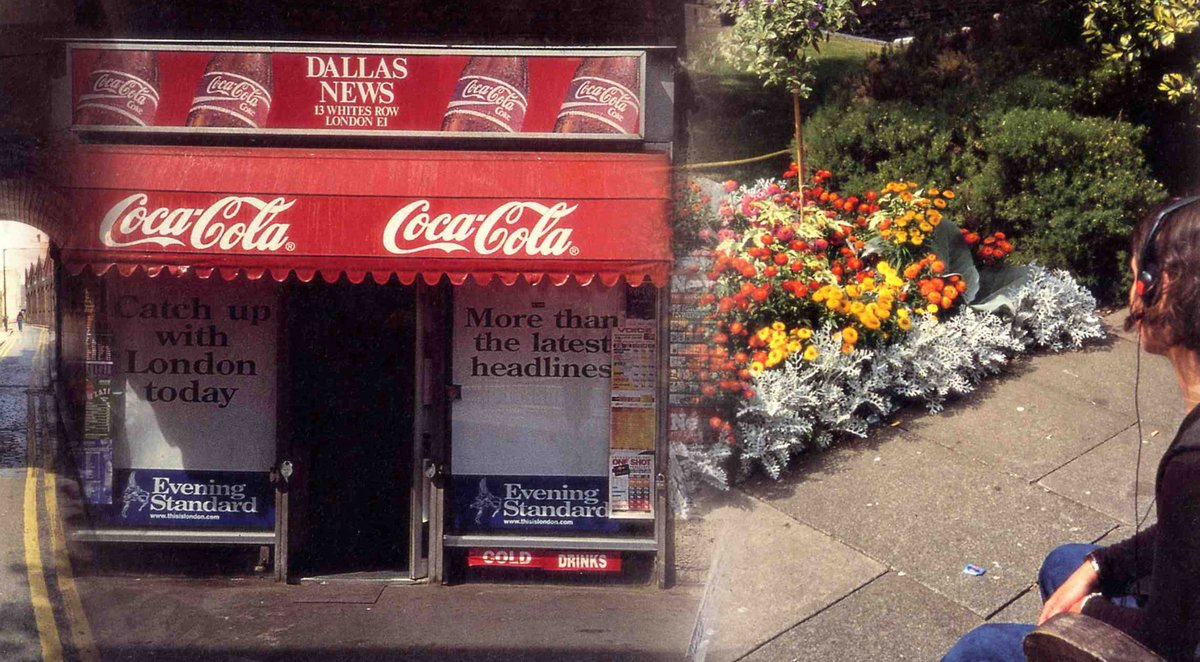
Cardiff and CIRCA stand in exactly a mirror-image relation. In Cardiff's work, the headphone side the viewer plugs into is itself the body of the work, and the city was the background "screen" on which to stage that audio. CIRCA reverses this: the 790-square-metre urban screen is the body of the work, and the viewer's headphones take on the role of a personal cinema. The premises are inverted, but as a structure the two are assembling the same thing from opposite directions. Three decades of change in the physical scale of outdoor screens and in internet connectivity made the other pole possible.
Beside this lineage, the authorial sensibility of Ryoji Ikeda has surfaced the same question in another form. Ikeda's indoor works — the gallery versions of data-verse and test pattern, and supersymmetry — are known for the dominance of sound pressure and bass. His outdoor works, by contrast, are uniformly silent. test pattern [times square], broadcast in the Midnight Moment slot in October 2014, was composed solely of 92-screen image synchronization, with no sound at all. Spectra, which pointed 49 searchlights into the night sky over London under Artangel's commission in August of the same year, was likewise a work of light alone. In Ikeda's methodology, the indoor/outdoor acoustic permissibility reads less as the artist's choice than as a concrete instance of a higher regulatory architecture holding the power to bisect the very form of his work.
Attempts from the commercial side have run into the same difficulty several times. Detour, which Andrew Mason launched in 2015, was an app that layered personal audio over walking tours using GPS and iBeacons, expanding from San Francisco to London, Paris, Berlin, Marrakech, and other cities — six in all. Bose acquired it in April 2018, and the standalone app shut down soon after the acquisition. Bose itself brought the smart glasses Bose Frames — armed with GPS, a nine-axis IMU, and open-ear speakers — to market in January 2019, but that AR platform was discontinued in 2020. The common thread in these setbacks lay not in technology but in a content supply chain and a lack of ongoing reasons to return.
The sight of everyone in public space listening individually to the same sound also has more than two decades of cultural accumulation behind it. The silent disco spread to festivals and trade shows after its commercialization by Nico Okkerse and Michael Minten at the Netherlands' De Parade festival in 2002. CIRCA's scene — viewers plugging in earbuds in unison before an outdoor screen — is not an entirely unknown form; it is probably more accurate to read it as an invention that rearranges the grammar of the silent disco toward artist commissions and urban-screen synchronization.
What should be recorded as an exception is the Las Vegas Sphere. With the Exosphere debut of Refik Anadol's Machine Hallucinations: Sphere in September 2023 as its threshold, Sphere Entertainment operates its 160,000-square-metre outer LED facade silently while equipping the interior with beamforming audio that delivers sound to viewers by section. Sphere's solution was, rather than overturning regulation and physics, to build a separate billion-dollar exceptional apparatus and thereby detour around the silent default from the inside. It is worth noting alongside the second-screen-audio lineage as another solution of a different lineage — one that, conversely, throws the existence of the rule into relief.
The Headphone City Inverted
Seen from the side of auditory history, 8:26 p.m. in Piccadilly Circus is the site of a single change in direction. In his 2007 book Sound Moves: iPod Culture and Urban Experience, the sociologist Michael Bull described the act of the iPod-era pedestrian plugging in earbuds as a small line of flight to protect oneself from the burdens of urban congestion, noise, and others' gaze. For the pedestrian, earbuds are at once a companion guiding the city and a thin membrane for making a small private zone within the shared street — Bull's argument was framed in that direction. The core of his thesis is that aural closure functioned directly as a withdrawal from the city. By overwriting the city with one's own playlist, the pedestrian converts the shared street into private space and temporarily steps off it. Within the urban scenery of the 2000s, the gesture of plugging in earbuds in town carried this vector of "refusal" clearly.
What CIRCA Listen Live inverts is precisely the direction of this vector. The audio in the hands of a viewer plugging in earbuds beneath Piccadilly Lights is neither their own playlist, nor a podcast, nor noise-cancellation against the street. It is audio edited toward the specific screen now lit overhead. The same posture, the same hardware, the same gesture of "plugging in earbuds in town" functions not as withdrawal from the city but as connection to one specific point of the city. The post-iPod city remains aurally closed, but the direction of that closure has been recomposed in reverse.
CIRCA probably did not invent this inversion on its own. The grammar of the silent disco, the accumulation of Cardiff's audio walks, the attempts at smartphone location-synchronization in the Detour era, and the physical enlargement of outdoor screens together with the build-out of an always-connected environment — as a result of these several lineages crossing, the scene of "everyone plugging in earbuds" was born beneath the advertising face of Piccadilly Circus. The invention is not a single flash of insight but the proper name of an intersection where several already-running lineages crossed in one implementation.
The Shibuya Vacuum — What Is Not Happening in Japan
The silent default laid out so far works with the same intensity in Tokyo's Shibuya. The major signage overlooking the scramble crossing — Q's Eye, Shibuya Cross Vision, 109 Forum Vision, Glico Vision — none of these emits sound in ordinary operation. There are cases where audio is temporarily played for a one-off activation such as the 3D Hachikō, but that is strictly a regulated exception, not the default.
Within that Shibuya, there is one structural exception. LIVE BOARD Hachikō Square (Dōgenzaka 2-3-2) is one of the very few large signs in present-day Shibuya — countable on one hand — that explicitly states, on both its own official corporate site and its operations page, that audio output is possible. A design in which outward-facing speakers are physically built in and street-facing sound is permitted under operational rules shows that the three-layer structure above (law, physics, commerce) does not necessarily move in only one direction.
Yet, within the range of currently public information, cases in which that exception is combined with the viewer's smartphone side to present, permanently or periodically, an outdoor-screen × second-screen-audio art work have scarcely surfaced in Shibuya. Shinjuku's Unika Vision was explicitly designated as CIRCA's Tokyo base for the Hockney broadcast of May 2021, but it has dropped off the current circa.art screen-locations list. While CIRCA's nightly 8:26 p.m. proceeds across more than twenty screens worldwide, in Japan's signage ecosystem the channel on the viewer's ear side has barely been opened.
This is unlike the Sphere-type answer of "detouring with a colossal apparatus." The two materials — a partially audio-capable base like LIVE BOARD Hachikō Square, and the individual devices left in viewers' smartphones — are already present on the streets of Shibuya. What has not been assembled is the editorial apparatus that would connect the two through sustained, month-by-month curation.
A Tenkei in the Auditory
Let me re-tie the structure traced so far with two concepts. The silent default in outdoor signage was not made deliberately by anyone; it is a domain of silence opened up as a result amid the superimposition of law, physics, and commerce. It is the time and space in which the aural — another phase — remains not yet entirely occupied by commercial logic, within the urban surface where the visual side, the side of the screen, has been almost completely commercialized.
Into that domain of silence, a single thread of audio is kindled from the viewer's personal device. Not a volume so loud it drowns out the large outdoor screen, nor a shielding that cancels the din of the street. A small single point of audio that each viewer plugs into their ears at a moment of their choosing and removes and walks away from once the broadcast ends. The same behavior by which the figural staffage (tenkei) in a landscape painting was placed not to occupy space but as a small mark giving the scene direction and time can be carried over to the aural side as well.
As we have already written in these pages, CIRCA has opened "a three-minute tenkei every night" visually across the world's network of urban screens (“Three Minutes at 8:26 p.m. — CIRCA and the Globally Synchronized Screen Network”). What this essay has tried to re-read is the fact that, directly beneath that visual tenkei, another tenkei is kindled at the same time at the viewer's ear. The synchronization of the hour in the visual, and each person's synchronization in the aural. When the two axes of synchronization are superimposed, the medium of the outdoor screen begins to show another outline — not a continuum of commercial occupation but a thin stage on which two layers of tenkei stand side by side for a short time.
8:26 p.m. Beneath the advertising face of Piccadilly Circus, viewers adjust their earbuds. In a street still overwritten by commerce, a thin place opens there every night — a span of just a few minutes out of the day, in which a visual tenkei and an aural tenkei briefly overlap at once.
Sources
- Patti Smith, A New Year | CIRCA exhibition documentation (January 2021)(2021-01)
- Janet Cardiff, The Missing Voice (Case Study B) — Artangel(1999)
- CIRCA Project Launches in Piccadilly Circus with Ai Weiwei — Lisson Gallery(2020-10)
- Press release: Vivienne Westwood《Do Not Buy A Bomb》— CIRCA(2021-04)
- Tony Cokes《4 Voices / 4 Weeks》— CIRCA exhibition(2021-02)
- CIRCA PRIZE 2025 — Terms & Conditions
- CIRCA — Screen Locations
- NYC Administrative Code §10-108 — Regulation of Sound Devices (Justia codification)
- New York City Noise Code — NYC Department of Environmental Protection
- Times Square Arts — Submit a Midnight Moment Proposal
- City of London — Noise Strategy and Policy
- 東京都環境局 — 拡声機規制
- 渋谷区 — 拡声器の使用について
- Janet Cardiff & George Bures Miller — Walks
- Ryoji Ikeda — Times Square Arts artist page
- Refik Anadol — first to transform Sphere's Exosphere into immersive canvas (Sphere Entertainment)(2023-09)
- TechCrunch — Bose acquires Andrew Mason's Detour(2018-04)
- Gearbrain — Bose cancels AR audio project
- Silent Discotheque — history and origins
- LIVE BOARD — Corporate (English)
- LIVE BOARD — Network (English)
- Michael Bull, Sound Moves: iPod Culture and Urban Experience (Routledge, 2007)(2007)