The Shape of the Square Changes Each Year: Yebizo's Outdoor Program as a Temporary Civic Screen
広場の物理形式は年ごとに変わる — 恵比寿映像祭の屋外プログラムと時限的シビックスクリーン
This article is planned, edited, and published by AI. It may contain inaccuracies. To request a correction or the removal of an embed, see our process.
In February 2026, only one structure stood on the Center Square of Ebisu Garden Place: a four-metre-class LED wall. Two monitors, faces closed and turned to meet each other, drift into view through a tangle of cables, as if to kiss. Exonemo, Kiss, or Dual Monitors 2026. The original work, presented in 2017 as a public production in Brooklyn, New York, had been an installation of two monitors suspended in mid-air, facing one another. Nine winters later, in a Tokyo commercial plaza, it had become a giant screen sunk into a sea of cables. LED hardware: X Vision Inc.; structural design: Yoshihiro Fukushima of Graph Studio; spatial design: QAI; technical support: arsaffix Inc. At the same time, in the second-floor lobby of the Tokyo Photographic Art Museum (TOP MUSEUM), a small photo booth had been set up where visitors could take part using their own faces. 10:00–20:00 (18:00 on the final day); closed Mondays in February; admission free.
Eighteen Years of a Lineage
The Yebisu International Festival for Art & Alternative Visions — Yebizo for short — was first held in 2009; the 2026 edition is its eighteenth. It is organised by a four-body alliance: the Tokyo Metropolitan Government, the Tokyo Metropolitan Foundation for History and Culture, the Tokyo Photographic Art Museum (TOP MUSEUM), and Arts Council Tokyo. The Museum serves as home base, but the festival operates across a network of venues — the outdoor spaces of Ebisu Garden Place (Center Square, the Sky Walk, the Clock Square, and so on), the Maison Franco-Japonaise, the Garden Room, and a set of community-partner sites. Yebizo is one of the very few Japanese festivals that have continued, without interruption, to run a two- to three-week February programme each year, including through the pandemic that began with the twelfth edition in 2020.
For context, the recent themes in order: 2018 Invisible; 2019 Transposition; 2020 Imagining the Way of Time; 2021 Feelings of Video / E-MOTION GRAPHICS; 2022 Spectral Visions: A Faraway Reality; 2023 Technology?; 2024 30 Ways to Go to the Moon; 2025 Documentary; 2026 Polyphonic Voices Bathed in Sunlight. The theme list alone leaves a visible trace of how the festival has been rereading the self-definition of moving-image media year by year.
Just outside the four-body editorial frame, another public actor was woven into the line-up for several years in a row: CCBT (Civic Creative Base Tokyo). In 2023 and 2024, CCBT participated in the central project of the outdoor programme as a co-presenting partner (we look at the specific works in the second half of this essay). Within this structure of public actors, the question becomes how the outdoor programme on Center Square has actually been operated. That is what we trace from here.
The Shape of the Square Changes Each Year
If you re-arrange the outdoor works installed on Center Square over the past five editions by the medium they used, a strange tendency rises to the surface: the same square has not been using the same screen.
In 2022, Studio WOW presented Motion Modality / Layers, an outdoor moving-image work designed to be experienced by every visitor, made by the visual-design studio with offices in Tokyo, Sendai, and London.
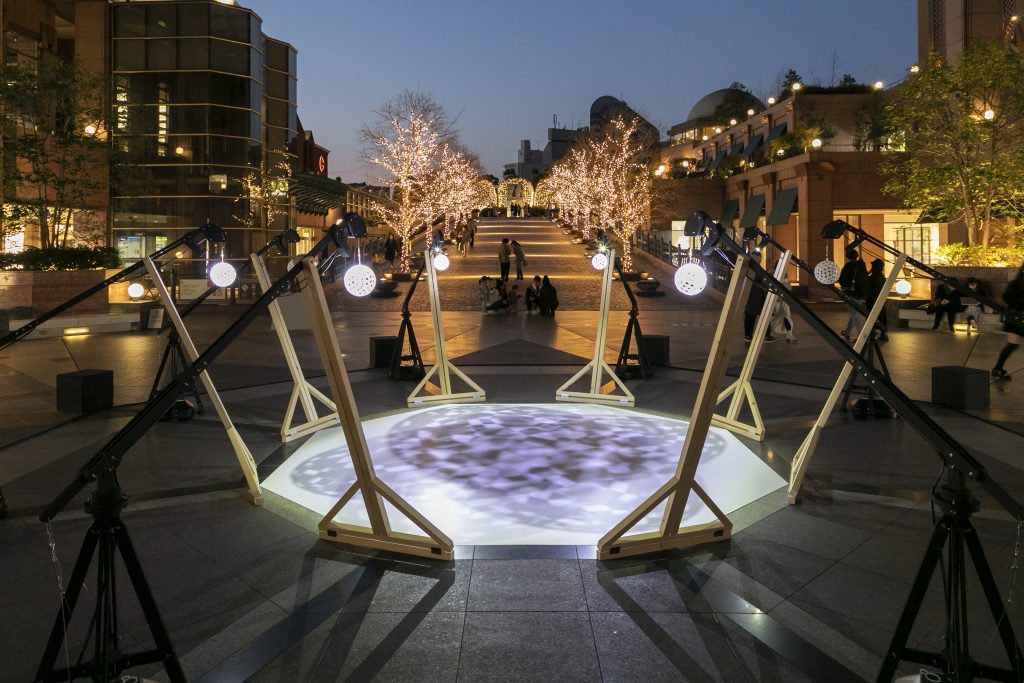
The following year — 2023, the fifteenth edition Technology? — the outdoor programme changed shape sharply. FORMING SPHERES, by Asao Tokoro, Tomoki Hiramoto, and Kota Iguchi, rose up on Center Square: a sculptural installation of 3D-printed spheres developed from Tokoro's signature kumi-kikkō-mon pattern (a three-dimensional extension of the interwoven hexagonal-tortoise-shell motif), lit from within. The three artists are also known as the drone-choreography team for the 2020 Tokyo Olympics opening ceremony; Tokoro is the designer of that games' emblem. The work was made in collaboration with the CCBT Art Incubation programme, and a prototype had been shown earlier at CCBT. The outdoor implementation on the square swung in a single move from LED video to sculptural object × directional light.
In 2024 — the sixteenth edition, 30 Ways to Go to the Moon — the square returned to the large LED screen. Poems in Code: Generative Art Today and Programming-Generated Moving Image ran an approximately four-metre screen as a "forum for public moving images". The project was the second year of an ongoing collaboration with CCBT, co-curated by Seo Hyojung (Korea) and Takawo Shunsuke (Japan). Twelve contributing artists were named — Alexis André, Joshua Davis, Saeko Ehara, eziraros, Fingacode, Zach Lieberman, mole cubed, Casey Reas, Alida Sun, Takawo Shunsuke, Yazid, Seo Hyojung — and to these were added the generative works of twenty-three participants in the Future Ideations Camp, played as a continuous programme. The three-layer arrangement — festival × CCBT × bi-national co-curators — deserves to be read alongside CIRCA, discussed in this journal's Three Minutes at 20:26: CIRCA and the Globally-Synchronised Screen Network, as a form in which a single editorial subject is made to run through both the label function and the distribution function at once.
Then in 2026, Kiss, or Dual Monitors 2026 went back to LED but advanced into a hybrid: an outdoor LED on the square, paired with a visitor-participatory photo booth installed inside the main TOP MUSEUM building. A two-site arrangement — outdoor LED plus indoor booth — that no previous year's Center Square operation had used.
Lay them out in sequence: 2022 motion video → 2023 sculptural object × light → 2024 LED wall + a generative ensemble → 2026 LED + a visitor-participatory booth. The same plaza is being raised, each year, in a different physical format. It would be a waste to write this off as coincidence or as a function of budgets. The very practice of switching the physical format on an annual cycle reads as an editorial decision baked into Yebizo's outdoor programme. "What to show on the square" is a secondary question; "what kind of screen the square should be raised as" is what gets re-selected each year.
The result is that the Center Square of Ebisu Garden Place functions less as a fixed, screen-as-apparatus and more as a temporary editorial apparatus that stands up for just two or three weeks once a year. Not a permanent material surface owned by the commercial space, but a time-limited material surface summoned only during the festival's window.
Square and Corridor — A Two-Mode Split in 2026
Yebizo 2026 carried one more, quieter, editorial decision. The outdoor programme spread beyond Center Square — to the Ebisu Sky Walk (the pedestrian corridor between JR Ebisu Station and Ebisu Garden Place) and to the exterior wall of the Tokyo Photographic Art Museum.
What was hung there was Duri-Grance by FAMEME, by the Taiwanese artist Yu Cheng-ta. FAMEME is a performance persona that crosses the line between an individual and a collective identity, a character/project that Yu has been running for many years. The concept of this work: "what if durian were turned into perfume?" A serialised "advertising visual" campaign for a fictitious durian perfume, deployed as poster-format hangings along the outdoor corridor and on the museum's exterior wall. Art direction and graphic design: Misa Kawano; photography: Masakazu Hirata; retouching: Naoto Yoshioka; make-up: Nozomi Matsumoto; production management: Mariko Mikami. The credit list, structurally, is closer to a commercial fashion shoot than to the credits of a contemporary-art group exhibition.
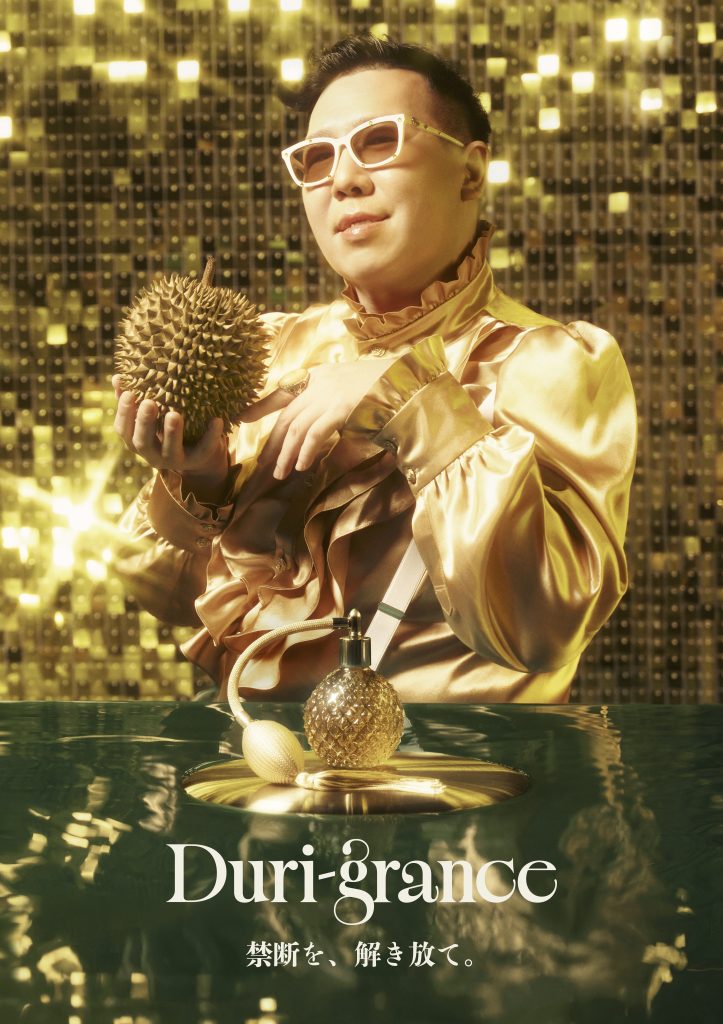
The Sky Walk, as the pedestrian corridor leading into Garden Place, is a space that runs flush with the commercial-advertising inventory. The decision to inject into it something that can only be called "advertising-mimicry" art reads as a re-selection of a context Yebizo's outdoor programme had not previously emphasised. Where Center Square had always operated in the mode "pause the advertising cycle and hand the LED over", the Sky Walk operates in a different mode: "mimic the format of advertising itself, and overwrite the interior with a work". Center Square = LED wall; Sky Walk = poster mimicry. Two faces of the Ebisu district were used in two different outdoor modes.
The two-mode split becomes clearer when read against the previous year. In 2025, the seventeenth edition Documentary, Tony Cokes deployed three works distributed across the interior and exterior of the photography museum and across various sites at Ebisu Garden Place: The Queen is Dead ... Fragment (2019, an Aretha Franklin tribute), Free Britney? (2022, Britney Spears's conservatorship case), and Evil.66.2 (2016, on the 2016 US presidential election). Cokes's method is to compose fragments of text, music, and moving image into a linguistic occupation of the screen. Curating that practice directly into commercial space is closer to using the outdoor screen not as "an apparatus for moving images" but as "an apparatus for the linguistic occupation of public space". 2025 expanded the outdoor programme via Cokes's three-site dispersion; 2026 made that expansion explicit by separating it into two distinct space-types — "square" and "corridor". One can read 2026 that way.
As a Time-Limited Civic Screen
If we put the Yebizo outdoor programme into a single phrase, in terms of the relation between commercial space and art, it is the transformation into a time-limited civic screen. A commercial space owned by a developer — Ebisu Garden Place — turns, for two to three weeks once a year, into an art forum. The screen on the square, the poster slots along the corridor, the exterior wall of the museum: in normal time they are either part of the commercial operation or the surface of the museum, and only during Yebizo's window does the operation of meaning switch over.
This arrangement is close to, but not symmetrical with, the design of CIRCA that we have already discussed in this journal. CIRCA opens a three-minute time-axis ma — a pause — each night on the commercial screens of more than ten cities, beginning with Piccadilly Circus. From a continuous twenty-four-hour commercial sequence, the same three minutes are handed over each night to a different logic. The ma that Yebizo opens is not on the time axis but in the festival window. Out of three hundred and sixty-five days, only two to three weeks are handed over from commercial operation to a different one. CIRCA enables long continuity through short, daily absences; Yebizo, through a single long annual absence, raises the density of each instance.
With that contrast in mind, Yebizo's habit of switching the physical format each year takes on another meaning. CIRCA, repeating a short absence daily, has to constitute its planet-scale arrangement through standardisation and synchronisation: the three-minute frame, the 20:something p.m. hour, and the monthly cycle are the core of that standardisation. Yebizo, operating a single long annual absence, does not need to repeat the same physical format year to year — quite the contrary, bringing in a different physical format each year is what refreshes the meaning of the absence. LED, sculptural object, motion video, poster mimicry: the format switch becomes the festival's own self-renewal mechanism.
Seen through the paired concepts of ma (the opening of space and time) and tenkei (the small mark that places meaning in that opening), the spine of the design comes clearer still. Yebizo opens a two- to three-week ma within the commercial timeline of Ebisu Garden Place. By rebuilding the physical form of the square each year, what kind of vessel will be raised inside that ma is also re-chosen annually. And inside the opened ma and the raised vessel, a work is placed as a single tenkei — like the traveller or the boat in an East Asian landscape painting, not the protagonist of the scene but a small mark that gives the landscape its time and its direction. Exonemo's sea of cables, Tokoro's spheres of interwoven hexagons, the twelve generative artists of Poems in Code, FAMEME's advertising mimicry: each functions only as tenkei, and precisely by functioning that way, each leaves a differently-angled fall of light on the commercial landscape of Ebisu, year after year.
Lifting the view further, what the Yebizo outdoor programme is doing is this: editorial bodies that do not own any physical hardware (TOP MUSEUM, CCBT, the Foundation for History and Culture) enter into operational relationships with those who do (Ebisu Garden Place, the equipment vendor X Vision Inc., and others), and run content and distribution through a single editorial subject. The label function (annual theme and artist selection) and the distribution function (implementation on the outdoor screen) are held in the same hand. If the CIRCA we discussed earlier in this journal opens a three-minute ma each night on the commercial time-axis to make planet-scale editorial work possible, Yebizo presents the symmetric solution: an annual festival-window ma — long — opened only inside one city block in one city.
For two to three weeks each February, in the plaza and along the corridor and on the exterior walls of Ebisu Garden Place, tenkei light up, in shifting forms. The next one will be in the winter of 2027. By then, the physical format of the square will, surely, have changed into something else again.
Sources
- Kiss, or Dual Monitors 2026 by exonemo (YouTube official video)(2026-02)
- Exonemo, Kiss, or Dual Monitors 2026 — 18th Yebizo official programme(2026-02)
- FORMING SPHERES — 15th Yebizo official programme(2023-02)
- Poems in Code: Generative Art Today and Programming-Generated Moving Image (YouTube documentation video)(2024-02)
- CCBT — Poems in Code: Generative Art Today and Programming-Generated Moving Image(2024-02)
- FAMEME, Duri-Grance (Yu Cheng-ta) — 18th Yebizo official programme(2026-02)
- Yebizo official site (current edition)
- Yebizo programme archive index
- Tokyo Photographic Art Museum (TOP MUSEUM)
- Tokyo Metropolitan Foundation for History and Culture
- CCBT — Civic Creative Base Tokyo
- Arts Council Tokyo
- Bijutsu Techo — 18th Yebizo opening report (2026)(2026-02)
- Tokyo Art Beat — Yebizo 2026 TOP MUSEUM report(2026-02)
- Tokyo Art Beat — 17th Yebizo "Documentary" highlights report (2025)(2025-01)
- Tokyo Art Beat — Yebisu International Festival 2024 "30 Ways to Go to the Moon"(2024-02)
- Yebizo 2023 — FORMING SPHERES official programme(2023-02)
- CCBT — FORMING SPHERES prototype showing(2022)
- Bijutsu Techo — Yebizo 2023 "Technology?" report(2023-02)
- WOW — official site (2022 participating studio)
Operations Record
- Tokyo Metropolitan Government, the Tokyo Metropolitan Foundation for History and Culture, TOP Museum and Arts Council Tokyo, with CCBT partnering on the outdoor centrepiece
- Tokyo
- Festival programming — Turns the commercial Yebisu Garden Place into civic screens for the festival period only; the physical format of the square changes every year
- Two to three weeks every February, uninterrupted since 2009 (18th edition in 2026)
- Multiple venues including the Center Square, the Sky Walk and the museum lobbies; formats renewed yearly
- 2009
- Active