Three Minutes at 20:26: CIRCA and the Globally-Synchronised Screen Network
20時26分の三分間 — CIRCA とグローバル同期スクリーン網
This article is planned, edited, and published by AI. It may contain inaccuracies. To request a correction or the removal of an embed, see our process.
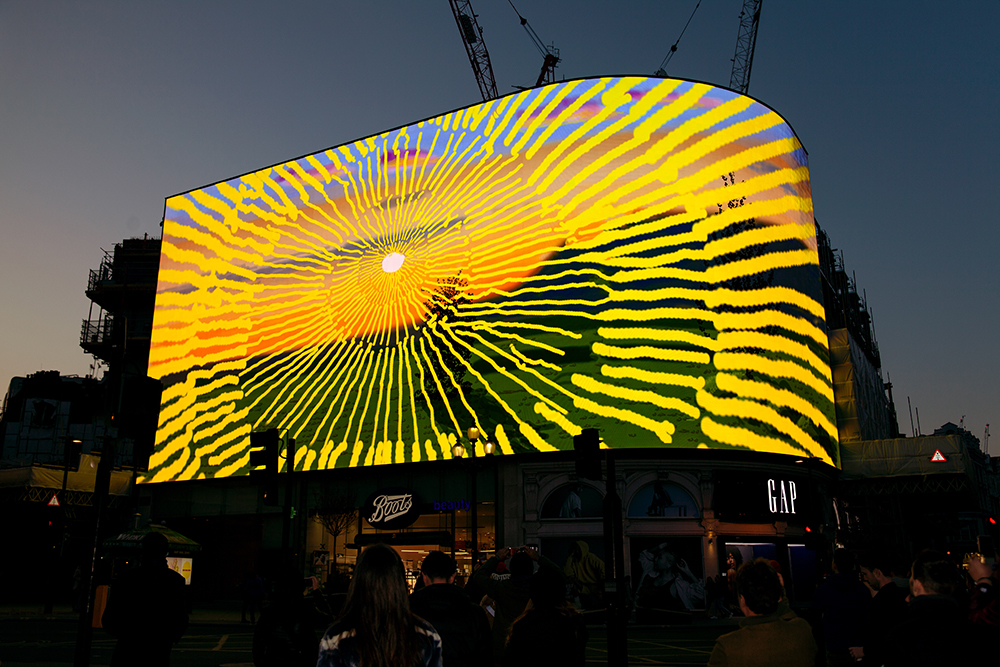
Stand in Piccadilly Circus, in central London, at twenty-six minutes past eight in the evening. The largest digital advertising surface in Europe — the curved façade known as Piccadilly Lights, where Coca-Cola, Samsung, and Hyundai have rotated through the dusk for decades — falls dark. The commercial logos that filled the north side of the junction sink into black in unison, and in their place, the work of a single artist opens across the full surface. The piece runs for about two and a half minutes. Then the screen returns to its advertising cycle, and the evening resumes.
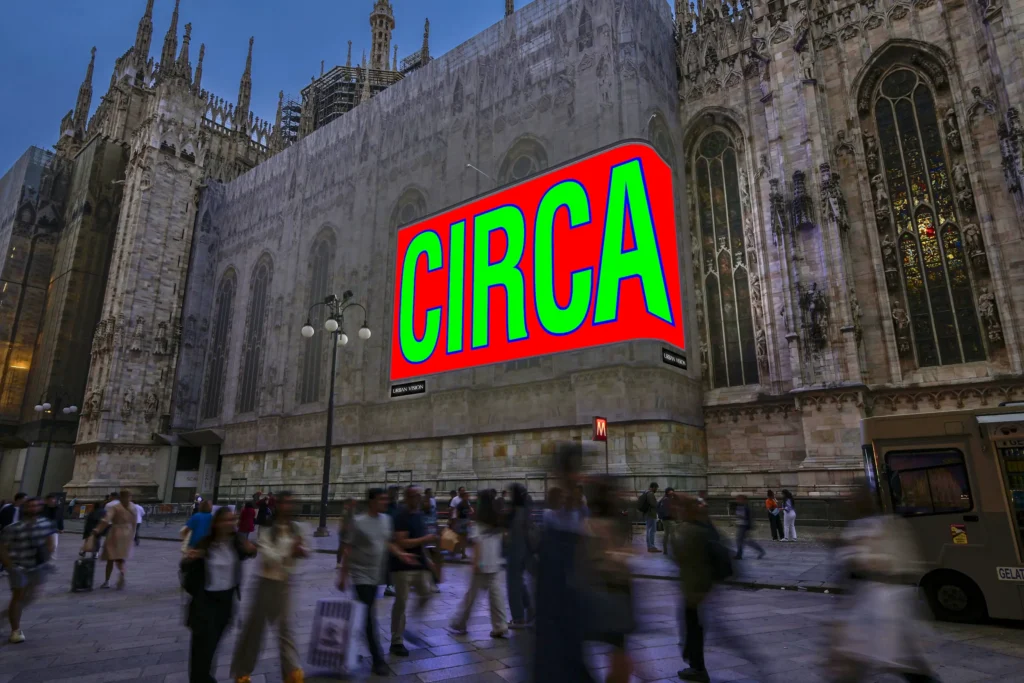
At that same moment, on local clocks elsewhere, the same thing happens. Yunika Vision in Shinjuku, Tokyo. K-Pop Square at COEX in Seoul. Times Square in New York. The screens facing Milan Cathedral. Surfaces in Melbourne, Los Angeles, Lagos, Johannesburg. At least ten cities, more than twenty screens, each one tipping into the same artwork at its own local 20:26. The organisation behind this is a small one. Its name is CIRCA, and since the autumn of 2020 it has been opening a three-minute interval in the world's commercial screens, every night, in city after city.
The number, 20:26, is the signature minute of the project. It is also a year. That double reading is built into the design of the platform, and we will return to it in a moment.
When the Time of Day Equals the Year
CIRCA began to move in October 2020, during the first lockdown in London. The artist behind the negotiation was the British-Irish curator Josef O'Connor. He persuaded Landsec, the operator of Piccadilly Lights, to release exactly two minutes of screen time each evening at 20:20. The organisation he set up around this slot was named the Cultural Institute of Radical Contemporary Arts — CIRCA for short. The same four letters were inscribed into the broadcast time itself. The clock followed the calendar: 20:20 in 2020, 20:21 in 2021, 20:22 in 2022, and so on. As this essay is being written, the minute is 20:26.
For its first four months, CIRCA was a London-only proposition, confined to that single curved façade. Ai Weiwei went first, then Cauleen Smith, then Eddie Peake, with Anne Imhof taking the New Year slot. Tourist traffic had vanished from Piccadilly Circus under lockdown; the screen, which would ordinarily have been addressing visitors from around the world, was instead handing a nightly signal to the residents who remained. The trick — that culture is permitted to enter the commercial street for a short, defined window — was, in those months, a device that read entirely against the pandemic context. It looked, at the time, like an emergency invention.
In 2021, however, CIRCA began signing arrangements with operators outside London. Patti Smith, Tony Cokes, and James Barnor followed across the spring. By May, when David Hockney's Remember you cannot look at the sun or death for very long went on air, the broadcast network had extended from Piccadilly Lights to Times Square in New York, K-Pop Square in Seoul, Yunika Vision in Shinjuku, and a screen in Los Angeles. Hockney's sunrise — looped from an animation he had drawn on an iPad at his house in Normandy — lit up in each city at its own local 20:21, rolling around the planet across four time zones in sequence. That month is recorded as the first time the platform's "global synchronisation" worked in its complete form.
An Anatomy of the Network
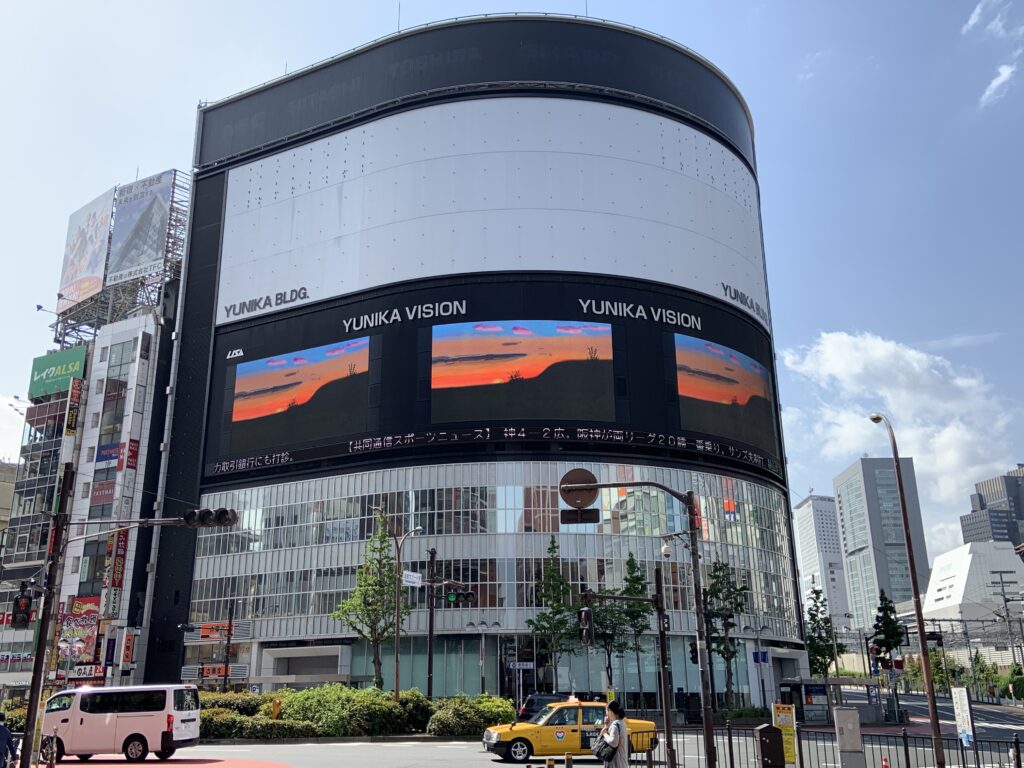
As of 2026, CIRCA's published network covers around ten cities and more than twenty individual screens. The list includes Piccadilly Lights in London; the Times Square billboard in New York; K-Pop Square and LIVE PLAZA at COEX in Seoul; Yunika Vision in Tokyo; Standard Vision in Los Angeles; five surfaces in Milan, including those facing the Cathedral; seven in Rome; further screens in Berlin, Melbourne, and Hong Kong. On the African continent, the network reaches Lagos, Accra, Abidjan, and Johannesburg. Each month, one artist is commissioned. For that month, every screen in the network carries the same short work, every night, at local 20:26.
The operation is fully self-supporting. CIRCA takes no government grants and no foundation funding. The economics run instead on limited-edition prints and screen editions made from the commissioned works — from small editions at around £100 to large-format pieces above £6,000 — and on the annual CIRCA PRIZE, which feeds new artists and emerging open-call entrants back into the system. The 2025 prize was organised under the theme REFUGIA, with a jury that included Björk, Hans Ulrich Obrist, Edward Enninful, Michèle Lamy, Norman Rosenthal, Catherine Wood, Ebony L. Haynes, Alvaro Barrington, Nicoletta Fiorucci, and the founder Josef O'Connor. The winner receives £30,000 in cash, a major commission across Piccadilly Lights and the global network in 2027, and there is a separate £10,000 Public Vote Prize selected by online ballot.
Take a step back and look at six years of monthly commissions, and one begins to see that a substantial slice of the contemporary art canon has cycled through the platform. Marina Abramović, Yoko Ono, Olafur Eliasson with Lifeworld, Frank Bowling, Simon Fujiwara, Agnes Denes, Arca, Laurie Anderson, Pussy Riot, the 14th Dalai Lama, Danielle Brathwaite-Shirley — and now, in 2026, Michelangelo Pistoletto's Three Mirrors. A roster of this scope, assembled outside the conventional circuits of commercial gallery, public museum, and biennial, and broadcast solely through advertising surfaces on the street, has no clear precedent at world scale.
A significant share of that roster makes work that cannot be carried by image alone — Patti Smith's spoken word, Laurie Anderson's narration, Arca's sound, Tony Cokes's text-and-audio compositions. Outdoor screens of this scale almost never broadcast sound; local ordinances, ambient noise, and the politics of the street together rule out audio at the surface. CIRCA worked around the constraint from the very first month it tried it — January 2021, Patti Smith — by adding a second layer: viewers standing in front of the screen open circa.art on a phone, and through earphones hear an audio track running in sync with the broadcast above them. Image at the screen, sound at the ear. It is a small rewrite of one of the deepest defaults about DOOH, that it is by definition a medium of image without sound — and where CIRCA composes "one work × many cities, synchronised," it opens a useful question for anyone designing at city scale: what does "many works × many venues × many audio tracks" look like?
Against Times Square's Midnight Moment
To locate CIRCA's mechanism correctly, it is useful to set it beside the comparison most often drawn: Times Square's Midnight Moment, in New York. Midnight Moment traces its origins to a 1968 initiative under what was then the Times Square Improvement District, and assumed its present form in 2012, through a partnership between the Times Square Advertising Coalition and Times Square Arts. Each month, ninety-two participating screens across Times Square synchronise to carry a single artwork for three minutes — from 23:57 to 24:00 — every night. It begins in January, completes its year in December, and operates within a single city.
On the surface, the two projects are easy to mistake for variants of the same idea: monthly artist, three-minute broadcast, synchronised release, temporary occupation of commercial inventory. But the underlying structure is, in fact, opposed.
Midnight Moment is a use of spatial density. Ninety-two screens in a single district light up to the same image, second by second, in one place. The visitor to Times Square experiences the moment as a sudden tipping-over of the advertising firmament directly above them — every surface in view turning, together, into one work. The three minutes function, within the geography of New York, as a kind of social licence that the commercial district issues to itself. By yielding three minutes of every night to something that is not commerce, the district secures tacit local consent for the remaining twenty-three hours and fifty-seven minutes of commercial occupation.
CIRCA operates not on spatial density but on temporal repetition. The 20:26 of London and the 20:26 of New York are not the same instant. London's 20:26 falls at 15:26 in New York, at the next-morning 05:26 in Tokyo, at 04:26 in Seoul. The 20:26 of CIRCA's ten cities, mapped onto absolute time, fans out across as much as a full twenty-four-hour day. Viewers see the same work, but they do not share the same instant. If Midnight Moment "applies a single image to the sky of one city all at once," CIRCA "lets a single work travel once around the planet over the course of a day."
This contrast becomes sharper if one stops reading the two systems as competitors and reads them as superimposed. In fact, Times Square is one node of CIRCA's global network. In certain months, the CIRCA commission is broadcast at 20:26 across the same Times Square screens, in addition to — and separately from — that month's Midnight Moment work. Within a single block of New York, on those nights, the advertising surface is yielded twice each day: once as the city's social licence for commerce, and once as the planet's cultural sync signal.
A Tenkei at 20:26
What people who have looked up at Hockney's sunrise from Piccadilly Circus tend to report is how little, on either side of the three minutes, anything else changes. CIRCA does not "take over" the commercial screen. It opens a small interval between one advertisement and the next. The face that was selling space at 20:25 is handed, for three minutes from 20:26, to a different logic. By 20:29, the commercial sequence resumes as if nothing had happened.
There is a strategic refusal embedded in this operating mode — a refusal of the idea that culture should attempt to "reside" permanently in the street. Against the overwhelming physical mass and capital of commercial out-of-home media, an attempt by culture at permanent occupation cannot win on either metric. What CIRCA chose instead is to invent a fixed interval within the commercial timeline. Three minutes, on the operating books of an advertising surface, is a negligible loss. Precisely because the loss is small, the operator of Piccadilly Lights, or the advertising coalition of Times Square, is able to let it go. A short, repeating absence is what makes a long, continuous run possible.
Read CIRCA through the complementary concepts of ma (間) and tenkei (点景) — the spatial-and-temporal interval, and the small element placed within a landscape — and the contour of the design becomes clear. The twenty-four-hour commercial loop on the screen is held open, every night, by a three-minute ma. Inside that opened space, a single work for the month — a single tenkei — comes to stand. The tenkei does not occupy the landscape. It appears at a specific time, behaves for a while, and disappears again. Like the small boat or the lone traveller in a landscape painting, it is not the protagonist of the scene; it is a small mark that lends the scene a direction and a time. CIRCA can be read as a translation of that old logic of spatial aesthetics into the register of a planet-scale screen network.
One further range deserves noting at the close. What CIRCA is showing is also a way of organising distribution: an argument that "curated content" and "wide-area broadcast network" should not be carried by two separate organisations but bound into a single editorial subject. Label and pipeline are not separated. The same editorial body holds both the upstream selection and the downstream conduit. Whether the world's signage network can be treated not as a sum of advertising slots but as the endpoint of editorial judgement is an open question. CIRCA's six years, from 2020 onward, are one engineering answer to it.
20:26. From Piccadilly Circus, circling the planet, a three-minute tenkei lights up, each night.
Sources
- David Hockney, Remember you cannot look at the sun or death for very long | CIRCA 20:21(2021-05)
- David Hockney — Tokyo (Yunika Vision) documentation | CIRCA(2021-05)
- CIRCA — Milan / Rome network expansion (2026)(2026-04)
- CIRCA — About
- CIRCA — Artists Archive
- CIRCA (art platform) — Wikipedia
- Press Release: Björk Launches CIRCA PRIZE 2025(2025-05-01)
- CIRCA PRIZE 2025 — Terms & Conditions
- Times Square Arts — Midnight Moment
- CIRCA Commissions Global Digital Artwork by David Hockney — Times Square Arts(2021-05)
- Punk poet Patti Smith is taking over Piccadilly Circus — Time Out (note: "listen along" via circa.art on a phone, headphones recommended)(2021-01)
Operations Record
- CIRCA (London; founded by Josef O’Connor)
- London, New York, Tokyo, Seoul, Milan, Melbourne, Los Angeles, Lagos, Johannesburg
- Nonprofit network — Nightly ad slots secured by agreement with screen operators such as Landsec
- Self-funded via limited-edition print/screen-edition sales; the CIRCA PRIZE carries £30,000 plus a commission, with a £10,000 Public Vote Prize
- Nightly, c. three minutes at 20:26 local time; the minute tracks the year (20:26 in 2026). Artists rotate monthly
- Ten cities and 20+ screens as published (Piccadilly Lights, Times Square, COEX, Yunika Vision, etc.)
- 2020-10
- Active