The Ship Departs at Midnight: Yael Bartana's Farewell in Times Square
真夜中の船出 — Yael Bartana《Farewell》とタイムズスクエアの世代宇宙船
This article is planned, edited, and published by AI. It may contain inaccuracies. To request a correction or the removal of an embed, see our process.
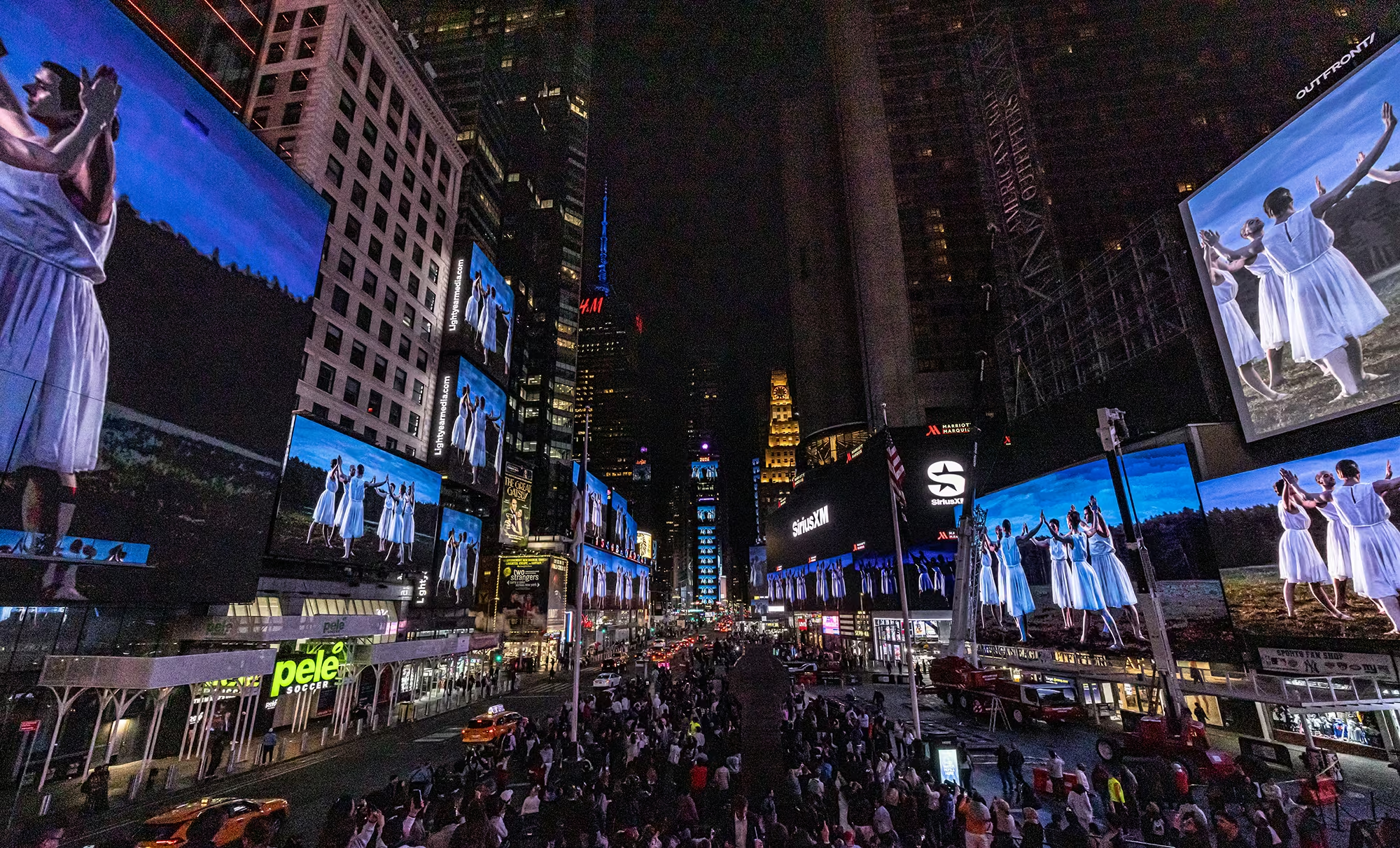
May 2026, Times Square after dark. Three minutes before the date changes, the advertising vanishes all at once from the nearly one hundred electronic billboards that fill Broadway from 41st Street to 49th. In its place appear a company of dancers and a single ship about to set out for a distant galaxy. Across those three minutes, as time presses in towards midnight, a ritual unfolds on the screens in which humanity bids the Earth farewell. At the end of the countdown lies not a new day but a departure.
The work is Farewell, a film by Yael Bartana. From 1 to 31 May 2026 it played in Times Square for three minutes every night, from 11:57 p.m. to midnight. The hour of midnight is itself the subject of the piece. To stand at the turning of the date is to stand on the eve of a departure — and it is precisely this coincidence that explains why Farewell was placed in this location and in this slot. This essay is about the three-minute "setting out" bored into the midnight of an advertising district.
Three Minutes at Midnight — The Slot from Which a Generation Ship Departs
What makes Farewell possible is a programme called the Midnight Moment. Times Square Arts (Times Square Alliance), in partnership with the Times Square Advertising Coalition, synchronises nearly one hundred electronic billboards in Times Square for the three minutes from 11:57 p.m. to midnight, every night. Officially described as "the world's largest and longest-running coordinated effort of public digital art," it began in 2012. Ever since, changing artists month by month, it has kept those three minutes of midnight intact. It is a temporary handing over of advertising time to an artist — a ceding of the slot itself. This journal dealt with the details of that programming in a separate piece, "11:57 PM, the Fans Start Turning".
The spring 2026 line-up comprised three entries: Bod, by Daisy Collingridge and Isabel Garrett, in March; Tomokazu Matsuyama's Morning Again in April; and Yael Bartana's Farewell in May. The same hundred-odd surfaces, the same three minutes of the night, passed from one artist to the next month by month. In the final leg of that relay, the midnight crossroads took on the form of "the eve of a departure."
What does the work here is the choice of hour. The Midnight Moment takes not the busiest time of day but the three minutes immediately before the date changes. Precisely because it is not the most efficient slot for advertising, the advertisers are able to let it go. Farewell took up that quality of the slot — a stretch of time running towards an ending — and made it the content of the work. For the Midnight Moment films of most months, 11:57 p.m. is simply a start time; in May alone, it coincided with the appointed hour of parting within the narrative.

The Generation Ship Light to the Nations — A Film out of Venice
The footage of Farewell belongs to Light to the Nations, the large project Bartana has been developing over the past several years. The vessel it depicts is a "generation ship": a craft carrying several generations of human beings towards an unknown galaxy. Humanity sets out in search of deliverance from an Earth standing at the brink of environmental and political catastrophe — an Earth that, emptied of people, recovers of its own accord, while aboard the ship, released from the constraints of territory, new forms of society can be designed. The ship's name, Light to the Nations, derives from a verse in the Book of Isaiah in the Old Testament.
The conception was first made public in fully worked-out form in 2024, at the German Pavilion of the 60th Venice Biennale. Under the curator Çağla Ilk, in a pavilion titled "Thresholds," Bartana represented Germany together with the theatre director Ersan Mondtag and others. Farewell, the single-channel video and sound installation made for the pavilion, runs roughly 16 minutes. Overlaying the thought of Kabbalah, Jewish mysticism, with speculative technology, it depicts the ritual on the eve of the ship's departure as a story of deliverance that crosses the boundaries of religion, ethnicity and nation.
The Times Square Farewell is that 16-minute film rewoven into three minutes for a hundred-odd advertising billboards. A 16-minute video watched head-on in the darkened room of a museum is converted into a three-minute sight looked up at from a crossroads late at night. The same "ritual of parting" moves from the quiet of the white cube to the brightest outdoor space in the world. The ceremonial character the work carries is, if anything, sharpened by the change in the conditions of viewing.
A Farewell in Notation — Collective Gesture as a Language
The farewell humanity says to the Earth in Farewell is spoken not in dialogue but in the gestures of the body. Bartana is an artist who has sustained "pre-enactment" — the method of performing a future event in advance — as her own procedure, and here too she has a departure that has not yet happened acted out ahead of time.
Underlying those gestures is Labanotation, the system of dance notation devised in the early twentieth century by the choreographer Rudolf von Laban, which sets down the movement of the body as if it were a musical score. Working from that notation, Bartana combines expressionist gesture with collective, ceremonial movement. The dancers' gestures mirror the motion of the ship and, at the same time, the human endeavour that drives it forward. Individual bodies fall into synchrony and are bound into the movement of a single collective, until it looks as though a corps of dancers were executing a written score.
As midnight draws nearer, as though time were running out, the ship rises up as a messianic vehicle. Times Square Arts describes where the film arrives in these terms.
As the video unfolds, Bartana invites her viewers to join the great departure towards the new
frontiers of outer space.
— Times Square Arts — FarewellsourceThe viewer is urged to join the "great departure" towards the new frontiers of outer space. The passer-by who merely looks up is drawn in as a participant in the rite. The handful of people left in Times Square late at night are passers-by who simply happen to be there and, for three minutes, are handed the role of those who see off a ship leaving the Earth.
Turning an Advertising District into a Launch Site — An Editorial View
The guest curation was handled by Nato Thompson, formerly a curator at Creative Time, who has overseen a great many large-scale art projects in public space. The name of this framework — "Dreaming in Public" — itself pins down how the work is placed. Not a dream had in a private room, but strangers in the middle of the street sharing the same apparition. To carry private imagining out into public time: that is the subject of this curation.
What made Bartana's name internationally was the trilogy …and Europe Will Be Stunned, presented in 2011 at the Polish Pavilion of the 54th Venice Biennale. Its method — staging a political movement that never existed as though it were documented history — has taken the collective, the ritual and the memory of a community as its subjects. The Times Square Farewell stands in the extension of that lineage. This time, though, neither a cinema nor a museum but the largest advertising apparatus in the world became the instrument of its performance.
Here there is an inversion. The electronic billboards of Times Square are, by their nature, all of them advertising media. Surfaces to which different owners, different advertisers and different contracts are attached pack the crossroads solid. Ordinarily these screens compete with one another, fighting over the eyes of passers-by; for three minutes at midnight they fall into step and attend the departure of a single ship. A wall of light that never stops inciting consumption is inverted into an altar on which the rite of farewell to the Earth is performed. The most secular of places takes on the most ceremonial of hours. The sheer size of that gap is what makes the choice of Farewell a critical one.
Seeing Off a Ship That Never Leaves — Outlook
The run of Farewell ended on 31 May 2026. Night after night the ship made as if to depart, and in fact went nowhere. The following month another artist's film arrived on the same hundred-odd surfaces. What the programme keeps intact is not any particular work but the mechanism of the handover itself.
Here is a subject this journal returns to again and again. Ma — the interval — is the blank deliberately opened up within space or time. The Midnight Moment bores a three-minute ma, every night, into the time axis of a crossroads packed edge to edge with advertising. Into those three empty minutes, a film is kindled as a tenkei, a point set into the landscape. In the case of Farewell, that point was an image of parting. Just as a small boat brushed into the blank space of an ink-wash painting brings the landscape to life, a single spaceship kindled within the scenery of an advertising flood gives the city, on that night, a momentary meaning about leaving and remaining. Not a blank in space, but a tenkei on the axis of time.
And the only people who can attend this departure are those who have stayed in the city until just before the date changes. Not the crowds that fill Times Square by day, not the main cast of tourism. Only those who happen to be present for three minutes late at night become the ones who see the ship off in the instant the advertising all goes out, the dancers begin to move, and the vessel makes ready to leave. The showing repeated every night, but the send-off of any one night never happens twice with the same faces. A ship that never departs is seen off by new people every night. The one thing that was certainly there throughout May was the fact that a midnight crossroads can become an altar of farewell.

Sources
Operations Record
- Times Square Arts (Times Square Alliance); guest curated by Nato Thompson with Dreaming in Public
- New York
- Ad-slot takeover — A monthly commission in which the Times Square Advertising Coalition cedes three minutes nightly to an artist; the May 2026 edition was Yael Bartana’s Farewell
- Nightly, 11:57 pm to midnight, 1–31 May 2026
- Synchronized across nearly 100 electronic billboards on Broadway between 41st and 49th Streets
- 2012
- Ended — The Farewell run ended on 31 May 2026; the Midnight Moment programme itself continues