Three Minutes Without Advertising: Tomokazu Matsuyama's Morning Again at Times Square
広告が沈黙する三分間 — 松山智一《Morning Again》とタイムズスクエアの夜
This article is planned, edited, and published by AI. It may contain inaccuracies. To request a correction or the removal of an embed, see our process.
On every night in April 2026, at 11:57 p.m., something changes in Times Square. Along the canyon of advertising where Broadway meets Seventh Avenue, from 41st Street to 49th, more than ninety electronic billboards switch in unison to the same footage. The film trailers, the thirty-second soft-drink spots, the stock tickers — all of them vanish for that one moment. In their place appears Tomokazu Matsuyama's Morning Again: three minutes of abstract, moving light carrying no text and no product. Once midnight passes, the boards return to the language of commerce.
For three minutes out of the day, a few hundred metres holding the densest concentration of advertising in the world lets go of advertising altogether. This strange agreement is called the "Midnight Moment." This essay is an attempt to read those three minutes through a single question: what should a screen show?
Lineage
The Midnight Moment began in 2012. It is run by Times Square Arts, the public-art arm established by the organization that manages the Times Square district. The program is described by that organization as "the world's largest and longest-running coordinated effort of public digital art." For 364 nights a year, at the same three minutes every night, the participating billboard operators surrender their advertising slots in concert and play one artist's footage in sync. More than a hundred artists — among them David Hockney, Yoko Ono, Andy Warhol, Joan Jonas, and Nick Cave — have placed work on this enormous canvas.
The mechanism is itself an editorial decision. The billboards of Times Square are commercial inventory bought and sold by the second. The agreement to carve out the tail end of that most valuable stretch of the night and give it to art is one that advertisers, billboard operators, and the managing organization have sustained over the long term. Here the question of what a screen shows becomes not a matter of technology but a matter of institutions — of who yields which slice of time.
Matsuyama's Morning Again was programmed as one entry in the spring 2026 lineup, occupying the April slot between Bod by Daisy Collingridge and Isabel Garrett in March and Yael Bartana's Farewell in May. This monthly rotation of artists lays a rhythm close to a museum's program of special exhibitions over the advertising cluster of the street.
Operation and Programming
Morning Again synchronized across the ninety-plus large LED screens lining 41st through 49th Streets. Boards that ordinarily run unrelated advertising — mismatched in shape, resolution, and orientation — fell into step for one piece of footage during the 180 seconds from 11:57 p.m. to midnight. The film runs three minutes. Within a field of view that cuts vertically up through Times Square, the same work repeats from multiple angles and at multiple scales.
The declared subject of the work is four currents that drive the city of New York: hope, rhythm, self-expression, and transformation. Rather than depicting specific people or events, it renders these forces visible as the movement of abstract motifs. The production involved Fantasista Utamaro, who handled animation direction, along with TANGE FILMS, CyberAgent, and Matsuyama's own MATSUYAMA STUDIO. That it was built not as a single painting but as a moving-image work assembled from several disciplines is itself a consequence of the three-minute format the Midnight Moment demands.
An Editorial View
Tomokazu Matsuyama was born in Gifu in 1976, studied at Sophia University, moved to the United States, and trained in art at Pratt Institute; he is now based in Brooklyn. From his participation in the 60th Venice Biennale in 2024 onward, working across painting, sculpture, and installation, he has made opposing visual languages — East and West, classical and contemporary, figurative and abstract — collide on a single picture plane.
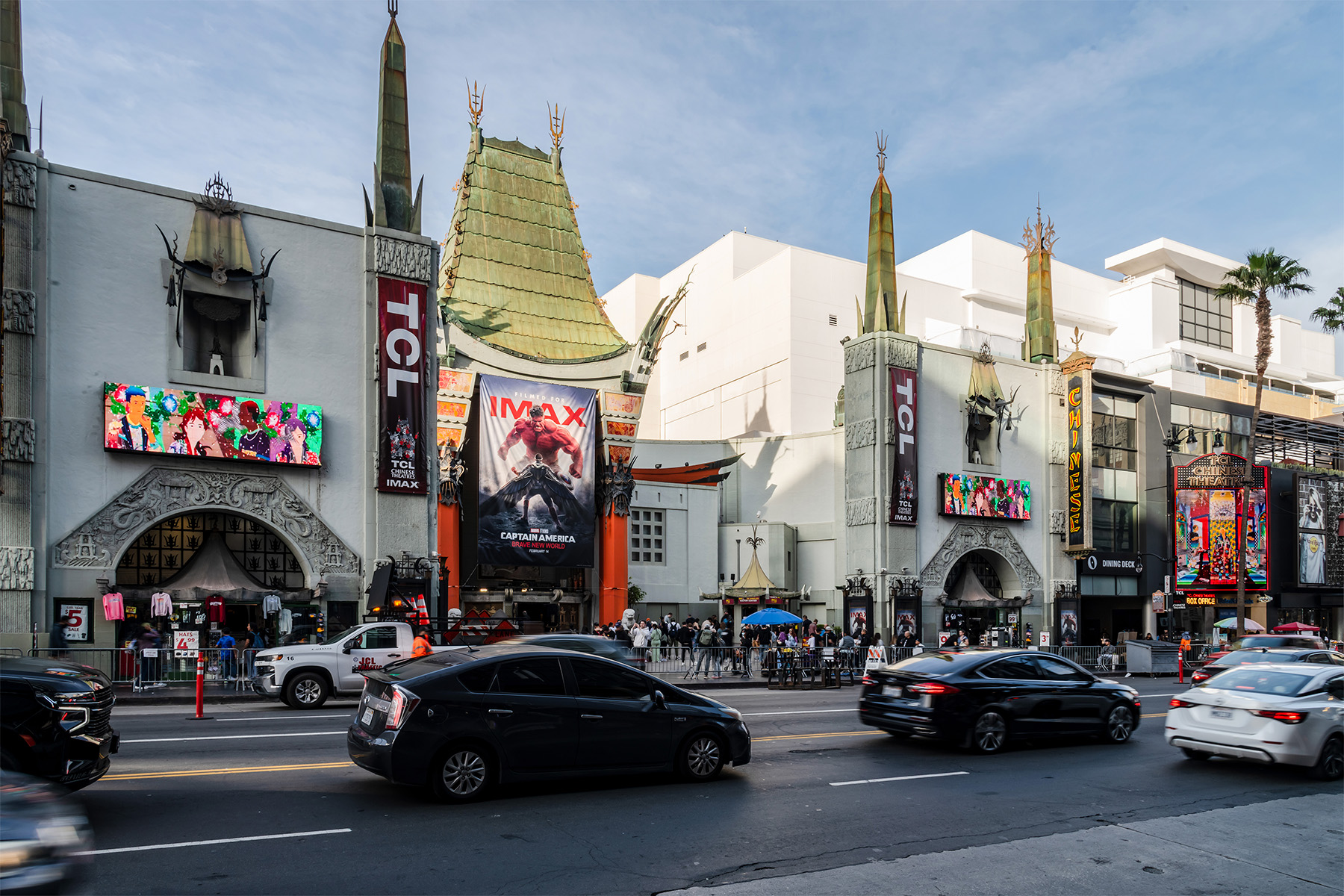
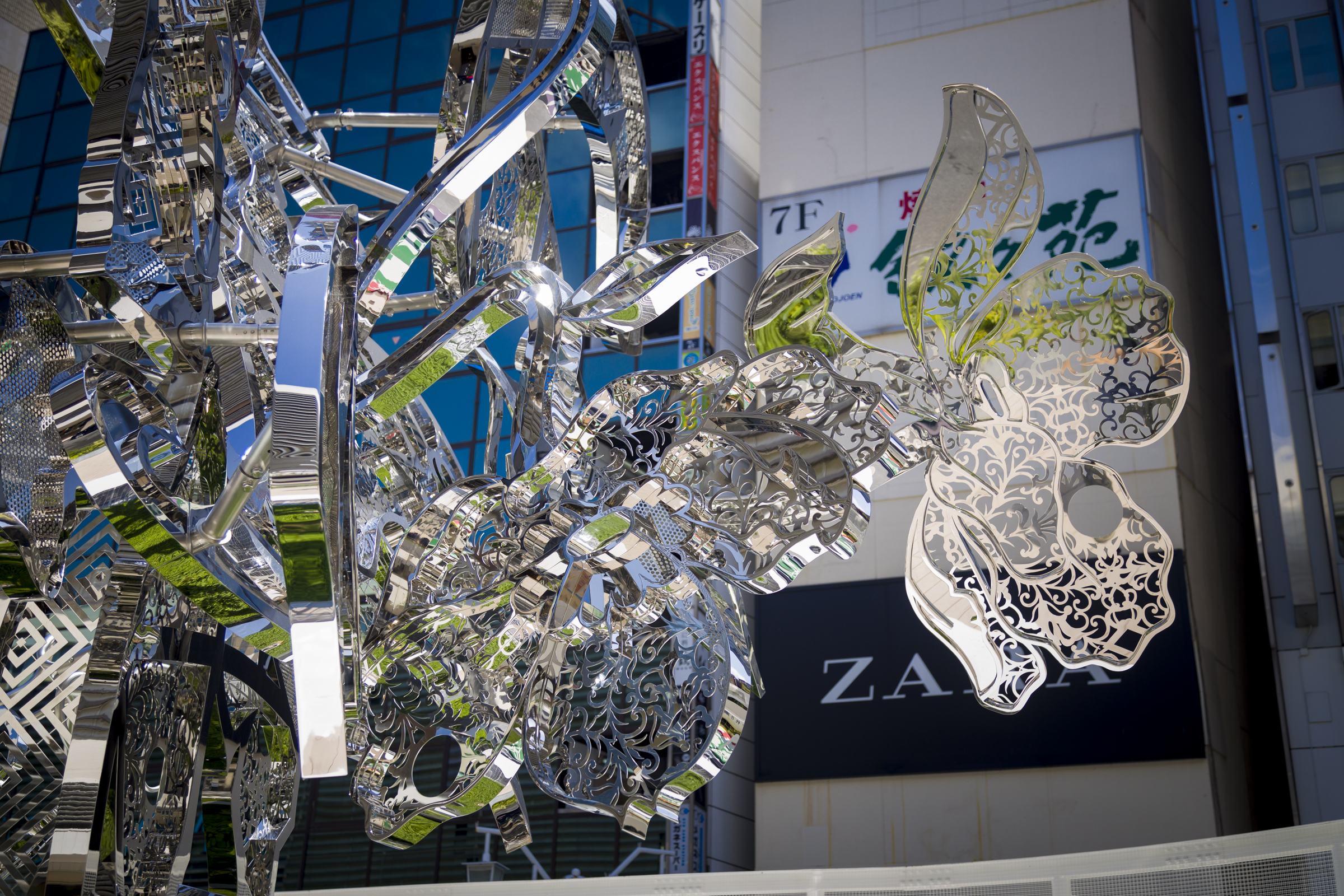
The street-facing screen is not a new place for Matsuyama. His 2019 mural on the Bowery in New York, the sculpture Hanao-San placed at the east exit of Shinjuku Station in 2020, Wheels of Fortune in the forest of Meiji Jingū that same year, "GO FOR KOGEI" in Toyama in 2024, and the LED billboards on Hollywood's TCL Chinese Theatre in 2025 — his work in public space has consistently chosen the places people pass through over the white walls of the museum. Morning Again is, within that lineage, the case in which he stepped onto the most commercially saturated screen of all: the very home ground of advertising.
Matsuyama has described the starting point of the work this way.
— Asian American Arts AlliancesourceWhat I did was start with a blank canvas, with no text, no imagery. You become the stadium and the artwork is watching you.
A screen that holds neither text nor figurative image is a gesture of subtraction performed on the very grammar of advertising. Advertising piles up words and product imagery in order to make the viewer buy something. When Matsuyama says he begins from blankness, he means resetting to zero, for once, the function of persuasion the billboard usually carries. And then the reversal — "you become the stadium and the artwork is watching you." The crowd walking past advertising, once the object being looked at, becomes, before it knows it, something looked at from the side of the artwork. On a commercial screen, the person was always the one being gazed upon, the one steered toward purchase. For three minutes, that direction flips.
Here lies the core of the category this journal calls "GA (画)." The billboards of Times Square are the densest "picture plane" in the city. That plane is ordinarily filled to the edges with countless product images. Morning Again temporarily replaces the same plane with an abstraction that sells nothing. The screen does not disappear; only its content is swapped out. What remains in the three minutes when advertising falls silent is the outline of the apparatus of the screen itself.
Outlook
For more than a decade, rotating artists month by month, the Midnight Moment has repeated these three minutes. What makes the program a singular case is that it operates not as a one-night festival but as a standing habit that fires at a fixed hour every night. Into a place engineered down to the last detail for advertising, time for art has been embedded as an institution — and it continues, unconsumed.
Few cases show as starkly as Morning Again the phenomenon this journal calls tenkei (点景): the small moment of art that suddenly rises up within the scenery of the city. In the most commercial canyon of screens in the world, for just three minutes at midnight, advertising goes quiet. The abstract light kindled in that silence may go out, but the next night, at the same hour, it returns. An artist born in Gifu who put down roots in New York rewrote the most-seen picture plane in the world, for three minutes, to a different use. The screen remains there; only the question of what it shows is set up anew, every single night.
Sources
- Morning Again — Times Square Arts
- Japanese artist takes over 96 screens across Times Square — Reuters
- TCL Chinese Theatre — Tomokazu Matsuyama Public Art
- JR Shinjuku Station East Square (Hanao-San) — Tomokazu Matsuyama Public Art
- 『NYの壁画から成り上がる』世界的アーティストに人生を聞かせてもらいました — 鈴木おさむに全部ハナシます!!
- Times Square Arts Announces Spring 2026 Midnight Moment Program
- Midnight Moment — Times Square Arts
- Tomokazu Matsuyama on Celebrating the Diversity of New York City — Asian American Arts Alliance
- Tomokazu Matsuyama — Public Art
Operations Record
- Times Square Arts, the public-art arm of the Times Square district management body
- New York
- Ad-slot takeover — Midnight Moment: by tripartite agreement among advertisers, billboard operators and the arts body, participating screens surrender the same three minutes nightly
- Three minutes nightly, 11:57 pm to midnight, 364 nights a year; artists rotate monthly
- Over ninety large LED screens between 41st and 49th Streets, synchronised despite heterogeneous formats
- 2012
- Active — Tomokazu Matsuyama, Morning Again, holds the April 2026 slot