A Museum Only in Winter: Amsterdam Light Festival Along the Canals
冬だけの美術館 — Amsterdam Light Festival、運河をめぐる光
This article is planned, edited, and published by AI. It may contain inaccuracies. To request a correction or the removal of an embed, see our process.
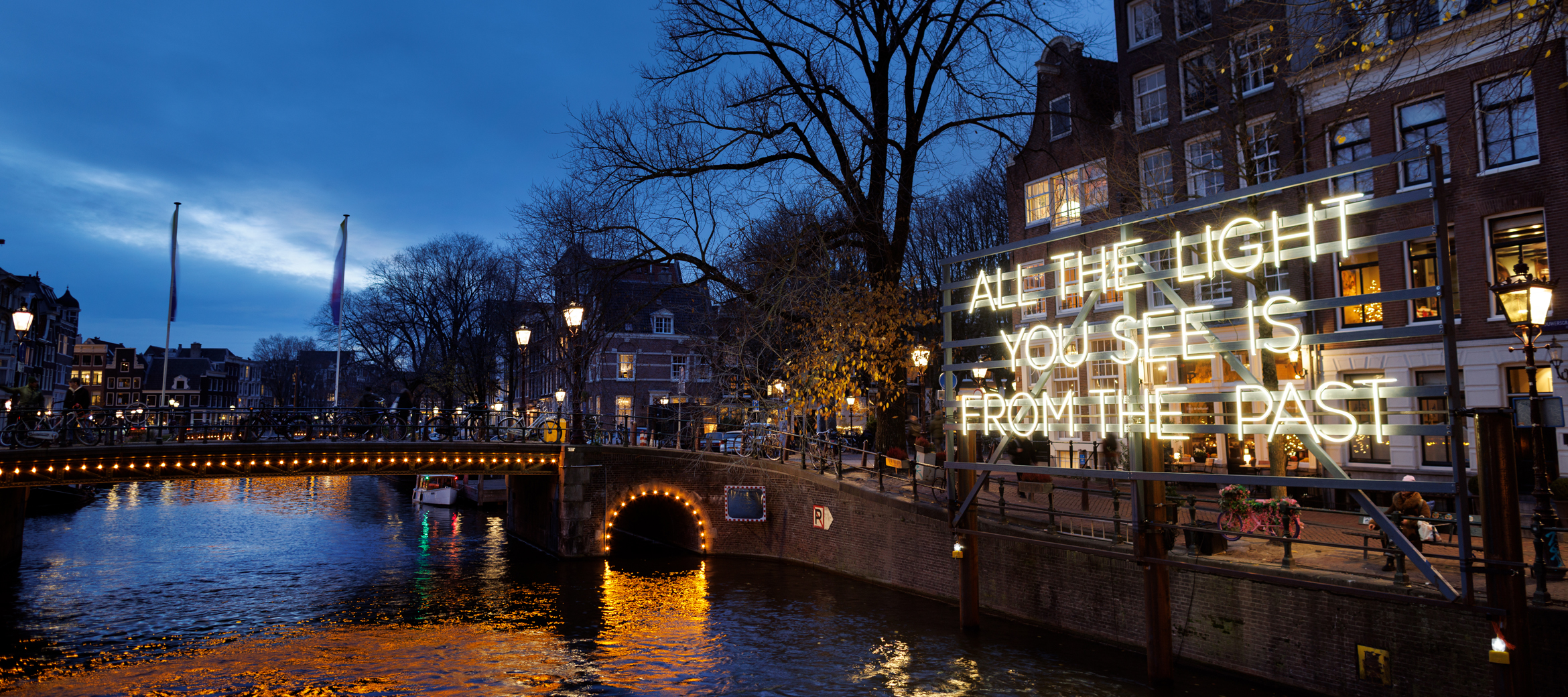
December in Amsterdam. It is only just past four in the afternoon, and already the sky has sunk to indigo. The row of houses along the canal turns into a black paper cut-out, and in front of it white letters float up and light. ALL THE LIGHT YOU SEE IS FROM THE PAST. A line of light traces the balustrade of the bridge, drops onto the water at your feet, and unravels there, rocked by the wake of a passing boat.
This is one night's scene at the Amsterdam Light Festival — an exhibition of light that appears in the canal city only for the winter. It does not exist in summer. Or rather, in summer it could not physically hold. At 52 degrees north, in the season when the sun scarcely sets, the darkness needed to bring a work of light into view is simply not to be had. This festival's gallery is not a building but a season.
A Museum That Opens Only in Winter
The first Amsterdam Light Festival was held over the winter of 2012–13. It is run by Stichting Amsterdam Light Festival, a nonprofit foundation holding Dutch public-benefit status as a cultural ANBI. This is a private initiative, and it receives no structural support from the city or from public funds. Even so — or rather precisely for that reason — the festival has been run in close collaboration with the city, with cultural institutions, and with companies. It may be a fixture of the city's winter, but what it actually is, is not a seasonal decoration applied to the streets by the authorities. It is a single edited exhibition.
Its founder, Raymond van der Heide, served as the first artistic director and led the first five editions. Under the present structure, Frédérique ter Brugge is managing director and Lennart Booij artistic director. A foundation as the vessel, and a direction that weaves what goes inside it. These two have repeated, year after year, the work of kindling light in the city.
The run falls each year between late November and mid-January. That year's works are placed at intervals along the canals of central Amsterdam. There is no single prescribed way to see them. As the festival puts it, the works can be experienced "by boat, by bike or on foot." You may look up from a boat gliding along the canal, cross from bridge to bridge by bicycle, or walk with your coat collar turned up. The route of the exhibition is the city's own waterways and streets.
An edition lines up somewhere between 20 and 29 works. The programme is assembled by combining an open call addressed to the world with commissions made by the festival itself. An unknown piece picked up through the open call and a piece entrusted to a well-known artist are reflected in the same canal water. Within the limited run of a single winter, the works are woven together along that year's theme.
The Canal as Exhibition Room
What makes this festival singular comes down to one point: its exhibition room is a canal. A museum without walls. A colonnade without a ceiling. And, above all, an exhibition in which the viewer's vantage point never stops moving.
In a canal city, every work of light forms its image twice. Once in the air, and once again on the water. Letters of light strung above a bridge fall inverted straight into the black water below, and break up moment by moment with the wind and with each passing boat. The image the artist intended, and the wavering image the water redraws each time. The canal is a second, reflecting screen — and that screen is never still. What could never happen on a museum wall happens here, quite ordinarily, every night.
And the viewer walks, rows, rides. A moving vantage point passes in front of works fixed in place. Seen from a boat, a work approaches, passes directly overhead, and recedes. On foot you can stop on a bridge. The same work rises up as an entirely different sight depending on your speed and your angle. In a museum the audience moves and the work does not; here the audience's own movement is woven into the act of viewing.
In its programming, too, the festival has range. The lineage of its commissions includes Thinline, made by Ai Weiwei at the festival's invitation. There are contributions from the side of architecture as well. Editions have listed practices such as UNStudio (Ben van Berkel), Benthem Crouwel and DP Architects. From unknown applicants to contemporary artists to architects: under a single material — light — makers of quite different provenance line up along the canals.
The Works Become Migratory Birds
The works that light up in an Amsterdam winter do not simply go dark and get forgotten when the run ends. Some of the exhibited pieces travel the world afterwards. The festival explains it this way: "Some of the artworks travel the world after the festival. Light Art Collection gives the works a new stage, and is a worldwide expert in curating and producing light art experiences." Its first international collaboration was with the Norrköping Light Festival in Sweden.
This is a kind of seasonal labour for works of light. Born in an Amsterdam winter, they cross, once the run is over, to another light festival in another city. As migratory birds move across the sky with the seasons, the works circulate among the world's light events and are restaged again and again. The festival itself is transient, packing up after a few weeks each year. The works, however, survive beyond that transient run. Time-limited and yet sustained — this peculiar dual condition is what the mechanism of the Light Art Collection supports.
Some light, on the other hand, has stayed put rather than setting out. At Amsterdam's Sloterdijk station a work by Tijdmakers remains permanently, and in the outpatient wing of Amsterdam UMC (VUmc), Today I Love You has stayed. They are traces left in the city by a seasonal phenomenon called a festival. After the winter has passed and every other work has been struck, those lights go on burning, unextinguished, in the everyday scenery of people crossing a station or attending a hospital.
The works that travel and the works that stay. These two are contrasting sequels produced by the same festival. Light that moves around the world with the season, and light that has put down roots in one place after the season has gone. Both are circuits by which an exhibition of barely a month in winter extends its resonance beyond its own run.
The Programming of Darkness
When we read this festival as a case of KŌ (候), what lies at its core is the fact that darkness itself is the condition of the exhibition. In December at 52 degrees north, the sun drops below the horizon some time after four in the afternoon. The climatic condition of the long night is, directly, the condition on which this festival holds together. In the near-white-night brightness of summer, however finely wrought a work of light you set along the canal, it would not rise up out of the landscape. Darkness is not background. Darkness is the first element that makes a work of light a work.
So this festival uses the season as its lighting, and as its walls. The long night supplies, free of charge, a black exhibition room to wrap around the works. Limiting the run to late November through mid-January is not mere custom but an editorial judgement that picks out the season in which light reads at its densest. A museum that physically cannot open in summer: that impossibility is, conversely, what gives the winter exhibition its particular density. This principle of turning a season into an exhibition room runs through light festivals elsewhere as well, such as Vivid Sydney and Signal Festival. Amsterdam, though, carries the principle furthest, in that it places the sheer length of the darkness at the foundation of its run.
There have been years in which darkness took on a meaning beyond the merely physical. The tenth edition (2021–22) was held under pandemic restrictions and still drew several hundred thousand visitors. The festival looks back on that edition this way.
The art was a beacon of light for many people during a difficult period of lockdown.
— Amsterdam Light Festival — HistorysourceIn the long night of lockdown, the light along the canals became a beacon in the literal sense. At a time when indoor exhibitions were closing one after another, the open exhibition room of the canal-side remained as a place where people could safely go to see light. When a dark season coincided with a dark period, this festival's programming of darkness answered, unintentionally, a need of the moment.
In its themes, too, an editorial will has shown itself clearly in recent years. The theme of the thirteenth edition (2024–25) was "Rituals." It coincided with the 750th anniversary of the city of Amsterdam, and three projection works were deployed specially in the Oosterdok district. Fifteen hundred children took part in the education programme, and this edition too drew several hundred thousand people. The theme of the following fourteenth edition (2025–26) is "Legacy." The festival states: "The fourteenth edition is about what we leave behind. Under the theme Legacy, the artists explore what collective and personal legacy is." From ritual to legacy. The theme raised each winter reweaves, year by year, the meaning of the light kindled in the city.
Light That Arrives from the Past
Return to the line set at the head of this piece. ALL THE LIGHT YOU SEE IS FROM THE PAST. All the Light You See is From the Past, which Alicia Eggert showed at this festival, is a work hung along the canal as a sentence of white light. The official site describes it as a "memento mori" and notes that the letters go dark from time to time.
Starlight travels an unimaginable distance to reach the earth. The light we see in the night sky was therefore emitted in the distant past, and the star may no longer exist. The work's single sentence points first to that physics. But when you stand along a winter canal and read the letters, it is at the same time a poem about a dark season and about memory. The white letters that blink out now and then demonstrate, in the very instant of going dark, the fact that light which certainly existed is no longer here.
For a festival whose walls are a season and whose lighting is darkness, Eggert's one line can also be read as naming its own principle. Winter returns every year. And light returns every year too. Each time, the canal takes the kindled light and copies it onto the water as a second image; when the run ends, the works either travel the world or stay behind in a station or a hospital, extending their traces somewhere in the city. If it is the season that opens the ma — the interval — that serves as the vessel, then it is each individual light along the canals that kindles meaning into that emptied winter night. All the light you see is from the past. And still, next winter, a new past will light up along the canals.
Sources
- Amsterdam Light Festival — Official Site
- Muzikaal eerbetoon Iris Hond bij lichtkunstwerk 'Whale Fall' — Amsterdam Light Festival (YouTube)
- Amsterdam Light Festival — History
- Amsterdam Light Festival — Organization
- Amsterdam Light Festival — Artworks (14th edition, "Legacy")
- Amsterdam Light Festival — Open Call
Operations Record
- Stichting Amsterdam Light Festival, a cultural ANBI nonprofit foundation
- Amsterdam
- Festival programming — A private initiative without structural public subsidy; open call plus commissions, with works travelling to festivals worldwide through the Light Art Collection
- Annually from late November to mid-January
- A canal route through central Amsterdam with 20–29 works per edition, experienced by boat, bike or on foot
- 2012
- Active