Making a Season on the Equator: i Light Singapore and the Planning Authority's Festival of Light
赤道の夜につくる季節 — i Light Singapore、都市計画庁の光の祭
This article is planned, edited, and published by AI. It may contain inaccuracies. To request a correction or the removal of an embed, see our process.
Late June 2026, and there is no light left along the waterfront of Marina Bay. Until a few days ago, rings of light pulsed across the lawns and people walked the promenades. Every night, for three hours after sundown, the bay became a single exhibition hall. That light was struck and the ordinary night came back exactly five days ago.
For twenty-four days, a city on the equator had a "season." i Light Singapore ran from 5 to 28 June 2026 and closed on 28 June. On 3 July, as this piece is written, the bay is quiet again. But there is something worth thinking through backwards from that quiet. At a latitude of one degree north, this city has no long winter night — so why, and how, does it manufacture every year a season called a "festival of light"? The question touches on an urban technique: a city without seasons inventing one.
The Planning Authority's Festival
i Light Singapore was conceived in 2010. By the official account, it began as one of several initiatives intended to inject life into Marina Bay. The purpose was clear from the outset — to give people a reason to gather, to walk, and to linger in this new waterfront district, itself the product of reclamation and redevelopment. Light art was chosen as that reason.
What deserves attention is the body that organises the festival. Not a museum, not a cultural foundation, not an arts-festival executive committee. The organiser is the Urban Redevelopment Authority — the URA, Singapore's planning authority. A government agency responsible for land use and urban planning runs a festival of light directly.
As the place manager of Marina Bay, the Urban Redevelopment Authority (URA) of Singapore organises
and facilitates exciting activities in the precinct in collaboration with other government
agencies and private stakeholders.
— i Light Singapore — FAQsourceThe self-definition as "place manager" concentrates the character of this festival. As the manager of the place called Marina Bay, the URA organises and supports activity in the precinct in collaboration with other government agencies and private stakeholders. Which is to say that light art here is, before it is an artistic activity, built into an administrative framework as an instrument of placemaking — a way of putting life into one quarter of the city.
The dry language of the administrative document, and the brilliance of light colouring the bay: the two cohabit within the same festival. Survey the world's festivals of light, and this arrangement — the planning authority itself standing as the body that programmes and runs the event — stands out. i Light Singapore is a festival of art and, at the same time, a method of urban management.
Lights Up at 7:30 pm
The format of this festival reflects directly the condition of its ground on the equator. The 2026 edition lit up at 7:30 each evening and went dark at 10:30. Three hours a day. That window repeats for twenty-four days.
This lighting window sits at the core of i Light's design of time. Many European festivals of light take the natural condition of the long winter night as their vessel. In the season when the sun sets early and the darkness runs long, they fill the city with light. The dark has been prepared for them in advance, by nature. Singapore, on the equator, has no such long winter night. Across the year, the hour at which night arrives barely shifts. Nature does not hand out a "dark season" here.
So the city partitions the night itself. It establishes the three hours from 7:30 to 10:30 pm as an institution and makes only the inside of that window the time of the festival. The "special night" that a natural season will not supply is cut out instead by an artificial frame: the lighting hours. One might say the clock is standing in for the season.
Marina Bay was the main venue, with the festival extending to Raffles Place as well. Admission is free (a few programmes are ticketed). The shape of viewing differs from moving through the galleries of a museum. People walk the waterfront promenades, cut across the lawns, and move on to the next light. Between one work and the next lies the space of the night bay itself. Walking — and the darkness and the water surface that sit between one light and another — becomes part of the experience of viewing at this festival.
There is one further subject that i Light officially declares: sustainability. By the official framing, the festival has grown into a form that carries not only light art installations but a set of complementary programmes, through which it advocates an environmentally conscious way of living and puts out an important message about sustainability. A festival that kindles countless lights in the tropical night takes environmental awareness as its theme. The reversal between consuming light and speaking about the environment is woven into this festival.
Movement
The theme for 2026 was "Movement." The edition was programmed to turn the light on artists from Asia. A range of artists, from within the region and beyond it, lined the waterfront.
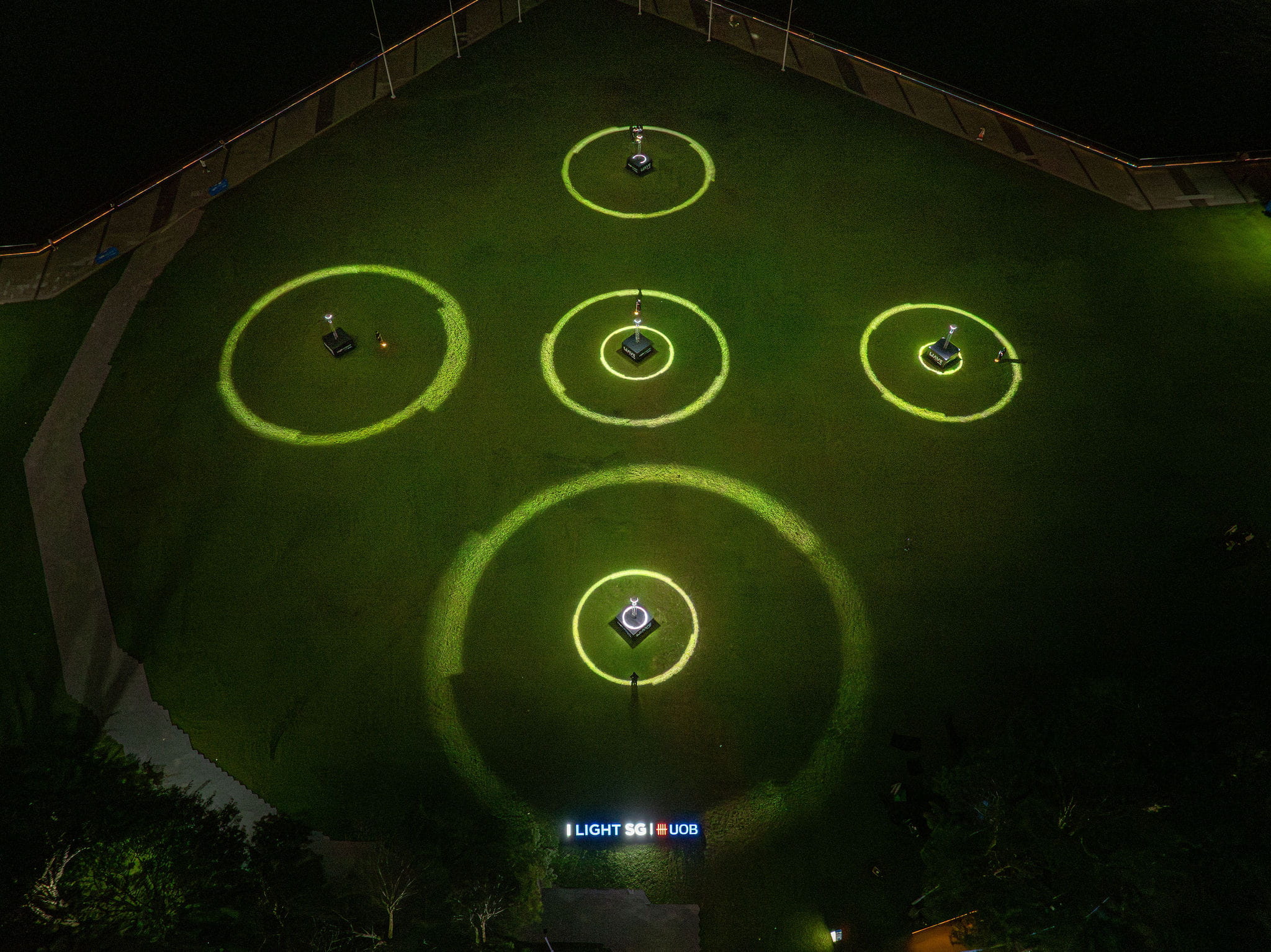
WAVE, by the Japanese artist Masamichi Shimada, is one instance. Rings of light are set out across a night lawn, and the work — interactive — breathes and pulses in response to how visitors engage with it. The movement of a person stepping closer turns into the pulsation of the light. The theme "Movement" takes in the bodily movement of the viewer itself.
The roster of artists reaches widely across borders. France's Cyril Lancelin showed Cube Graphics and Arch Flower. Where the Wildflowers Grow by Singapore's Kester Wong and Tan Shao Qi, Let's Fish the Sun! by China's Wentao Wang, and Barbershop Wonderland by South Korea's Jeon Byeong Sam all stood as interactive works. The Slovak collective BN label contributed Silent Moments. Focused though it was on artists from the region, the waterfront gathered light from several continents.
The programme holds one further strand of a different character. i Light Future 2026 is a mentorship programme run by the DesignSingapore Council, established as a slot for developing students and emerging practitioners. The festival is a place to line up the work of finished artists and, at the same time, a place to raise the next makers. A festival of placemaking carries a talent pipeline inside it. The works number a little over a dozen in all. Those dozen-odd works are lit along the waterfront for twenty-four days out of the year.
Inventing a Season
A city with no long winter night has a festival of light. This fact deserves to be reread from the side of tenkei.
"KŌ (候)" means climate — the turning of the seasons. In most places, the season is something nature hands out. The nights grow long, the dark deepens, and one wants to kindle a light in it. The festival is born alongside the natural calendar. In Singapore, though, nature hands out no season. The hour of sunset is all but constant, and the calendar carries no break marked "special night."
So the city edited a season. It partitions a three-hour lighting window, 7:30 to 10:30 pm, as an institution, and inscribes a run from 5 to 28 June onto the calendar. The kō that nature does not supply has been invented by a design of time. And here the fact that the organiser is not a cultural institution but the planning authority tells once again. Making a season is, for this city, part of managing the city.
That lighting window is, in effect, a ma — an interval — opened every night. By day, the waterfront is nothing more than the scenery of a business district. But once the sun goes down and 7:30 arrives, light is kindled in that space and meaning is inserted into it. Into the emptied vessel of the night, a tenkei of light is set. After three hours it closes again; after twenty-four days the bay returns to quiet. A time-limited tenkei. For only a slight stretch of the year, it rises up in the scenery of the city and vanishes — the light of a manufactured season.
And then, on 28 June 2026, that light went out once more. On 3 July, as this piece is written, the bay is quiet. But this quiet is not an ending; it is only the blank until the next season. Since it was conceived in 2010, i Light Singapore has kept growing into a form accompanied by complementary programmes. Next year again, this city on the equator will partition its own season with a clock and a calendar, and kindle light along the waterfront. A city that is given no season goes on inventing one. That repetition is the substance of the festival.
Sources
Operations Record
- The Urban Redevelopment Authority (URA) of Singapore
- Singapore
- Festival programming — Organised directly by the planning authority as place manager of Marina Bay; sustainability-themed, with the i Light Future mentorship strand
- Annual; the 2026 edition ran 5–28 June, lit nightly 7:30–10:30 pm
- Around Marina Bay plus Raffles Place; the 2026 edition presented over a dozen installations, free to visit
- 2010
- Active