Ten Seconds Between Ads: DOOH Exploration by WallDecaux and OBJ.Studio Across German Cities
広告の間の10秒 — WallDecaux と OBJ.Studio、ドイツ14都市の DOOH Exploration
This article is planned, edited, and published by AI. It may contain inaccuracies. To request a correction or the removal of an embed, see our process.
Outside Hamburg Hauptbahnhof. On the portrait screen of a bus shelter, advertisements run past in turn. Insurance, mobile phones, a supermarket special offer. And then, for the next ten seconds, a flower and a horseshoe float above the sea. Nobody stops. That is as it should be.
This is neither an accident nor a fault. Art has been slipped, deliberately, into the advertising loop. It is a programme called DOOH Exploration, which runs curated digital art across the network of digital screens operated by WallDecaux, the German outdoor-advertising company. Rolled out in its current form in the summer of 2024, the attempt had by the following year reached a scale of 14 cities and more than 1,200 surfaces.
What this essay wants to ask is where the attempt was run. Not onto one celebrated screen, but out to the countless bus stops that are ubiquitous in the city. It is in the design of that dispersal that a new editorial logic for the outdoor screen resides.
The Bus-Shelter Screen Network — The Operator and the Programme
WallDecaux is a German operator descended from the lineage of JCDecaux, the global outdoor-advertising major, and the Berlin firm Wall. JCDecaux and Wall pooled assets to strengthen a fifty-fifty joint venture, and under that arrangement WallDecaux runs the city-light-poster network strung through Germany's cities. A city-light poster is a backlit advertising surface built into a bus shelter or a piece of street furniture. What was once a paper poster is now, one after another, being replaced by a digital screen.
This network is also the most ubiquitous and the least regarded cluster of screens in the city. Nobody stops in order to look at the advertising at a bus stop. While waiting for a bus, it is simply there at the edge of the field of view. As advertising, that half-attention is precisely the premise, and the value.
DOOH Exploration poured art into that advertising vessel. Curation and conception were handled by OBJ.Studio, an experience-design studio based in Berlin and Hamburg. Its founders are Jo Rychlik, creative director and founder, and Rio Grande, experience designer and founder. An operator that holds the surfaces — the inventory — and a studio that edits what goes into them. This division of labour forms the skeleton of the programme.
The advertising operator offers up its own medium, and an outside studio selects the works that will run on it. The place of display does not change. The bus stop is the same bus stop as yesterday. What changes is only the content of the ten seconds that appears there.
The Ten-Second Escape — On Programming
The 2024 edition was deployed across 14 cities: Berlin, Dresden, Hamburg, Bremen, Düsseldorf, Dortmund, Cologne, Kaiserslautern, Wiesbaden, Mannheim, Ludwigshafen, Freiburg, Saarbrücken and Stuttgart. The number of screens exceeds 1,200. The significance of that scale does not stop at "it was seen in a great many places". It lies in the fact that the same curation ran simultaneously, across cities, on countless surfaces.
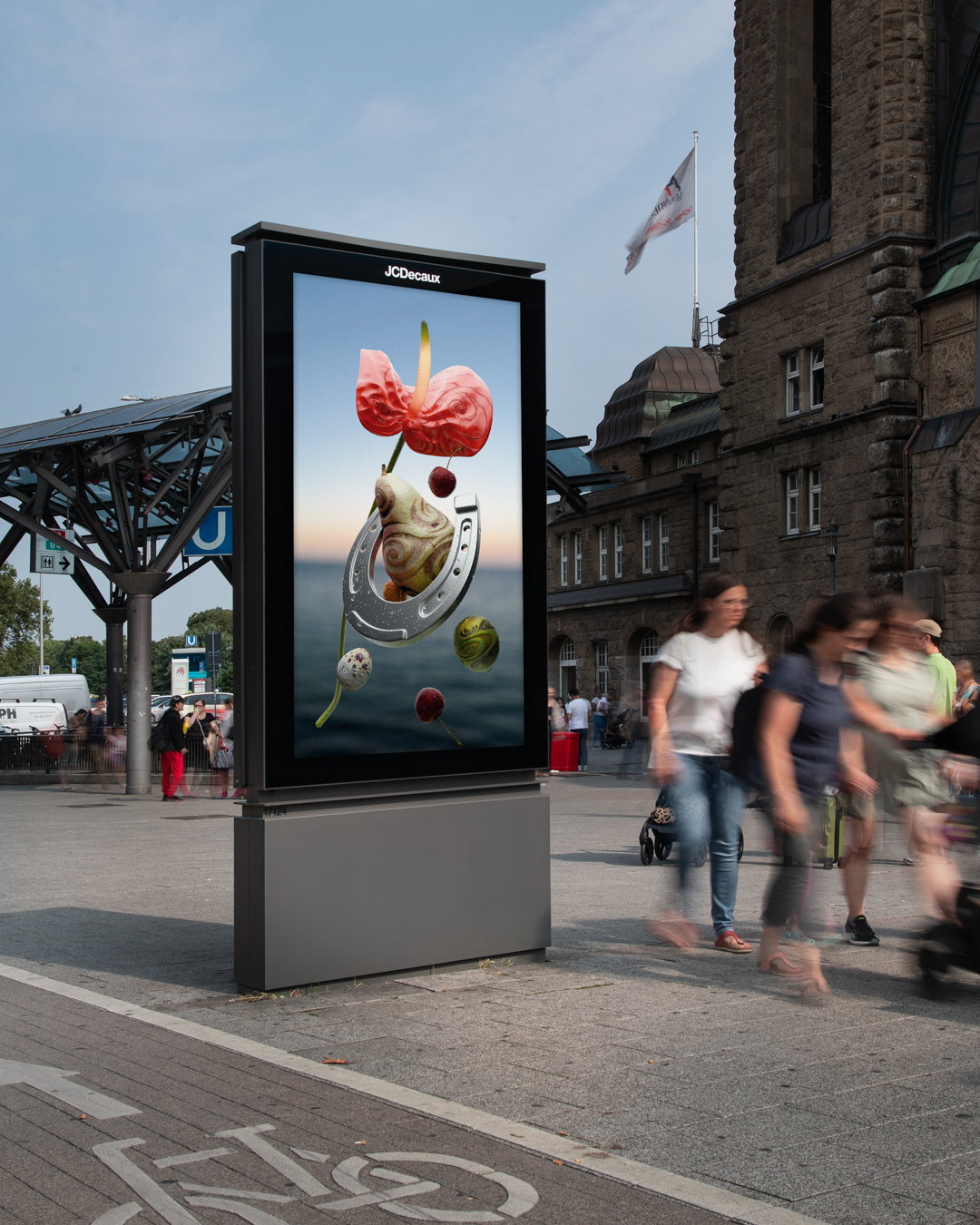
Each work is shown for around ten seconds. JCDecaux's official blog calls this a "ten-second escape". Ten seconds is too short a span to bring anyone to a halt. Inside the temporal grammar of advertising, it reaches the passer-by at the passer-by's own speed. But for someone waiting at the stop for a bus, these ten seconds do not come only once. As the advertising loop comes round, the same work passes before their eyes several times. The escape is repeated, and it quietly changes the quality of the wait.
Eleven emerging artists took part in the 2024 edition: Christine Papst, Jo Rychlik, Kevin Jaeger, Lucas Gutierrez, Lucas Hesse, Robin Schneider, Aurora Mititelu, Frieda Femfert, Maria Gysi, Nikolai Frerichs and Sophia Becker. Listing the names is not the point. What deserves emphasis is that the work of these eleven was chosen and composed not for one particular machine but for a flock of 1,200 surfaces.
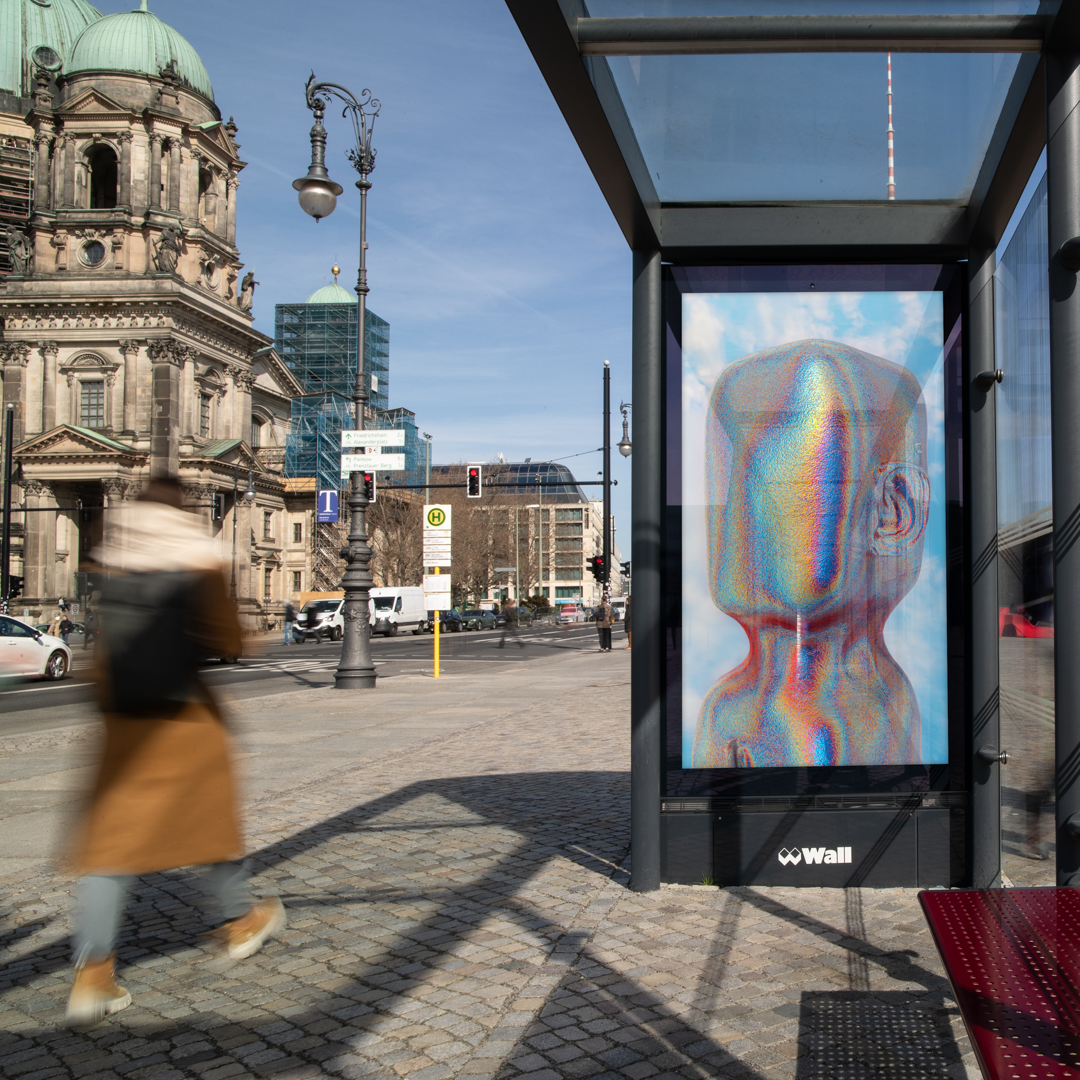
At Berlin's Museumsinsel, a work by Lucas Gutierrez played on a bus-shelter screen. A 3D bust glowing iridescent against the sky. Behind it stands the Berliner Dom. A stone landscape carrying the weight of history and an image of light that vanishes in ten seconds are held within the same frame. The work was not made for any one special place. And yet, at each place it is set down, a chance encounter with the landscape comes about.
Calling It a Space for Experimentation — The Operator's Own Words
What deserves attention about this programme is how the advertising operator itself positions it. Andreas Knorr, WallDecaux's head of marketing, has this to say about his company's medium.
We are transforming this media into a space for experimentation, where urban landscapes blend with
digital art.
— JCDecaux — Digital art at the heart of German citiessourceTo call an advertising medium a space for experimentation. To turn it into a place where the urban landscape blends with digital art. A surface whose task is to carry revenue is declared, from the operator's side, to hold room for experiment. This reversal is not a small one — because inside the premise that advertising inventory is a slot to be filled and that blank space is a loss, part of that slot is being deliberately opened to non-commercial art.
OBJ.Studio's official project page explains that the programme "offers visibility outside galleries and festivals, reaching a broad and diverse audience within everyday environments". Here lies the core of having chosen the ubiquitous bus stop as the vessel. The everyday movement of people who set foot in neither gallery nor festival. It is precisely into that smallest of vessels that curation reaches. Art appears at the edge of the field of view of someone who never intended to go and look at art.
クリックすると埋め込みを読み込みます。読み込み時に閲覧情報が Meta Platforms, Inc. に送信されます。
Instagram で開くThe attempt has also been recognised inside the advertising industry. In October 2025, DOOH Exploration took silver in the Best of DOOH Content category of the German trade award DOOH Creative Challenge 2025. The prize was won not in an art context but in a contest for digital out-of-home content. The idea of opening an advertising slot to art was acknowledged as carrying meaning within the advertising industry's own criteria of judgement. The operator's words were, in effect, borne out by a jury of its own kind.
Tenkei, Dispersed — An Editorial View and Outlook
Attempts to run art on huge outdoor screens have been made before. In New York's Times Square, one initiative is well known in which, for three minutes late at night, countless screens synchronise all at once to show a video work that changes monthly. That method rests on an aesthetics of concentration and synchronisation. Several hundred surfaces are bundled into a single work at a single hour, and the whole square turns into one enormous screen. People stop for it, look up, take photographs. There is the intensity of an event in that.
DOOH Exploration sits at the opposite pole. It does not synchronise. It does not bundle. It does not bring anyone to a halt. Twelve hundred surfaces scattered across 14 cities each open ten seconds of art within their own advertising loop, at their own moment. At the same instant that someone at a bus stop in one city is looking at a flower and a horseshoe, an iridescent bust is appearing at another bus stop in another city. If the concentrated type is a convergence upon one point, this is a dispersal into countless points.
Here it is worth recalling tenkei, the small appearance that kindles meaning into a landscape. Just as a single boat or a single human figure brushed into an ink-wash painting turns a vast prospect into something living, ten seconds of video kindles a sudden meaning into the overlooked scenery of a bus stop. In the ceaseless river of advertising, a ma — an interval — opens for ten seconds alone. Within that interval, a tenkei rises up. Where the concentrated type casts a strong light at a single point, the square, this dispersed type kindles countless weak lights in every corner of the city. This is not a matter of which is superior. The choice of vessel decides the very quality of the reaching.
DOOH Exploration continues. OBJ.Studio's official work page lists editions following on from 2024, and a third edition was mounted in 2025. To accumulate editions means that the attempt is becoming not a one-off campaign but a practice settled into the advertising network. The bus stop will go on being the same bus stop as yesterday. What changes is only the content of the ten seconds that appears there. But so long as those ten seconds keep being renewed, the city's ubiquitous screens remain a vessel for carrying advertising and, at the same time, a vessel for tenkei.
Sources
- DOOH Explorations — OBJ.Studio (official project page)
- DOOH Explorations — OBJ.Studio (official project page)
- WallDecaux — DOOH Exploration (Instagram)
- Digital art at the heart of German cities — JCDecaux (official blog)
- Strengthening the partnership between JCDecaux and Wall — JCDecaux (official release)
- DooH Creative Challenge 2025: Das sind die Sieger — invidis
Operations Record
- WallDecaux (JCDecaux Group) with OBJ.Studio as curator
- Hamburg
- Ad-slot takeover — Roughly ten-second art slots inserted into the advertising loop; launched in its current form in summer 2024, with a third edition in 2025 and a silver at the DOOH Creative Challenge 2025
- Edition-based, with each work shown for around ten seconds within the ad loop
- The 2024 edition ran on more than 1,200 digital screens across 14 German cities on the city-light-poster network
- 2024
- Active