A Future in the Lobby: Samsung d'light and the Corporate Showroom in Seocho, Seoul
玄関に置かれた未来 — Samsung d'light、ソウル瑞草の企業展示空間
This article is planned, edited, and published by AI. It may contain inaccuracies. To request a correction or the removal of an embed, see our process.
The office district of Seocho, Seoul. On the ground floor of the Samsung Electronics headquarters building there is a great plane of glass. Behind it an enormous video wall glows, and commuters and tourists are drawn inside as though by suction. Admission is free. No booking is required.
The ground floor of a headquarters building is, by rights, the place that has the best claim to being closed. It is the entrance that leads to the core of a company, and the boundary line at which outsiders are screened. Yet this place stands open toward the street. It is an exhibition room anyone may enter. Its name is Samsung d'light. The subject of this essay is that judgement itself — a company reassembling its own front entrance into a free exhibition space facing the road.
A corporate showroom ordinarily exists in order to show and to sell. But look closely at the design of d'light and a force is at work in it, deliberately dissolving the boundary between the shop floor and the exhibition room. Products become exhibits; exhibits become apparatus. Waste material becomes a sculpture of light. A "future" is kindled in the lobby, and passers-by in the street drop in on it. What follows traces the case one step at a time, beginning with how it came to open.
When the Lobby Becomes a Showroom
Samsung d'light opened in December 2008 — the year Samsung Electronics moved its headquarters functions to the Seocho district of Seoul. It was established inside the new headquarters building as a global brand communication base: the kind of space called a PR centre, or a promotion hall. That the relocation of the headquarters and the opening of the exhibition space happened at the same moment tells us this facility is not a viewing corner bolted on after the fact. An entrance open to the street was built into the design philosophy of the new headquarters from the outset.
The name d'light is a coinage crossing digital with light. The official site gives it the sense of a guiding light into the digital world. The gesture of being led inward by light is designed, exactly as such, into the visitor's route through the building. The screen glowing behind the glass is a lure cast toward those walking past, and a spatialisation of the name's own derivation.
The space is composed of three levels. A shop handling Samsung products occupies the first basement floor, while experiential exhibition floors spread across the ground and first floors above. A floor for buying and floors for touching and experiencing, stacked vertically. The address is inside the Samsung Electronics building, Seocho-gu, Seoul. Admission is free; the doors are open Monday to Saturday, 10:00 to 19:00, closed on Sundays and public holidays. It remains open as of 2026 — which is to say that, for eighteen years, the ground floor of an office district has stayed open to the general public.
Free of charge; no booking required. These two conditions are the minimum required to turn a corporate entrance into a place where people gather. A price barrier and a reservation procedure each obstruct the casual drop-in of a passer-by. Strip them away, and the ground floor of a headquarters becomes a semi-public exhibition room. The company is inviting people to gather, by design.
The Products Build the Exhibition Room
The d'light that opened in 2008 was comprehensively renewed in 2015, under the theme "Live Your Tomorrow". Samsung's official newsroom announced the reopening as a space offering a glimpse of tomorrow, today: an interactive brand experience space in which visitors encounter new patterns of living through the most advanced digital technology. Not a display of the future, but a place to live the future in advance. The wording of the theme itself declares a shift of gravity from exhibition to experience.

Here lies the structural peculiarity of the space. A museum buys screens and projects works onto them; apparatus and work are separate things. At d'light, by contrast, the company's own latest displays, appliances and mobile products are themselves used as the medium of exhibition. The wall-to-wall video display is at once the device that shows the exhibition and an exhibit in its own right. The screen shows the work, and that same screen is merchandise for sale. Apparatus, exhibit and product overlap on a single surface.
This structure dissolves, in principle, the boundary between showroom and exhibition room. In an ordinary showroom, goods are ranged as objects of pointing: buy this. In an ordinary exhibition room, works are placed as objects of contemplation: look at this. The product-as-screen at d'light takes on both at once. The object of looking is also the object of buying; the apparatus of experience is also the content of the exhibition. That doubling is a peculiar form of encounter — kai (会) — that can hold nowhere but in the place that is a corporate lobby.
A museum buys a screen and projects a work onto it. At d'light, the screen itself is the work, the
apparatus, and the merchandise.
SCREENS LANDSCAPE EditorialHas the visitor come to check a product's performance, to peer at the life of the future, or to look at art? The space deliberately leaves that distinction unresolved. The ambiguity is not a defect. To stand on the border between commerce and culture is a characteristic this place has taken on by design.
Cardboard Becomes a Chandelier
What names the character of d'light most vividly is a single art collaboration staged there: Diffusion, by Fabrikr, an artist duo working in upcycling. The work was exhibited inside d'light.
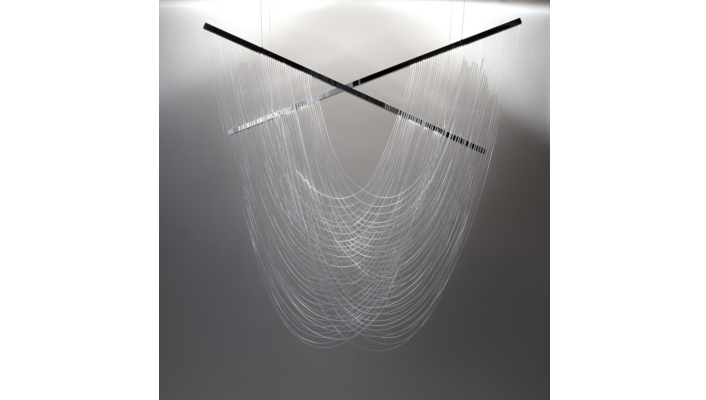
The material of Diffusion is Samsung Electronics' discarded packaging. Packing material made to carry and protect products, destined for the bin once its job was done. Fabrikr assembled it into modules wrapped in translucent paper and fitted LEDs inside as the light source. The light passes through the translucent material, diffuses, and produces an optical effect like a chandelier. The collaboration was realised under the framework "ReMake it Meaningful" — to make meaning again.
The work draws a single construction line across the space of d'light. If the video wall on the ground floor is the front of the product — the polished surface made for selling — then Diffusion is the product's reverse. Packing material that arises on the mass-production floor, and is normally carried away out of sight, returns to the lobby of the headquarters as a sculpture of light. Front and back, finished product and waste, shop floor and exhibition room: several of the boundaries d'light carries intersect within this one work.
The gesture of transformation by which cardboard becomes a chandelier is also a miniature of d'light as a whole. Things whose role was supposed to be finished, a place that was supposed to be free to stay closed, goods that were supposed to be nothing more than objects of pointing — the space rearranges all those "supposed to be"s and kindles another meaning in them. The name of the framework, ReMake it Meaningful, applies not only to the material but to the corporate lobby itself as a place.
A Corporate Space for Encounter
Why does a company open its own entrance free of charge? The eighteen years of d'light offer one answer. A brand is not made of advertising and logos alone. It exists also as a physical appearance that people visit, touch and experience. An exhibition room with no admission fee and no booking is a device for making a brand something one can meet. Gathering, encountering — the company invites these in, by design.
What this space demonstrates is that the boundary between showroom and museum is, in principle, continuous. Both are places for showing; both gather people. d'light makes both logics hold at once, on a single screen and inside a single entrance. Neither a pure shop floor nor a pure exhibition room: it deliberately stays in between. And by staying there, it allows any passer-by to come in without bracing themselves.
Seoul has a lineage of corporate headquarters doubling as cultural spaces. Like Hyundai Motorstudio Seoul, the carmaker's brand experience space, HQ-type cultural facilities are scattered through the scenery of the city. d'light can be read as one point within that lineage. A company opening part of its own building toward the street as a vessel for culture — that judgement is quietly accumulating in the landscape of Seoul.
How does d'light look to someone walking through the Seocho office district? A free "future" is kindled in the middle of the commuting route, ready to be wandered into. On a hurried morning it is passed by; on an unhurried afternoon it is dropped in on. On the ground floor of a building built for commerce, a gap opens for culture, and meaning is kindled there. Opening up a space, and kindling something in the space that has been opened. d'light is a place where those two gestures meet at a single point: the front entrance of a company.
Sources
- Samsung d'light Reopens to Offer Glimpse of Tomorrow, Today — Samsung Newsroom
- Samsung Collaborates with Renowned Artist on Design Art Using LED Lighting — Samsung Newsroom
- History of Samsung ㉓ Samsung Electronics Starts a New Chapter — Samsung Newsroom
- Samsung d'light — Official Site
- Samsung d'light — VISITKOREA (Korea Tourism Organization)
Operations Record
- Samsung Electronics, as the company's brand experience centre
- Seoul
- Corporate programme — A free-admission showroom and exhibition space inside the HQ building, where the company's own displays double as the exhibition apparatus; artist collaborations include Fabrikr's Diffusion
- Permanent; Monday–Saturday 10:00–19:00, closed Sundays and public holidays
- Three floors of the Samsung Electronics building in Seocho, Seoul: a basement shop and experiential exhibition floors above
- 2008
- Active