Gold Projected in a Banking Hall: Hall des Lumières and the Business of Immersion in New York
銀行ホールに投影された金 — Hall des Lumières、ニューヨークの興行と休止
This article is planned, edited, and published by AI. It may contain inaccuracies. To request a correction or the removal of an embed, see our process.
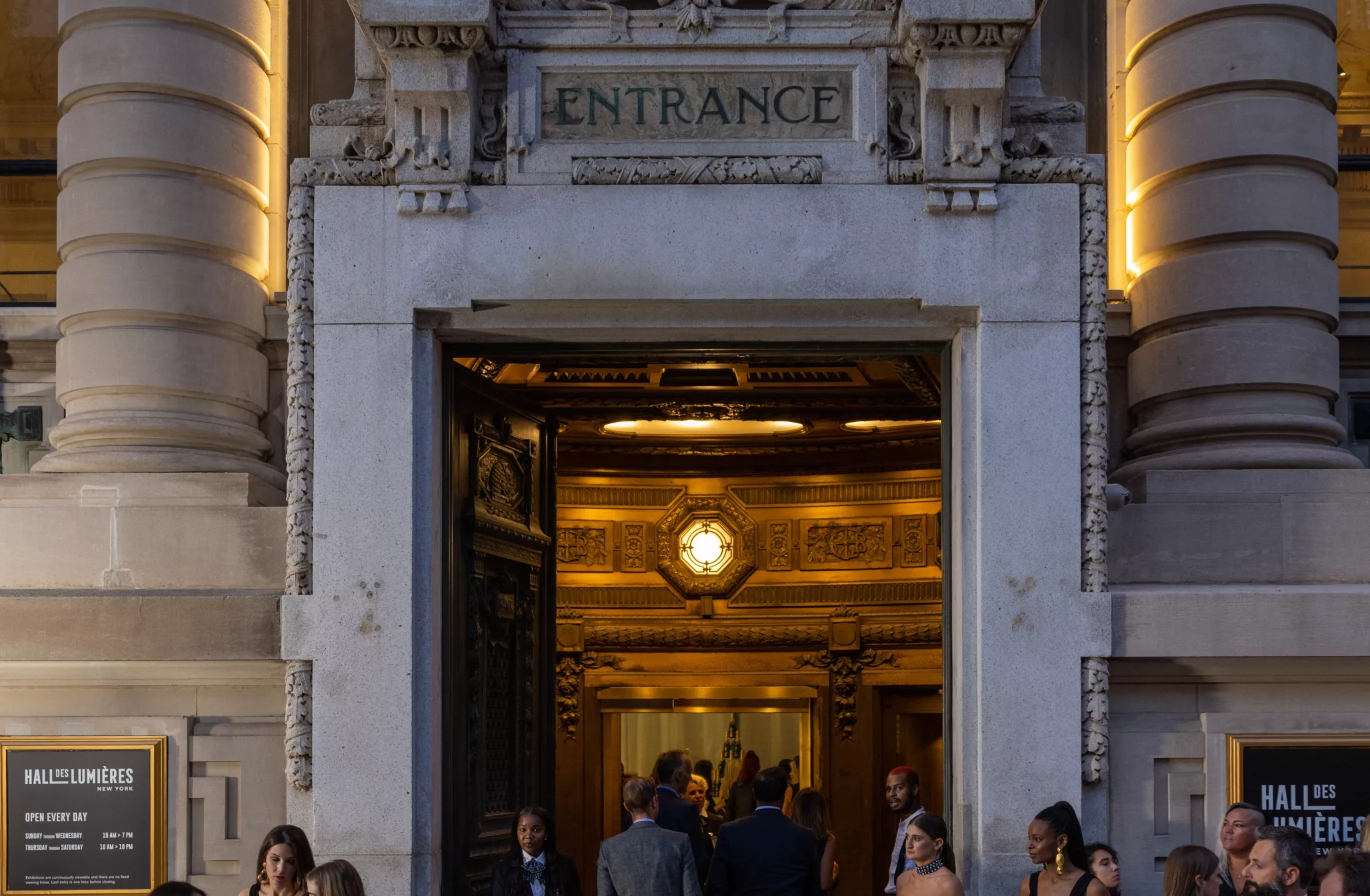
On the night of 14 September 2022, well-dressed people were gathering on Chambers Street in Manhattan. What they were being drawn into was an old bank building, the word ENTRANCE carved into its stone doorway. Inside, Klimt's gold was flowing across the ceiling of the former banking room. Women of gold leaf slid over the columns, the arches, the ceiling. A hall that had once counted the savings of immigrants had become, just as it stood, a vessel for light.
This was the opening night of Hall des Lumières. Converted from the teller hall and vault level of the former Emigrant Industrial Savings Bank, the venue was sold as Manhattan's first permanent cultural centre for digital art. It is operated by Culturespaces of France together with IMG. The opening programme was Gustav Klimt: Gold in Motion.
This essay reads the venue as a single screen. But that screen is neither liquid crystal nor LED. A Beaux-Arts bank building completed in 1912 — its columns, its arches, its very ceiling — became the surface on which Klimt's gold was cast. Borrow a piece of ready-made architecture, and kindle a light within it. And over three and a half years, that light came close to going out, and changed its form. A tenkei does not necessarily stay lit. It fades, changes shape, and is kindled again. Recording that wavering is the purpose of this essay.
The Immigrants' Bank, the Beaux-Arts Hall — A Story of the Building
The building was put up, in the first place, to safeguard the savings of Irish immigrants. In 1850, under the patronage of the Irish Emigrant Society and Bishop John Hughes, the Emigrant Industrial Savings Bank was founded. It was a bank that held the meagre money of people who had left home and crossed to Manhattan. In the New York of the mid-nineteenth century, that made it an institution with a significance beyond the merely financial.
The bank grew, and it expanded. In 1907 it acquired the adjoining land at 43-49 Chambers Street. The following year, 1908, an architect was engaged to design the new building: Raymond F. Almirall (1869-1939). He had studied at the École des Beaux-Arts in Paris, graduating in 1896. The Beaux-Arts vocabulary Almirall had acquired in Paris he brought with him to this Manhattan bank.
The Beaux-Arts building that resulted was later designated a city landmark. An imposing teller hall; a vault level below. These were an architectural language meant to make depositors believe that the money placed here would be protected. The weight of the stone, the height of the ceiling, the formality of the ornament. Bank architecture is an apparatus for making trust visible. A bank built to safeguard the savings of immigrants becomes a Beaux-Arts hall at the hands of an architect returned from Paris. That is the first circuit in this story.
Hall des Lumières turned this teller hall — the former banking room — and the vault level into a space for projection. Rather than construct new architecture, it borrows the surfaces of architecture that already exists. Columns, arches and ceiling all become, exactly as they are, planes that receive light. The formality the bank had accumulated over 110 years was converted, intact, into the stage set of an immersive experience.
Mapping the Gold Leaf — The Opening Programme
The artistic direction of the opening programme, Gustav Klimt: Gold in Motion, was in the hands of Gianfranco Iannuzzi. Klimt's body of work was projected onto the architecture as luminous images up to 30 ft high. This is not simply casting pictures at a wall. Onto the roundness of a column, the curve of an arch, the height of a ceiling, the imagery is mapped precisely. With the projections and recesses of the building taken into the calculation, paintings of gold leaf creep across three-dimensional space. Music composed for the performance accompanied the images.
There is a resonance at work here. Klimt's gold leaf, and the gold of the bank. The subject of the programme and the provenance of the vessel echoed one another. In a place that once counted gold, paintings made of gold flow. This superimposition, one may fairly say, was the greatest piece of staging at the opening. To choose a ready-made architectural screen is to borrow, along with it, all the meaning that architecture has carried. What was borrowed here was the subject of gold itself.
Companion programmes were prepared as well: a section on Friedensreich Hundertwasser, 5 Movements by Nohlab, Recoding Entropia, and an exhibition on the history of the bank building itself. Around Klimt, the pillar that drew the crowds, several moving-image works and the provenance of the venue were arranged. Tickets were 30 dollars for adults. Not a sum anyone can pay, but a price set for a permanent cultural institution.
We are in a city where if we want to see a Klimt, there are museums where we can go and see the
Klimt.
— ARTnews — David Milch(バルーク大学)sourceThese words were spoken two years after the opening, but they anticipate the essence of the inaugural show. New York is a city where a real Klimt can be seen. There is Klimt at the Metropolitan Museum, and Klimt at the Neue Galerie. In that city, can an immersive experience projecting reproduced gold go on holding up as a permanent attraction at a list price of 30 dollars? The question had been laid quietly at the venue's feet from the day it opened.
"des Lumières" as an Export
Hall des Lumières was not born of a single bright idea. Behind it stands Culturespaces, a French cultural-operations company. This company has been rolling out digital art centres under the brand name "des Lumières" around the world.
The lineage begins in 2018, with Atelier des Lumières in Paris. The show model established there — projecting famous paintings onto the inner walls of a historic building and staging them, with music, as an immersive experience — was subsequently replicated from place to place. Bassins des Lumières in Bordeaux, Carrières des Lumières at Les Baux-de-Provence, Fabrique des Lumières in Amsterdam, Phoenix des Lumières in Dortmund, Théâtre des Lumières in Seoul, Bunker des Lumières on Jeju. Across the network as a whole, some five million people attend each year.
This is the export of a format. Quarry, water tank or bunker, the idea of borrowing the surfaces of an existing space and making a screen of them is common to all. A different piece of architecture is chosen as the vessel in each territory, and the same show model is poured into it. The vessel is procured locally; the programme is edited at head office. "des Lumières" is not the name of a place but the name of a method.
Hall des Lumières was this format's first North American site. A model with a track record in Europe and Asia crossed the Atlantic for the first time. And the landing point chosen for it was a Beaux-Arts hall that had been an immigrants' bank. A show of light established in Paris is received by a building designed by an architect who trained in Paris. A bank built to safeguard the savings of immigrants welcomes, 110 years later, a show of light out of Paris. This is the second circuit in this story. Vessel and programme were tied together at a single point: Paris.
A Notice of Pause — The Turn of 2024
The programme kept turning over after the opening. On 1 August 2023, Hip Hop Til Infinity opened. From Klimt's gold to the visual language of hip hop. Destination Cosmos – Space Exploration, made in partnership with NASA, was staged as well. The programming diversified, and the range of genres used to draw an audience widened. This was the effort of keeping content in rotation as a permanent cultural centre.
In February 2024, however, Hall des Lumières quietly "paused" its art exhibitions. The official site explained this as a temporary halt for curating the next series, and as a step towards embarking on a new chapter. Not a closure. A pause, strictly — a temporary halt.
What took place at the venue during that pause was suggestive. Puppy yoga, Pilates, whisky tastings, drag shows. Events that were not art came to be held in this hall one after another. A space that had projected gold becomes a place to do yoga with a dog. The managing director, Alexandra Reiss, told ARTnews that the new policy was meant to make private events such as fashion shows and brand activations possible while exhibitions for the public were prepared. New shows staged at sister venues around the world would come here in time as well — Egyptian Pharaohs and Van Gogh – Starry Night, for instance, she said.
The words of David Milch quoted at the top were spoken in this context. As director of the arts administration programme at Baruch College, he pointed to the intensifying competition in the immersive market. Museum of Illusions; Summit One Vanderbilt. Venues selling similar immersive experiences had been multiplying in New York. On top of that, he observed that we are in a city where, if we want to see a Klimt, there are museums we can go to and see the Klimt. No remark has punctured the weakness of reproduced immersion more concisely. In a city where the original is within walking distance, what does reproduced light have to sell?
And Still the Light Is Open for Business
So has this venue vanished? It has not. As of July 2026, Hall des Lumières continues to operate. Its self-introduction, however, is nothing like what it was at the opening.
The words with which the official site now describes the venue are "New York City's Premier Luxury Immersive Event Venue". From "permanent cultural centre for digital art" to "event venue". The site carries pages for reception, fashion, wedding and corporate hire. Three spaces converted from a historic bank building, for up to a thousand people. The vessel itself has become the thing let out.
At the same time, the venue has not let go of exhibition altogether. A limited run, Renaissance: Da Vinci, Raphael, Michelangelo, is being staged, with tickets sold through Fever. The show of light once billed as permanent has been reorganised as a time-limited event. The vessel feeds itself day to day on event hire, and the programme returns to it now and then, by way of an outside ticketing platform.
This structure indicates the realistic form of survival available to the ticketed immersive experience. A tenkei that opened under the banner of the "permanent" enters a state of waiting to be programmed. Through that wait the vessel cannot be left empty, so it takes in yoga, weddings, fashion shows alike. And when the moment is right, the light is kindled again as a limited run. It has not gone out; it is blinking. To read that blinking as "failure" would be premature. It is, rather, one candid answer to the question of how reproduced light survives in a city where the real Klimt is a walk away.
A bank built to safeguard the savings of immigrants became a Beaux-Arts hall at the hands of an architect back from Paris, received a Paris-born show of light 110 years later, and is now let out as a luxury event venue. This building has moved through role after role. The vessel remains, and only the meaning kindled within it shifts. A point of light that rises in the landscape of a city does not, once lit, stay lit for ever. It fades, changes form, and is kindled again. This is an interim report on that wavering.
Sources
- Hall des Lumières (official site)
- Tickets Are On Sale Now for Hall des Lumières — PR Newswire (official release, 2022)
- New York's First Permanent Immersive Art Center Is Pivoting to Puppy Yoga and Other Activations — ARTnews(2024-07-08)
- Hall des Lumières — A Place of History (official venue history of the building)
- Culturespaces (official site)
Operations Record
- Culturespaces with IMG
- New York
- Ticketed show — The North American debut of the Paris-born 'des Lumières' format; art exhibitions paused in February 2024 in a pivot to event hire, with limited-run shows since
- Continuous rotation 2022–2024; now primarily event hire with limited-run immersive shows
- The teller hall and vault level of the former Emigrant Industrial Savings Bank (Raymond F. Almirall); projected images up to 30 ft high
- 2022
- Active — Art exhibitions paused in February 2024; as of 2026 the venue bills itself as a luxury immersive event space while presenting the limited-run show 'Renaissance'