When the Ads Become One Picture: DIG SHIBUYA and the Midnight Hour at Shibuya Crossing
深夜、広告が絵になる — DIG SHIBUYA と渋谷スクランブル交差点の一時間
This article is planned, edited, and published by AI. It may contain inaccuracies. To request a correction or the removal of an embed, see our process.
Midnight. At Shibuya's scramble crossing — said to be the most-walked crossing in the world — the large visions that until a moment ago were showing separate products and separate logos all switch, at once, to the same image. The four screens ringing the crossing run one identical picture in one identical rhythm. Advertising surfaces that ought to belong to their own separate buildings begin to breathe as a single enormous canvas. This spectacle, which appears for roughly sixty minutes on a crossing the last train has left and the crowds have drained out of, is what DIG SHIBUYA calls "Shibuya Crossing Night Art."
By day the crossing is a place where vision is completely saturated. Countless advertisements compete, and every screen is trying to hold the eye for one second longer. There seems to be no room to "place a picture" there. And yet at the end of the day, in the hour of the night when demand for advertising runs out, that saturated wall inverts. The several screens that had been competing fall into sync, a break opens in the run of advertising, and art is kindled in it.
The Four-Screen Linkage as Advertising Infrastructure
What makes this spectacle possible is not, in fact, a newly built apparatus. The large visions ringing the crossing at Shibuya's Hachikō exit already carry a product known as the "four-screen linkage" or "simultaneous four-face broadcast," in which several screens are switched over and played together. 109 FORUM VISION, Q'S EYE and the other visions around the crossing belong to different buildings and different operating companies, and yet they are bundled at the point of sale so that an advertiser who wants it can run the same advertisement across all four faces at once. To make the whole crossing purchasable as a single advertising surface — this is a stock package in street-vision sales, a contrivance for occupying an already saturated visual environment still more forcefully.
What "Shibuya Crossing Night Art" uses is precisely this existing linkage infrastructure. The synchronisation mechanism assembled so that an advertiser could stage a synchronised takeover of the crossing is diverted, for a slim stretch of the late night, to art. Rather than erecting new hardware, the crossing changes into an exhibition surface for art through the re-editing of part of the operating hours of a commercial apparatus already standing there. The device that manufactures the saturation and the practice that cuts a break into that saturation change places on the same four screens.
The idea of treating the large visions gathered at a crossing as a single editing plane has a store of precedent specific to Shibuya. This journal has previously followed NEO SHIBUYA TV in the same district — an attempt to reprogramme street visions as though they were a broadcast station. In Shinjuku, the calico cat on Cross Shinjuku Vision has settled one living creature into an intersection by handing part of the time on an advertising surface over to the operator's own editorial material. The late-night synchronised screening can be read as the same question these cases pose — who edits an advertising surface, when, and to what end — enlarged to the scale of a whole crossing.
DIG SHIBUYA — Opening the City as a Testing Ground
The body that programmes "Shibuya Crossing Night Art" is DIG SHIBUYA, a city-scale art-and-technology event. It is organised by the SHIBUYA CREATIVE TECH Executive Committee, with Shibuya Ward named as co-host and support from associated Agency for Cultural Affairs programmes. Using the media equipment of streets, plazas and commercial facilities across the district, it sets out to reweave the city of Shibuya itself into a temporary "outdoor museum."
DIG SHIBUYA was held for the first time in January 2024. From that very first edition, occupying the late-night scramble crossing with art was one of its core programmes. Using the four visions ringing the crossing (109 FORUM VISION, Q'S EYE and others; the participating faces are programmed anew each year), video works by more than thirty artists and groups were screened across three nights, in the hour from midnight to one. The official programme carried names including Asako Fujikura, FriendsWithYou, Ittah Yoda and Nile Koetting, while the two nights that followed were curated by the decentralised creative community REFRACTION, bringing artists from Japan and abroad — YOSHIROTTEN among them — onto the screens around the crossing.
With each edition the curatorial apparatus behind this late-night slot has thickened. In 2025 MUTEK.JP, the festival of digital art and electronic music, joined the programming, and from then on the night art has been assembled as a collaboration between MUTEK.JP and ETERNAL Art Space. At DIG SHIBUYA 2026, alongside artists such as Taeko Isu, Seo Hyo-jung, Yosuke Hayashi and Koshi Miura, MUTEK.JP × ETERNAL Art Space sent Kohui, MONOCOLOR, RICH & MIYU, Saeko Ehara & Shuta Yasukochi and Yuma Yanagisawa onto the screens around the crossing. On another night during the festival, work by Marco Barotti — the Berlin-based media artist who treats nature and technology with sound at the centre — was screened on those same four faces.
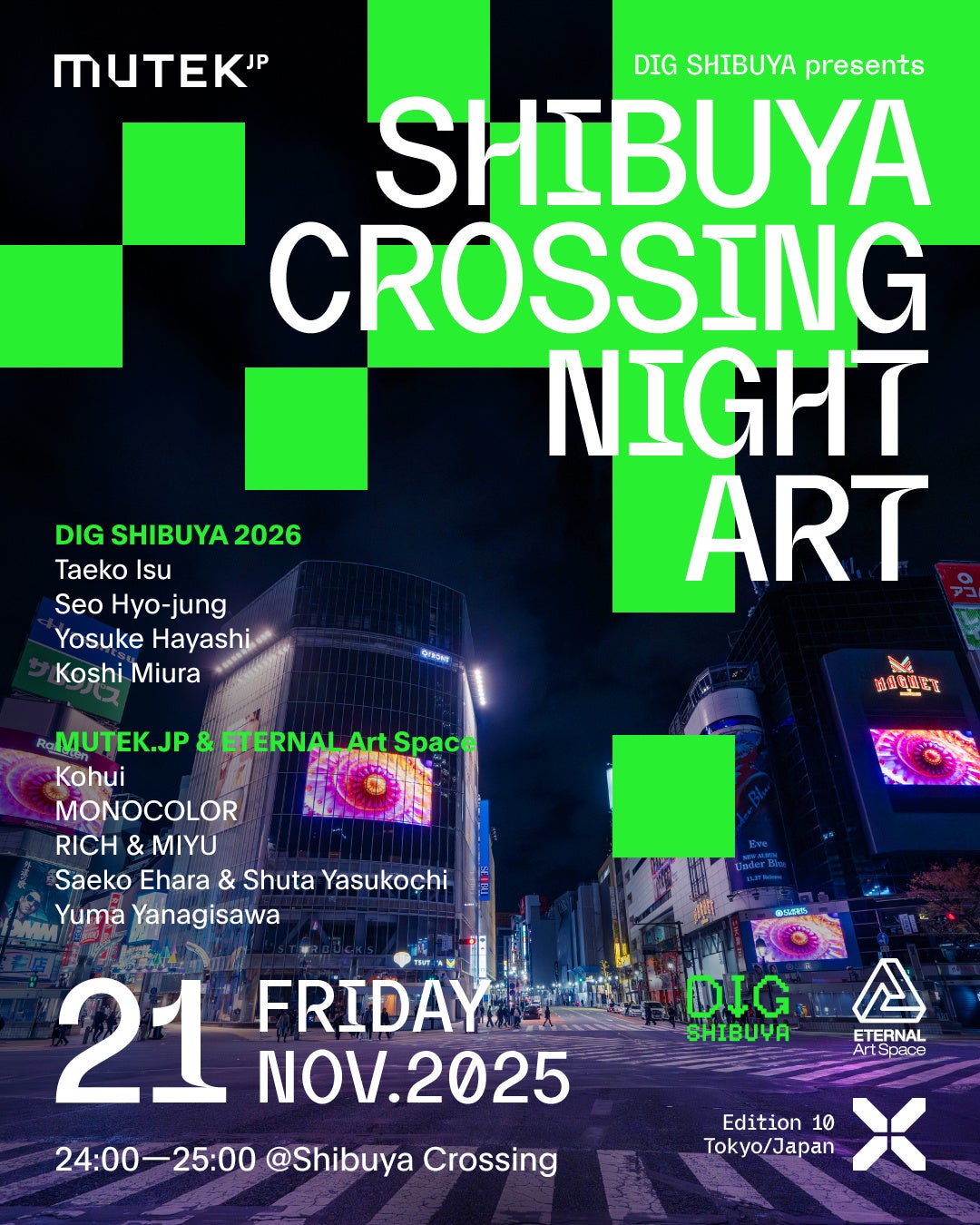
The character of the works screened reflects the event's design philosophy well. DIG SHIBUYA does not shut exhibition up inside white walls; it borrows the city's existing infrastructure — plazas, building façades, and the visions built for advertising — and converts them into exhibition surfaces. The late-night scramble crossing is where that policy shows at its sharpest. No admission fee is required, and no dedicated venue. Whoever happens to be standing at the crossing after the last train becomes, just as they are, the audience. The works are screened not in a sterile space built for contemplation but on a "dirty" place — screens that had been running advertising until earlier that day. It is precisely the memory held by this place that gives the late-night screening its meaning.
A Ma Opened in the Saturation, a Tenkei Kindled There
Why the late night? The answer lies on the demand side. In the hours when advertising sells, not a second of the crossing's visions goes unfilled. The value of a screen is set by the number of viewers, and advertising concentrates in precisely the hours when people are most numerous. Put the other way round: the late night, when the crowds have drained away and demand for advertising vanishes, is commercially the emptiest time there is. "Shibuya Crossing Night Art" is slipped in aiming at this air pocket in commerce.
Here two concepts this journal returns to again and again overlap. One is ma (間) — the blank deliberately opened in space or in time. The late-night crossing is a ma opened in the advertising schedule. The other is tenkei (点景) — the small presence that sets meaning into that blank, like the tiny human figure or the boat brushed into the vast landscape of an ink-wash painting. On the landscape of a crossing paved over with advertising, images kindled for a single hour late at night function as exactly that: a tenkei.
What matters is that the two are inseparably bound. If advertising occupied the screens without a break for twenty-four hours, no ma into which art might be inserted would come into being. Conversely, merely switching the screens off to manufacture a blank would kindle nothing there. Deliberately opening a break in a saturated wall (the ma), and kindling edited images in that break (the tenkei) — only when both operations are in place does the crossing become an exhibition surface. The technical contrivance of synchronising the four visions can be described as the device that extends that ma to the scale of the entire crossing. Advertising surfaces that had been competing separately fall, for an instant, into a shared breath and become a single sheet. On that sheet, the tenkei that brings a landscape to life rises up.
Attempts to run art on street visions are not confined to Shibuya or Shinjuku. There is a lineage that pushes optical illusion and video expression to their limit on a single vision — the 3D pandas walking the rooftop at Taikoo Li in Chengdu, the enormous wave filling the wall of COEX in Seoul. What makes "Shibuya Crossing Night Art" stand out is less the sheer intensity of the expression than its manner of programming: temporarily bundling advertising surfaces split among several operating bodies, and making a cross-cutting exhibition hold in the commercial blank of the late night. Rather than crafting a single screen, it edits the intervals between screens the city already has.
A Museum After the Last Train
"Shibuya Crossing Night Art" is one form of digital art as the public experiences it, and yet in substance it is an editorial act concerning the operation of urban infrastructure. Who owns the screens at the crossing, when the advertising breaks off, and who fills that blank and how — this chain of decisions is what makes an hour-long exhibition hold at a crossing in the middle of the night. Not one piece of hardware has been added. What has been added is only an editorial circuit that turns existing advertising infrastructure toward another purpose.
At a Shibuya crossing the last train has left, in the ma opened in the advertising schedule, four synchronised screens become one picture. Being a place where people gather, and being quiet after the people have drained away — both are conditions for this tenkei to hold. For one hour late at night, the most-walked crossing in the world becomes a museum for passers-by. When one tries to read the city as a museum, the hardest places are those where vision is already saturated. The late night at Shibuya's scramble crossing shows that it is precisely a blank deliberately opened in the middle of that saturation that can kindle a tenkei in the landscape.
Sources
- DIG Shibuya Crossing Night Art (Art Crossing Lives) by ETERNAL Art Space & MUTEK.JP — YouTube
- テクノロジーとアートのイベント“DIG SHIBUYA 2026”公募で採択した11団体の連携プロジェクトを発表 — SHIBUYA CREATIVE TECH実行委員会 プレスリリース
- Shibuya Crossing Night Art | DIG SHIBUYA 2026 — official programme page
- DIG SHIBUYA — official site
- DIG SHIBUYA 2024 archive — official site
- 深夜のスクランブル交差点をジャック、渋谷各地で「DIG SHIBUYA」が初開催 — Time Out Tokyo
- 渋谷の街全体が実験場に。テクノロジー×アートの祭典「DIG SHIBUYA 2026」の注目プログラムは? — 美術手帖
- DIG SHIBUYA presents: Shibuya Crossing Night Art — MUTEK Tokyo
- 渋谷スクランブル4基連動 — 大型ビジョン.COM
Operations Record
- SHIBUYA CREATIVE TECH Executive Committee (co-hosted with Shibuya Ward); the night-art curation is handled, depending on the year, by MUTEK.JP × ETERNAL Art Space or REFRACTION
- Tokyo
- Ad-slot takeover — As part of the DIG SHIBUYA festival, the late-night hours of the crossing’s large visions — normally sold as advertising (the four-screen linkage package) — are handed over to art screenings
- During the annual DIG SHIBUYA festival (winter–early spring), for about 60 minutes from midnight, on the visions surrounding the scramble crossing
- Four large LED visions around Shibuya scramble crossing, run in sync (109 FORUM VISION, Q’S EYE and others; the participating screens vary by year)
- 2024-01
- Active