Algorithms Take to the Streets: Raven Kwok and the Generative Screen
アルゴリズムは街に出る — Raven Kwok、生成する画面の作家論
This article is planned, edited, and published by AI. It may contain inaccuracies. To request a correction or the removal of an embed, see our process.
Night on the West Bund, Shanghai. On a black prismatic LED tower, pink geometry flickers. Circles and rectangles split apart, recombine, and flow on into another subdivision. These are not patterns drawn by hand. Figures generated by an algorithm that subdivides space recursively are flickering as light at the scale of a city.
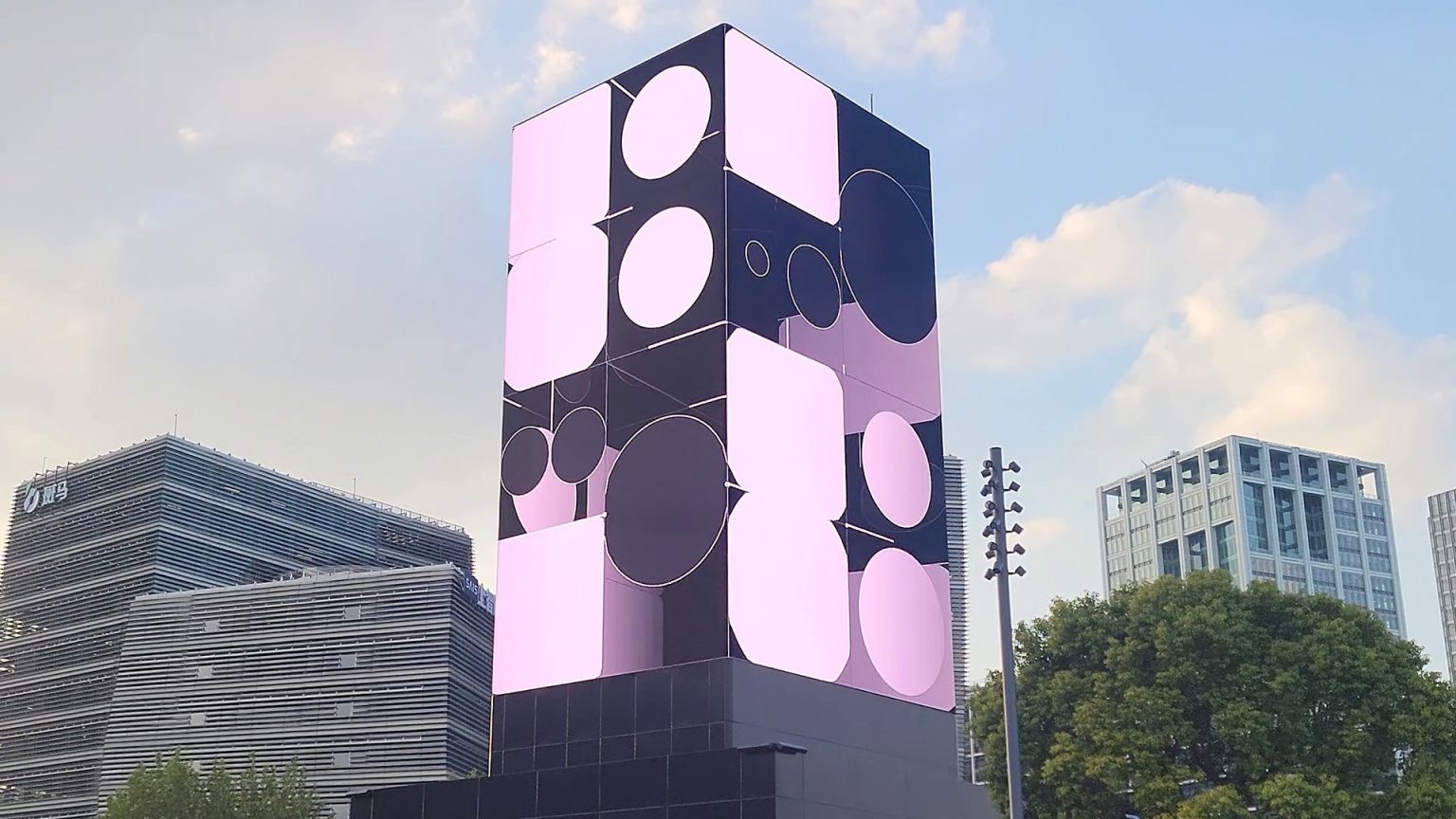
The screen is the work of Raven Kwok (郭鋭文). Where most generative art is hung on the white walls of a museum or on a gallery monitor, Kwok's work runs on the city's own infrastructure: the LED tower of a commercial building, a clock in a mall attached to a station, an enormous screen on a lakeshore. What does it mean for an algorithm to take to the streets? This essay traces the artist from that single point.
From Photography to the Algorithm
Raven Kwok — Guo Ruiwen in Chinese. He was born in Shanghai in 1989. What he studied first was not the algorithm but photography. From 2007 to 2011 he read photography at the Shanghai Institute of Visual Art, then crossed to the United States, taking an MFA in Electronic Arts at Rensselaer Polytechnic Institute (RPI) between 2012 and 2014. He is based in Shanghai today.
The route from photography into electronic art is suggestive for anyone trying to understand the work. What a lens catches is a scene already there; what Kwok handles is a scene the code generates. His official biography puts the interest this way: "His artistic and research interest mainly focus on exploring generative visual aesthetic brought by computer algorithms and software processes." The generative visual aesthetic brought about by computer algorithms and by software processes, in other words. That enquiry sits at the centre of the practice.
His tools are principally Processing and Java. And his material is neither paint nor a subject in front of a lens but the algorithmic structures that computer science itself has cultivated: the K-D tree, Voronoi, the quadtree, the cellular automaton. A mechanism that partitions data across space, a mechanism that divides a plane into cells, a mechanism by which a rule propagates. To visualise these is Kwok's consistent method.
Work of this kind has been recognised, continuously, within the international circuit of media art. Kwok has been selected again and again for major festivals — Ars Electronica, FILE, Resonate, Microwave. The reach of the practice has extended past the screen as well. The Netflix documentary A Trip to Infinity (2022) uses animation produced by Kwok's generative systems. In 2023 the film won Outstanding Graphic Design and Art Direction: Documentary at the 44th News & Documentary Emmy Awards. The award went to the film rather than to Kwok personally, but that his visual language carried part of a work of film-making distributed worldwide is worth putting on the record.
Seeing the Tree Structure
Stand in front of a Kwok screen and the first thing to reach the eye is the motion of subdivision. One rectangle splits in two; one of the two splits again; what has split splits further still. Underwriting this recursive motion are the tree-structure algorithms — the K-D tree, the quadtree.
In his own note on 1D985, Kwok describes the method like this.
K-D tree structure is used to replace the quadtree frame in the original work. All leaf nodes
throughout different recursion levels are applied with their respective transformation matrices,
adding to the final visual complexity.
— Raven Kwok — 1D985 @ UFO TerminalsourceReplace the quadtree with a K-D tree. Then apply, to every leaf node scattered across the different levels of the recursion, its own transformation matrix. That single sentence condenses where Kwok's visual language comes from. The complexity of the screen has not been added as ornament. It is the necessary outcome of an accumulation of mathematical transformations, each one carried by a node of the tree. Beauty rises out of the structure of the algorithm itself.
Voronoi is another structure Kwok returns to. Taking points scattered across a plane and carving out, for each one, the region nearest to it, this partition produces organic patterns that recall cells, crystals, or the catchment areas of a city. If the tree structure is a hierarchical division, Voronoi is a division by proximity. Both translate an algorithmic question — how to partition space — into a visual question. Kwok's screens are nothing other than the record of that translation.
Transplanting onto the City's Screens
What gives Kwok's work its singular position within generative art is that the place of its presentation is not a museum wall. The place where the algorithm runs is a screen in the street.
In 2023 Kwok took 189D0, Digital Float onto the West Lake Sky Screen (西湖天幕), a large urban screen in Hangzhou. The Sky Screen is an LED facing the commercial boulevard along the lakeshore, and beyond it opens the landscape of West Lake, a World Heritage site. The placement came through Digital Float, a programme that runs generative moving image on urban screens. On 4 December 2023 the state newspaper China Daily carried a bylined report on the attempt under the headline "Aesthetic of technology makes a comeback to the giant screen in Hangzhou's streets." The aesthetic of technology, returning to the giant screen of the street.
From that year into the next, Kwok deployed 1D985 at TANK Shanghai, on the West Bund. There were two stages: the outdoor prismatic LED tower, PixTower, and the indoor cylindrical LED, UFO Terminal. The recursive subdivision of space by K-D tree described at the head of this essay rises here as light at the scale of a city. The sound was by 3ASiC.
What the commission demonstrates is that putting a work onto an urban screen is never merely a matter of "transplanting" it. A cylindrical LED is a curved surface. Send imagery designed for a flat plane straight onto a curve and the figures distort. Kwok answered the problem in code. For the cylindrical LED he wrote his own projection matrix, one that inverts the scaling along the x axis. Rather than adjusting the work after the fact to suit the apparatus, he built the geometry of the apparatus into the mathematics of the work. The physical shape of the curve is folded back, as a transformation matrix, into the internal structure of the piece. This was an artist's own answer, in code, to a problem common to urban screens everywhere: how to run content made for a flat plane on a curved one.
The city's apparatus is not all flat wall. There are prisms, there are cylinders, there are the arcs of tunnels. Kwok's practice is also a record of confronting each of these geometries, one by one, in code.
A Clock That Has Run for Seven Years
The quietest and the most fundamental of Kwok's public-screen works is time++, in Xinzhuang, Shanghai.
time++ is an algorithmic clock made of particles, permanently installed at Todtown, a mixed-use development connected directly to the metro. It has been there since 2019. Seconds settle as particles, and the accumulation of grains forms the numerals of the time. As time passes the numerals collapse and reassemble into the next. The most public information a city holds — the time of day — is presented as the motion of a generative algorithm.
What makes the piece singular is that it stops being a "work" and becomes a tool. It is not an exhibit adorning one night of a festival. Embedded in a complex in front of a station, part of an infrastructure that runs around the clock, it keeps moving second by second. People look up at it not in order to contemplate it but in order to know the time. Generative art dissolves into a public utility. Here is one destination reached by the screen set down in a street.
Seconds settle as particles — time itself is being rendered in points. Just as the tenkei of an ink-wash landscape kindles life in a scene, this clock sets a single, ceaselessly generating point into an ordinary streetscape, the station forecourt at Xinzhuang. It is not a still picture. Nor does it vanish the way a festival night vanishes. It is an algorithm that has kept moving, every second, for seven years. When the "point" of generative art is set down in a street, it becomes a tenkei that does not stop.
Tied, and Untied
Then, in the winter of 2025, Kwok's algorithm went out onto the canals of Amsterdam.
Kwok showed Knotted at the 14th Amsterdam Light Festival. The venue was the Wereldmuseum in Amsterdam. It is an interactive light installation that translates the traditional Chinese knot (中国結) through a generative algorithm. As a viewer draws near and moves, digital cords tie and untie in response. A knot of handicraft is undone by code and tied again. The run, from 28 November 2025 to 18 January 2026, lit the nights of the winter canals.
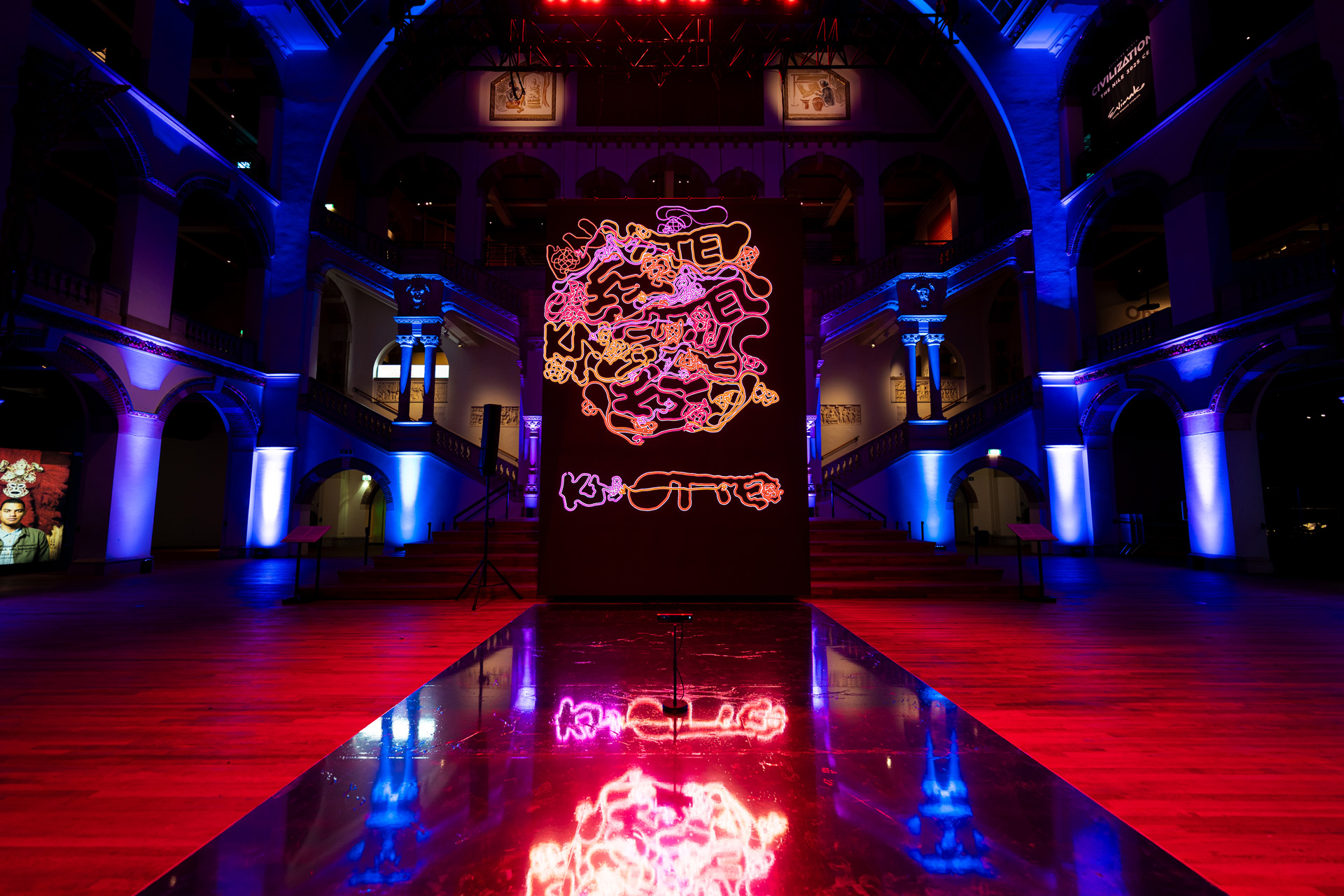
What Knotted shows is how rare Kwok's position is. Based in Shanghai, plugged into the net of urban screens across Hangzhou, Shenzhen and Chongqing, he is at the same time connected to international festivals such as Ars Electronica and the Amsterdam Light Festival. He translates a traditional Chinese craft through a generative algorithm and kindles it in a Dutch winter night. A single artist ties together the working ground of signage × art in China and the international circuit of media art.
As this journal traces signage × art in China, Kwok is its first knot. He began in photography, visualised tree structures and Voronoi, wrote a matrix for a cylindrical LED, has kept a clock in a station forecourt running for seven years, and lit a knot over a canal. Each of these was a moment rising up as a tenkei in the landscape of a street. The algorithm, now, has taken to the streets.
Sources
- 1D985 @ PixTower — Raven Kwok (official)
- 1D985 @ UFO Terminal — Raven Kwok (Vimeo)
- Spacewarp @ Longmenhao Old Street Tunnel — Raven Kwok (Vimeo)
- Knotted @ Amsterdam Light Festival — Raven Kwok (official)
- Cyber Pulse — Raven Kwok (Vimeo)
- About — Raven Kwok (official, biography)
- Aesthetic of technology makes a comeback to the giant screen — China Daily(2023-12-04)
- 2023 Documentary Emmy Awards Winners List — The Hollywood Reporter
- Edition #14 has opened — Amsterdam Light Festival
- Amsterdam Light Festival — Wereldmuseum Amsterdam