A Gate That Translates Color: Carsten Nicolai’s chroma actor at Seibu Shibuya, 2015–2026
色を翻訳する門 — 西武渋谷店 ART GATE と Carsten Nicolai《chroma actor》、十一年
This article is planned, edited, and published by AI. It may contain inaccuracies. To request a correction or the removal of an embed, see our process.
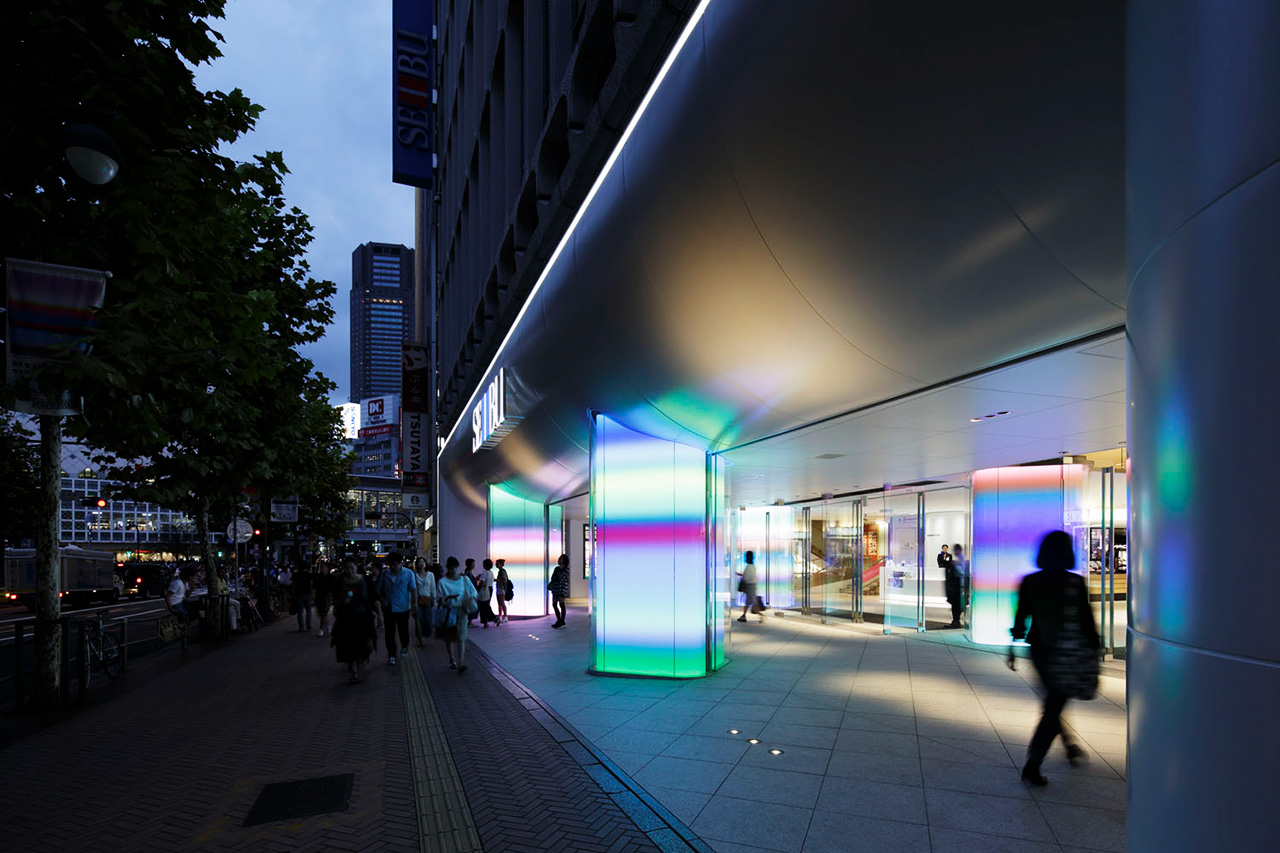
Step out of Shibuya station's Hachikō exit and walk a short way northwest along Inokashira-dōri. The front of Seibu Shibuya Building A comes into view. Four columns frame its entrance. Each stands between 2.8 and 3.3 metres tall, and each is wrapped, in its entirety, in LED panels. Across those surfaces, color is in motion. When someone passes one of the columns, the hue shifts in response to that movement; when another person crosses the opposite side, the field slides into a different register of blue or red. Air temperature, the date, even the weather over Berlin are translated, here, into color.
The four columns carry the title chroma actor. Carsten Nicolai installed the work as a permanent fixture in August 2015, on the occasion of the major renovation of Seibu Shibuya. The apparatus housing the work is known as ART GATE. For eleven years, from opening to closing, every day from 9:30 to 23:00, the device has translated the movements of those passing through Shibuya into color.
And on September 30, 2026, Building A and Building B of Seibu Shibuya will close. Negotiations with the landowner over the renewal of the lease broke down; subsequent discussions over redevelopment also collapsed. At the time of writing, roughly five months remain until chroma actor is removed or otherwise taken out of operation. This essay sets down a record of those eleven years, along two axes: the artist's oeuvre, and the philosophy of ma (間), the Japanese term for the interval.
The Lineage of ART GATE
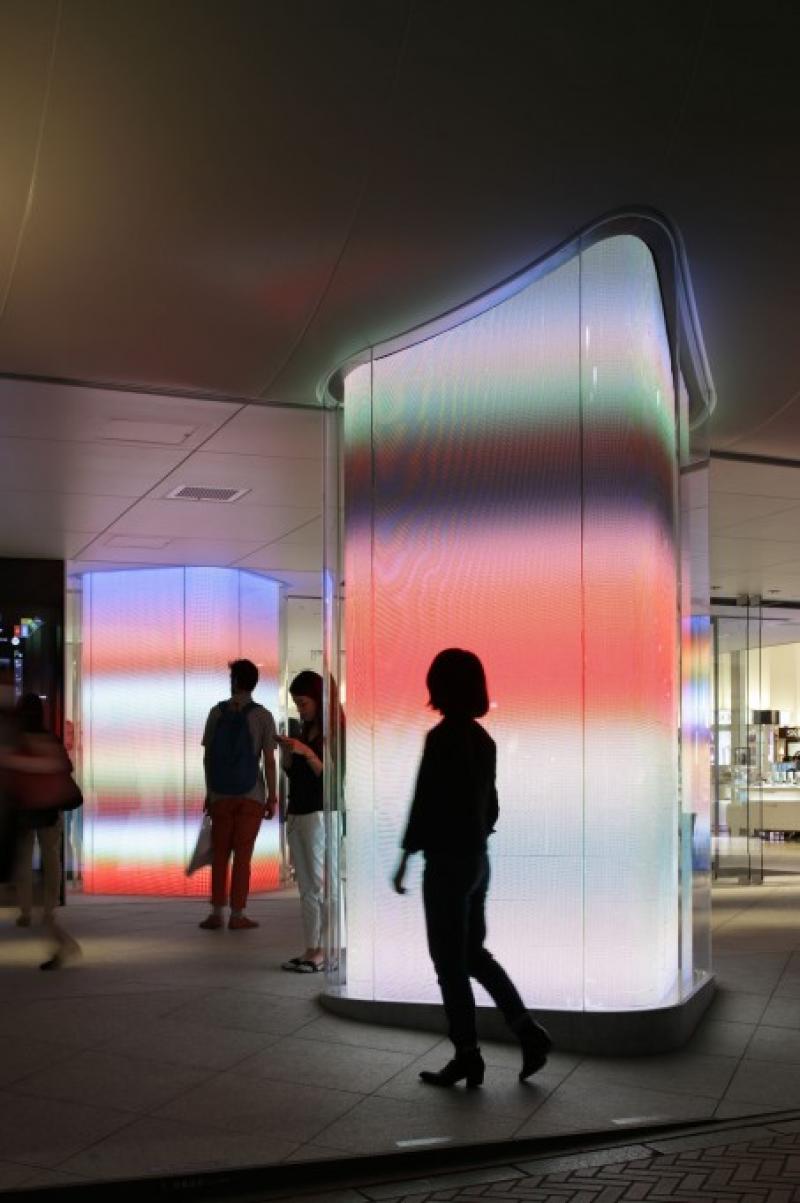
"Art meets Life" is the art programme that Seibu Shibuya inaugurated in 2011. Its premise has been to bring contemporary art into the commercial setting and, through that, to reframe the everyday route through the building as itself a space of exhibition. In August 2015, on the occasion of the store's first major renovation in eight years, ART GATE was installed at the entrance of Building A as the symbolic device of the programme — and on its surface, chroma actor began to run.
The production team was composite. The artwork is by Carsten Nicolai. Art direction was led by Masaaki Hiromura; interior design by Yuko Nagayama; construction by Nomura Kougei Co., Ltd. The client was Sogo & Seibu Co., Ltd. The specification — permanent LED columns combined with sensors and sound, operated as a single artist commission at a commercial entrance — was, at the time and arguably still, among the most advanced of its kind in the world.
One detail deserves emphasis. chroma actor is the work; ART GATE is the device. The distinction holds when one cross-reads @ART's entry on the piece against Nomura's record of the construction. Because the vessel and its contents are nominally separable, a slim margin remains — even at the moment of the building's closure — for the argument that the device may be lost while the work, in some form, persists elsewhere.
A Dual Identity
Carsten Nicolai was born in 1965 in Karl-Marx-Stadt — present-day Chemnitz — in the former East Germany. He spent five years studying landscape architecture at university and approached visual and sound art largely as an autodidact. He founded NOTON in 1996 and, in 1999, co-founded raster-noton. From the early 2000s on, his collaborations with Ryuichi Sakamoto — Vrioon, Insen, Summvs, among others — brought him an international audience. For The Revenant (2015) he co-composed the score with Sakamoto and Bryce Dessner, work that received a Golden Globe nomination.
What matters for the present argument is that Nicolai has long maintained, with strict discipline, two distinct names: Alva Noto for music, Carsten Nicolai for visual art. The reductionism and use of glitch-as-generative-principle that runs through the raster-noton aesthetic flows through both names alike, but the output channels — sound and image — have, as a rule, been kept to separate occasions.
Read against that background, the anomaly of chroma actor becomes visible. Sound and image are integrated into a single device. The columns carry moving image; the same columns emit sound. Environmental data — pedestrian flow, weather, date — is translated into color, and the color in turn modulates the timbre. On this single apparatus, Alva Noto and Carsten Nicolai shared a continuous timeline for the first time. Even within the artist's own career, this is a singular point.
From unicolor to chroma actor
If one places chroma actor inside Nicolai's own series, it stands between unicolor (2014) and PARALLAX (2017, at Omotesando Hills, Space O).
unicolor is a large-scale light and sound installation composed of sixteen modules, structured as a long projection wall set against mirror-faced walls that produce infinite reflection. The artist describes it as an apparatus that tests color perception.
I want to test the reality that we unconsciously create.
— The Vinyl Factory — Carsten Nicolai on unicolorsourceThe "reality we unconsciously create" here refers to the subjectivity built into the very act of seeing color. The sixteen modules are calibrated to identical specification, but the viewer perceives them as differing — through the relations among neighbouring colors, through the modulation of the mirrored surroundings. The frame, then, is one of using color to interrogate the structure of perception itself.
chroma actor was installed on a Shibuya street the following year. The sixteen walls have become four columns; the viewer no longer stands before the device but passes between its elements. The output of color happens not within the closed volume of a museum but along the open route of a commercial entrance. The object of the test has shifted — from perception in itself, to perception at the everyday point of passage. It is the most public release of the mapping that Nicolai has pursued since Bausatz Noto (a vitrine of color-tinted records back-lit alongside four turntables): color as sound material, set down here at the most quotidian site one could find.
Turning the Interval Itself into a Trigger
Four columns demarcating an entrance — that, in itself, is the minimal definition of a gate. Torii shrine gates, paired trees, James Turrell's Skyspaces: the device of marking inside from outside with a small number of vertical elements has a long lineage on both sides of the world. What makes chroma actor interesting is that this classical gate structure has been redesigned as an interactive apparatus that takes the very act of passage as input.
A person walks between the columns. The motion is captured by sensors, the data is translated into color, and the surfaces and the surrounding sound respond. There is, equally, the time when nothing happens. In the Shibuya of late night, when no one is walking, the device responds only to temperature, the date, and — one imagines — the distant weather of Berlin, cycling its hues in indifferent continuity.
This is where the concept of ma (間) that this journal has consistently engaged surfaces directly. The Japanese word ma denotes a spatial gap and, simultaneously, a temporal pause. Four columns establish the physical "between"; the operational principle that the device awaits passers-by, and continues to update color through inputs of weather and date when no one is there, embeds the temporal ma itself into the conditions of the device's existence. Most of Nicolai's other devices, set in the closed rooms of museums, presuppose a confrontation between viewer and work. chroma actor alone tolerates the absence of viewers, and by filling those empty hours with other inputs, has made eleven years of continuous operation possible.
To open a ma, and to place a point within it. Of these two complementary concepts that this journal carries, chroma actor implements the former in its very structure, and entrusts the latter to those who pass through. The device itself is not the landscape; it is the small element placed within the landscape — a tenkei, a point of scenery, that has stood there for eleven years.
Eleven Years of Operation, and the Closure to Come
In March 2026, the official announcement from Sogo & Seibu confirmed that Buildings A and B of Seibu Shibuya will close on September 30, 2026. The statement reports that negotiations to renew the lease with the landowner ended without agreement, and that subsequent talks toward redevelopment did not reach a settlement. No official announcement has yet been issued, as of the writing of this essay, regarding the removal, relocation, or archiving of chroma actor.
Eleven years is long for an artwork installed in a commercial setting. The standard commission runs from a few months to several years; even at the long end, it is rare for such a work to outlast a single architectural cycle of fifteen to twenty. chroma actor stands now poised to complete what is effectively one full generation of the building, accompanying Building A to its end. That length has been sustained not only by the durability of the device, but by the continuity of its operating institution — "Art meets Life" — alongside the routine maintenance carried out by Hiromura Design Office and Nomura Kougei, and presumably by some sustained line of communication, in some form, with the artist in Berlin.
For the five months remaining until the closure, chroma actor is expected to operate as it always has. In the final weeks, one anticipates that the movements of those who come to take their leave will register on the device as input behavior unlike that of an ordinary year — the literal final chapter of an eleven-year-long sequence of color.
A Point of Scenery, on the Eve of Its End
That a device embodying the raster-noton aesthetic stood at the entrance of a commercial building for eleven years — looked at in retrospect, this is, in fact, an exceptional state of affairs. It is difficult to name a permanent signage work elsewhere in the world that matches this one in scale and rigor. Refik Anadol at the Las Vegas Sphere, the artist programme at Hyundai Motorstudio Seoul: only when set alongside such cases does the position of chroma actor come into focus. A device by Carsten Nicolai / Alva Noto — one of the central figures of European post-minimal electronic music — has stood, for this length of time, at a Tokyo commercial entrance. That fact is itself a small thesis on Tokyo.
After September 30, the four columns will be still. Whether they remain in place or are removed, that remains, as of now, unsettled. But for the eleven years they were running, the movements of countless people walking the streets of Shibuya were — through the algorithm designed by an artist in Berlin — translated into color and sound. That fact remains. A point placed within a landscape brings the landscape to life. The logic of the tenkei, the small figure in a landscape painting, was being repeated, in twenty-first-century Shibuya, by this device. This essay is set down, before that closure, as a record.
Sources
- Seibu Shibuya Entrance Renewal — Nomura Kougei Co., Ltd.
- Carsten Nicolai — Official site
- Carsten Nicolai, chroma actor — @ART
- Art meets Life — Seibu Shibuya
- studio carsten nicolai,Carsten Nicolai — unicolor (2014), documentation video
- Art meets Life — Sogo & Seibu Co., Ltd.
- Carsten Nicolai,Alva Noto — Official site
- The Vinyl Factory,I want to test the reality that we unconsciously create — Carsten Nicolai on unicolor
- Tokyo Art Beat,Carsten Nicolai, Black Absorb Pol (2016)
- Kangaeru Media,Seibu Shibuya renewal report (2015)
- Nikkei,Seibu Shibuya to close at end of September(2026-03)
Operations Record
- Sogo & Seibu Co., Ltd. (Seibu Shibuya)
- Tokyo
- Operator commission — Artist Carsten Nicolai; art direction Masaaki Hiromura; fabrication Nomura Co., Ltd. Part of the “Art meets Life” programme
- Permanent; daily 9:30–23:00, opening to closing
- Four LED pillars with sensors and sound (the ART GATE)
- 2015-08
- Scheduled to end — Seibu Shibuya closes 30 Sep 2026; removal, relocation or archiving of the work not yet announced