Reselling Ten Seconds: Art Innovation Gallery and the Open-Call Economy of LED Billboards
再販される 10 秒 — Art Innovation Gallery と LED ビルボード上のオープンコール経済
This article is planned, edited, and published by AI. It may contain inaccuracies. To request a correction or the removal of an embed, see our process.
At 1 Times Square, along Broadway from 41st to 49th Street, there is a window at the end of the night when the same footage appears all at once. The three minutes from 11:57 p.m. to midnight. More than ninety-two electronic signs covering the flagship buildings erected in 1904 stop the flow of advertising and show the work of a single artist.
This is the Midnight Moment, a slot Times Square Arts has continued since 2012, the longest-running public digital public-art program in the world. The same screens of the same square are recomposed under a different logic for just three minutes at midnight. The time of advertising is yielded to the time of a curated exhibition. The artist rotates monthly — twelve in a year. Not one location but ninety-plus synchronized screens all show the same footage at once: for those three minutes, the passer-by's field of view is covered by a single work.
Very close to the same square, in another year, another month, an "exhibition" of an entirely different principle is at work. Take, for example, 20 February 2025. An organization based in Milan called Art Innovation Gallery used the four mega-billboards of 5 Times Square to hold a one-day program called Urban Pixels. The works of several dozen artists, selected after paying a submission fee, are run one after another as ten-second spots. If the Midnight Moment is "one artist × one month," this is "several dozen artists × one day."
クリックすると埋め込みを読み込みます。読み込み時に閲覧情報が Meta Platforms, Inc. に送信されます。
Instagram で開くWhat this essay traces is the outline of the latter — a new kind of business that collects submission fees and resells billboard time slots. Placing Art Innovation Gallery at the center, and contrasting it with the other two programming principles at work in the same square (public curation, and curator-led invitation), I want to look at what plural economies the act of "placing art on signage" rests upon in the digital age.
Three Programming Principles
The cluster of electronic signs in Times Square is not managed wholesale by a single owner. Multiple OOH media operators — Clear Channel Outdoor, Branded Cities, Outfront Media, and New Tradition Media, which holds the operating rights to 1 Times Square — own and sell individual billboards. The Times Square Advertising Coalition loosely binds these operators as a trade body. On top of this infrastructure, whose main business is advertising, attempts to insert art at regular intervals exist in many overlapping layers.
The oldest of these layers is the Midnight Moment, already seen. Led by Times Square Arts (the cultural arm of the Times Square Alliance), it has continued since 2012 with the cooperation of the participating billboard operators. Around the same time that Krista Kim herself proposed "Techism" in 2014, this experiment in public curation had already begun in Times Square. There is a mechanism for applying to the monthly slot, but selection is carried out carefully by organizational curators and outside judges.
The second layer is the method by which an outside curator or organization buys up time slots as an individual project. The representative case is Urban Pixels, which the Museum of Contemporary Digital Art (MoCDA) ran from May through July 2022.
MoCDA is an online museum platform founded in London in 2019, with Serena Tabacchi, a former curatorial staffer at Tate London, as co-founder and director, and Filippo Lorenzin as artistic director. In place of a physical exhibition space, it operates the collection, preservation, education, and exhibition of digital art on the web, and has collaborated with Tate, SuperRare, KnownOrigin, and others. It defines its own position as "a museum aimed at recording, collecting, and elevating the status of digital art." In not holding physical hardware it superficially resembles Art Innovation Gallery, but it differs decisively in that it organizes the accumulation of a collection, long-term dialogue with artists, and connection to public discourse.
Urban Pixels was a series MoCDA launched with the sponsorship of "Eyes on Art," a corporate-culture program of the eyewear giant EssilorLuxottica (a business initiative aimed at expanding access to the visual arts), with Lorenzin handling curation alone. Five artists/groups — Entangled Others Studio, Lethabo Huma, Krista Kim, Giuseppe Lo Schiavo, and XCOPY — from generative code to crypto art to a young Afro-diasporic video artist were invited on the basis of long-term dialogue with each. No submission fee was collected.
Each artist was assigned a fixed single screen, with a continuous four-week broadcast programmed on it. The placement was as follows — Entangled Others Studio at San Babila in Milan, Krista Kim's Continuum 04 at Cadorna, Lethabo Huma at Cordusio, XCOPY's Right-click and Save As guy at Covent Garden in London, Giuseppe Lo Schiavo's Antropogenica at Times Square in New York. Five squares in three cities shared the same series without communicating with one another. In an interview with Juliet Art Magazine, Lorenzin said of the selection criteria that he chose works "by how they would interact with the diverse audiences passing in front of the screen," and stated the rationale of the series: "digital art was born to be shown where there are digital screens."

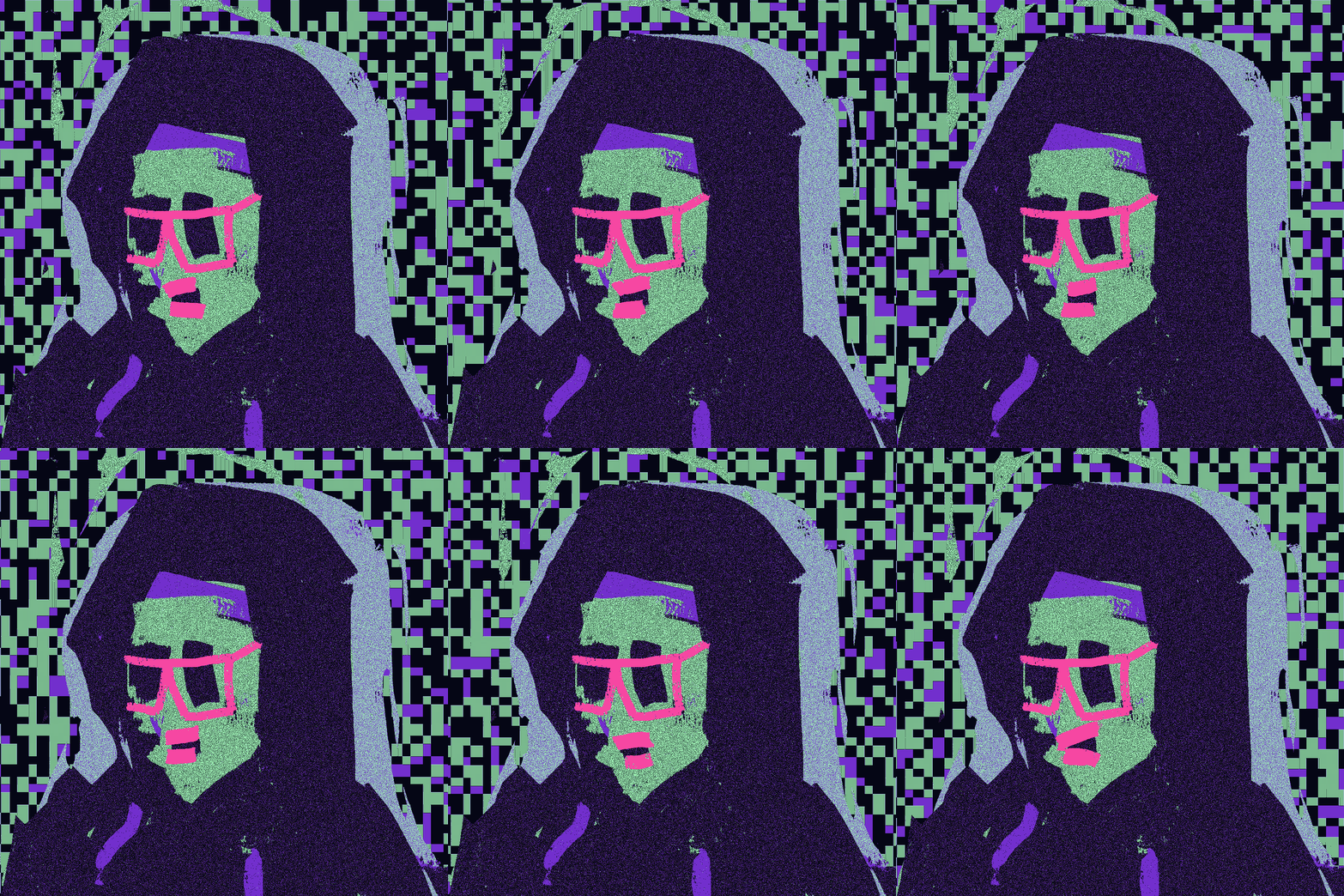
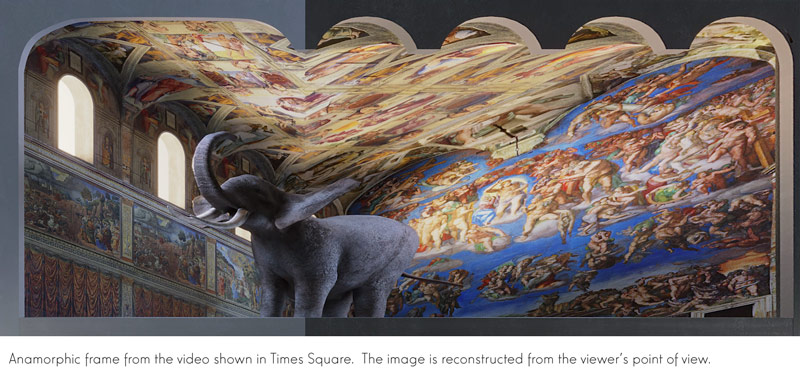
Krista Kim's Continuum, after thirty days of continuous exposure at Times Square Arts, would three months later appear again — this time as Continuum 04 — for four weeks on the large screen at Piazza Cadorna in Milan, within a curator-led cross-border public exhibition. The same lineage of work by the same artist passes in turn through two devices of entirely different operating principles. One is three minutes at midnight, ninety-two screens synchronized in the center of New York; the other is an all-day loop, four weeks on a single screen in Milan. Even for the same artist's work, the experience that rises up on the street becomes a different thing depending on how each device is programmed.
And the third is the protagonist of this essay, the Art Innovation Gallery type — an open-call commercial model that collects submission fees, sifts artists, and fills a billboard's day with the works thus gathered.
A Business That Began in Milan
Art Innovation Gallery is operated by Art Innovation S.r.l. (an Italian limited company) founded in Milan in 2021. It owns no physical billboards. It operates as a kind of intermediary distributor, buying up time slots from existing large signage in major world cities and swapping in the works of the artists it has recruited.
The first public event was the Digital Art Exhibition at Piazza Gae Aulenti, timed to Milan Art Week (MiArt) in April 2022. Piazza Gae Aulenti — the circular square at the heart of the Porta Nuova district, directly beneath the UniCredit Tower — has multiple large LED screens permanently installed, with Wave&Co operating a 120-square-metre-class advertising LED. Art Innovation bought up that advertising slot and ran a digital-artist exhibition of around fifty-seven names over three days. Cut a break into the time axis of the advertising base, and insert a layer of art. The basic structure of the business was consistent from the start.
Following this first Milan exhibition, Art Innovation has repeated the same package at a pace of roughly once a quarter, changing the host location each time. Times Square, Harbour City (Hong Kong), Miami Beach, Seoul (Parnas Media Tower), Los Angeles (The Reef), Dubai. Among the recently confirmable past projects alone are Floating Pixels, The Sound of Pixels, Double Interface, Skyline Stories, Reflective Surfaces, Light Visions, Twice Seen, Luminance, Afterglow, mi ami, CTRL/CITY, and The New Media Moment. The theme name changes each time, but the skeleton is the same.
The Design of the Open Call
Let me look at the skeleton concretely through the open call for the current The New Media Moment (September 2026, Times Square).
クリックすると埋め込みを読み込みます。読み込み時に閲覧情報が X Corp. に送信されます。
X (Twitter) で開くThe amount applicants first pay is published on the official page as two plans.
| Plan | Submission fee | What is included |
|---|---|---|
| Standard | €35 | Upload of 1 work / review by the curator committee / posting on official social media |
| Premium | €50 | Upload of up to 3 works / equivalent review and social posting |
The submission fee is described, in the official wording, as covering "the costs of managing applications, curation, and promotional activity," and it is made explicit that selected artists incur no additional charges beyond it.
A distinctive feature is the tiered deadlines. The first deadline is 7 June, followed by 7 July, 7 August, with the final deadline on 7 September. The official explanation states only that "after this date, the submission fee will be raised" and that "a further increase will be applied at each deadline," and the specific post-increase amount at each stage is not disclosed in advance. It is a structure in which applying early costs €35, while toward the deadline it swells geometrically. The same design as much airline pricing, but the thing paid for is not a seat — it is the chance to be judged.
Selection is forty names. Of these, thirty are chosen by the curator committee, and the remaining ten by engagement counts of "likes, shares, reposts" on Instagram, X, and TikTok. The existence of the latter ten slots means that drawing in acquaintances to harvest one's own votes is built into the design. From the applicant's view, the submission fee buys two things: (a) the chance to be judged by the curator committee, and (b) the official account's boost as a "seed" for spreading on social media.
The technical specs for submitted works are a minimum of 1280×1290 pixels to a maximum of 2640×1380 pixels, JPG or MP4, a ten-second spot. Ten seconds — this is the core format of this business. Where the Midnight Moment was "3 minutes × 1 month" and MoCDA Urban Pixels "1 loop × about 7 weeks," here "10 seconds × 1–3 days" is the standard.
The judges include Wiktor V/R of the creAtIva AI Art Book; Auronda Scalera and Alfredo Cramerotti, who co-curated Dubai Art Digital 2024; Massimiliano Lorenzelli of Lorenzelli Upcoming Projects; and Dante Yun, CEO of Here Creative. All are people with real careers in the digital-art world. From the applicant's view, in the sense of a chance for one's work to be seen by these curators, the submission fee is understood as "added value in the curators' name."
What the selected forty receive, and do not receive, is each clear.
| What the selected receive | What the selected do not receive |
|---|---|
| Ten seconds of exposure on a Times Square mega-billboard | Prize money |
| 4K-resolution photo and video documentation | Opportunities to sell or be commissioned |
| Inclusion in creAtIva AI Book | Subsidies for accommodation or travel |
| Press-release distribution to international media | Production fees or commissions |
| Copyright remains with the artist | Continued follow-up in subsequent years |
The return is, in principle, "the fact that one's work played in Times Square, the documentation of it, and one line of inclusion in a book." This is a structure with no channel for returning economic feedback to the artist's side, and it is a thing apart from the sales-brokerage function galleries have traditionally carried. The submission fee flows one-directionally from artist to operator, and there is no organizationally provided return path for money afterward.
A Different Project of the Same Name
Here it is necessary to be clear about the name "Urban Pixels."
There are two projects called Urban Pixels, put out by different organizations in different years. One is the curator-led cross-border exhibition by MoCDA × EssilorLuxottica of May–July 2022, already seen, in which five artists/groups including XCOPY and Krista Kim deployed across five screens in Milan, London, and New York. The other is the same-named one-day program at 5 Times Square held on 20 February 2025, solely sponsored by Art Innovation Gallery — a collective exhibition by several dozen artists gathered via open call.
クリックすると埋め込みを読み込みます。読み込み時に閲覧情報が Meta Platforms, Inc. に送信されます。
Instagram で開くThe operating entity and principle are entirely different. The former is a museum-led project composed by inviting artists already internationally recognized, at a curator's judgment; the latter is the self-organized project of a commercial company that selects forty from a pool of several hundred fee-paying applicants by committee and social-media vote. Art Innovation Gallery's official list of past exhibitions does not include MoCDA's 2022 project, and the two are not connected as organizations. Yet because the name "Urban Pixels" is shared, there can be a moment when, from the audience's or applicant's side, they look like a single continuous project.
This is not fraud. Art Innovation Gallery is clearly an operator that rents Times Square billboards and actually broadcasts selected works. The venue is real, and the 4K documentation is actually delivered. The problem lies elsewhere — because the same name rides on two different operating principles, an artist considering applying, on seeing the description "exhibited at Urban Pixels" in a search or a portfolio, takes on the burden of distinguishing for themselves whether it derives from MoCDA's invitation model or from Art Innovation's open-call model. The meaning of the description shifts according to the upstream programming principle.
Let me line up the structural differences of the two organizations by observable items.
| Item | MoCDA (curation) | Art Innovation Gallery (open call) |
|---|---|---|
| Legal form | Online museum platform | Commercial limited company (Art Innovation S.r.l.) |
| Base | London (founded 2019) | Milan (founded 2021) |
| Core figures | Serena Tabacchi (co-founder, ex-Tate) / Filippo Lorenzin (artistic director) | No publicly named operating head (only the curator committee is shown externally) |
| Work selection | Individually invited by the artistic director | Forty selected from several hundred fee-payers by committee + social media |
| Cost to artist | None | From €35 (rising with each deadline) |
| Return to artist | Four weeks of long-form exposure, a chance to enter the collection, long-term dialogue with curators | A 10-second spot over 1–3 days, 4K documentation, book inclusion |
| Funding / budget | Sponsorship from EssilorLuxottica and others | Applicants' fees, and per-edition individual monetization |
| Physical billboard | Not owned (borrows the city's permanent signage) | Not owned (buys time slots from the city's commercial billboards) |
| Main purpose | Recording, collecting, and elevating digital art | Marketizing exposure opportunities for digital art |
| Permanent Collection | Yes (Antropogenica entered in 2023) | None |
The two make a similar scene at the surface — both run digital works of ten seconds to a few minutes on the commercial billboards of Times Square or Milan. But because the upstream selection principle differs, the nature of the work that rises on the street and the capital that accumulates on the artist's side change. MoCDA is a model in which "a curator dialogues over the long term with a small number of artists and places that dialogue on the city's walls," and the artist gains the accumulation of dialogue and a permanent record of the work. Art Innovation Gallery is a model in which "short-term collective exposure is assembled from several hundred applications," and the artist gains brief exposure and portfolio material. In the former, three parties — museum, sponsor, artist — share the cost; in the latter, the applicants themselves bear part of the operating capital.
This is not a matter of which is superior. The question is that, when deciding which device to pass one's work through, one needs to keep visible that the two operate on entirely different economies.
The Intermediate Market of "Advertising → Art"
Art Innovation Gallery comes into being precisely where the oversupply in the digital-signage industry and the digital artist's demand for exposure meet in the middle.
On the supply side — large signage such as Times Square, Piazza Gae Aulenti, Hong Kong's Harbour City, Seoul's Gangnam, and Los Angeles's The Reef are, for advertisers, merchandise premised on high-priced unit purchases. Between advertising contracts and in the late-night hours, idle slots inevitably arise in operation. For an OOH operator, a party who will buy a block of time slots wholesale is welcome, even if not an advertiser. A comprehensive art-purpose contract is, from their view, one transaction that supplements revenue.
On the demand side — digital artists, AI image-makers, and 3D designers worldwide hold a strong desire to show their work "as part of the street's scenery." The symbolism the proper name Times Square carries is extremely strong as one line of a portfolio. For an artist without gallery representation, the description "screened on a Times Square billboard" becomes a long-lasting proof of achievement.
Art Innovation Gallery stands in this middle. It buys time slots wholesale from upstream large signage, and collects fees individually from downstream open-call applicants. The €35 submission fee corresponds, by their account, to the administrative cost of managing applications, but when hundreds of applications pile up, it itself also becomes part of the capital for purchasing time slots. Where MoCDA Urban Pixels budgeted with EssilorLuxottica's sponsorship, here there is a structure in which the applicants themselves are also suppliers of the capital.
This model is a different creature from the traditional contemporary-art gallery. The traditional gallery sells the artist's work and operates by taking a commission from the sale. Here, no opportunity for sale is provided. Exposure and documentation are the entirety of the return to the applicant. It is closer to a magazine's open submission than to a gallery. Or perhaps calling it a street "pop-up signage festival" conveys the structure more accurately.
A Structure Whose Only Return Is Exposure
The structure in which the only return is ten seconds of exposure has several consequences.
First, there is pressure for the criteria of work selection to converge on "something that can withstand ten seconds on signage." In the Midnight Moment, broadcast continuously for a month, or in MoCDA Urban Pixels, touring multiple cities over seven weeks, a work can be designed on the premise that the viewer encounters it more than once. A meditative, slowly shifting gradient like Krista Kim's Continuum does not hold unless the premise is to show it calmly, to a degree, over three minutes.
In a ten-second open-call slot, the work is not that; what is asked of it is the quality of seizing the eye in the first second and holding that attention to the last. This is close to the very production principle of signage advertising. AI-generated loop footage, 3D anamorphics, high-contrast abstract animation — the dominant format of submitted works leans structurally toward the grammar of advertising.
Second, there is the implication of no economic feedback returning to the artist's side. No sale, no prize money, no commission production fee. The direction in which money flows from artist to operator, in the form of a submission fee, certainly exists, but there is no flow in the reverse direction. This means that, over the long term, this kind of application experience has no path to contributing to the artist's livelihood. The expectation that an accumulation of exposure might someday reach a commercial gallery or museum may exist on the applicant's side. But at present that path is not organizationally prepared.
Third, the market value of the description "broadcast on a Times Square mega-billboard" itself is exposed to pressure to be diluted by the expansion of the Art Innovation type of intermediate market. When a selection of around forty names is repeated multiple times a year in each city, the population of digital artists who hold "exposure at Times Square" grows by hundreds a year. The scarcity of the description decreases in inverse proportion. Including editions that put out more than a hundred names at once, like Light Visions 2024, by calculation several thousand artists have already passed through this format.
And Yet, Something Is Kindled in the City's Scenery
I have written critically up to here, but it is hasty to dismiss the Art Innovation Gallery type of business as "not art."
The application conditions are made explicit, and the fee structure, tiered though it is, is published. The venue is real, and the selected can actually see their work at Times Square or Piazza Gae Aulenti. Real curators like Scalera and Cramerotti are involved in this kind of open call in parallel with international work such as Dubai Art Digital, so the sifting is not entirely empty words. For some artists, this becomes the first experience of their work appearing on the street.
And a single work that plays for just ten seconds, at a certain hour in a certain square, happens to enter by chance the field of view of someone passing by — in that moment, it cannot be denied that some memory may be inscribed for that artist, that passer-by, and that square. Just as the small figural staffage (tenkei) in a landscape painting kindles meaning into the scene, ten seconds shown on a single billboard can, in a way not yet sorted out, change the city's view for an instant.
But for that to happen, ten seconds is probably not enough. Or even if ten seconds is enough, the weight of the programming hand that selects those ten seconds needs to be involved in a way that exceeds the administrative cost of submission fees. That the Midnight Moment has been sustainable for more than ten years is probably because, in the process of choosing one artist a month, an editorial time independent of commercial logic is secured. That MoCDA Urban Pixels could gather mega-names was because of the individual dialogue Lorenzin wove with artists over years.
"Placing screens on the street" is no longer something special in itself. Supply is saturated, technology has become cheap, and distribution can be recomposed by the minute. The problem lies in the upstream curatorial process — who chooses, and how, what to show on that screen. What Art Innovation Gallery demonstrates is one way of organizing that upstream as an open-call economy. It is a new form of medium, but it is not equivalent to the exhibitions of a traditional gallery or museum. Looking at the two side by side while keeping them distinct is the starting point for grasping accurately what is happening on the screen.
When screens increase in the city, the subjects who do the selecting increase too. Art Innovation Gallery is one of those new subjects.
Sources
- Krista Kim — Continuum, Times Square Arts Midnight Moment(2022-02-01)
- Urban Pixels Recap — Art Innovation Gallery (Instagram)(2025-02-20)
- Yuge Zhou — Trampoline Color Exercise, June 2025 Midnight Moment(2025-06-01)
- Krista Kim — Continuum 04 at Piazza Cadorna, Milan (MoCDA × EssilorLuxottica)(2022-05-23)
- XCOPY — Right-click and Save As guy at Covent Garden, London (MoCDA × EssilorLuxottica)(2022-05-30)
- Giuseppe Lo Schiavo — Antropogenica at Times Square, NYC (MoCDA × EssilorLuxottica)(2022-05-23)
- The New Media Moment 2026 Open Call — Art Innovation Gallery (X)
- Urban Pixels — “We are Live!!” livestream, Art Innovation Gallery (Instagram)(2025-02-20)
- Colette Copeland — Galaxias tou Gala (Milk Galaxy), January 2026 Midnight Moment(2026-01-01)
- Art Innovation Gallery — Official
- Art Innovation Gallery — Open Call
- Art Innovation Gallery — Exhibitions Timeline
- MoCDA — Urban Pixels (2022)(2022-05-23)
- Filippo Lorenzin, Urban Pixels: public art and NFTs — Juliet Art Magazine
- Auronda Scalera + Alfredo Cramerotti — Co-Creating in the Digital Age (.ART)
- Times Square Arts — Midnight Moment
- Wave&Co — LED Display in Piazza Gae Aulenti, Milan
- Light Visions — Art Innovation Gallery (2024 New York)(2024-09-02)
Operations Record
- Art Innovation S.r.l. (Milan, founded 2021)
- New York
- Open call — Owns no screens; an intermediary buying time slots on existing large-format signage
- No fee paid to artists; entrants pay from €35 (rising at each deadline) for a 10-second slot, documentation and a book listing
- Roughly quarterly one-day events in rotating cities
- 2021
- Active